




The starting point: the gap between dreaming and truly imagining
We all dream of a better future, but that dream almost always stays trapped in vague words: “I want a greener city,” “I want a job that makes me happy.” The problem is not a lack of hope; it is a lack of form. We cannot see what we imagine, and what we cannot see is hard to believe and even harder to pursue.
2. The central promise
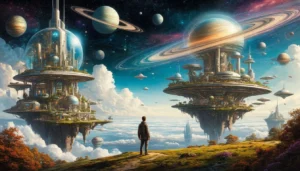
Futurating does not just ask you to describe your ideal future: it gives it back to you turned into image and motion. You write a sentence, a paragraph, a loose idea — and the AI transforms it into a video that represents the world you imagine. Your city without traffic, your dream job, your family in a sustainable home. It is no longer an abstract concept: it is something you can look at.
3. The user journey, step by step
Step 1 — Describe: the user writes, in their own words, how they imagine their ideal future (personal, for their city, for the world).
Step 2 — Transform: the AI interprets that text and generates a high-quality video that visually translates that vision.
Step 3 — See: the user receives a tangible representation of their own dream, something that previously existed only in their mind.
Step 4 — Share: that video becomes a visual statement within the platform, adding to a collective mosaic of positive futures imagined by real people.
Step 5 — Contrast: against the dominant apocalyptic noise on social media and in the media, Futurating builds a visual archive of hope, made by people, not by fear algorithms.
4. Why this matters (the emotional angle)
You don’t need to be a designer, a filmmaker, or have a production budget. The technical barrier disappears. The only thing needed is something we all have: an idea of how we would like the world to be. Technology stops being the obstacle and becomes the bridge between imagination and evidence.
5. The collective result
Each individual video is a small piece, but together they form something bigger: a living library of possible futures, built by thousands of people who decided not to give in to pessimism. It is the difference between talking about a better future and showing it.
This idea I would like to see turned into reality within 5 years; with the advancement of AI, it will be much easier to carry it out.








Comments (1)
Идея сильная, но, чтобы она заработала, нужно не просто генерировать видео по тексту, а проверять, насколько картинка не подменяет замысел пользователя. Как платформа коллективного конструирования будущего она могла бы опереться на нейромодели Сбера (Kandinsky, GigaChat): это готовая генерация, вычислительные мощности и большая аудитория для продвижения. Дальнейший шаг — сделать пилот с городской инициативой, например по образам города через 10–15 лет, а затем выяснить, чувствуют ли участники, что видео отражает их слова. Вопрос: какой критерий считать результатом платформы — количество роликов или реальное изменение в том, как человек думает о будущем?