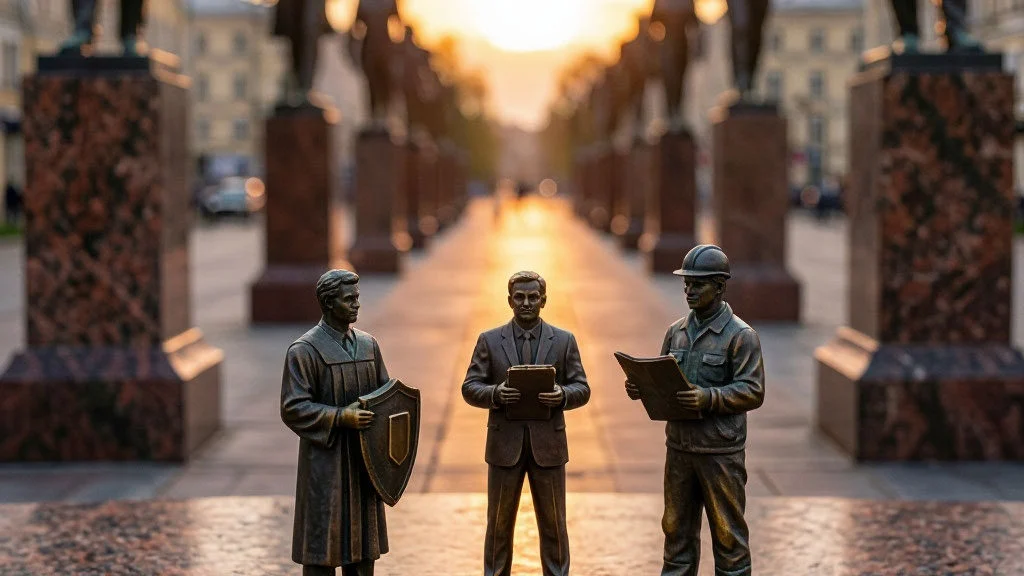

In every city in Russia—from Kaliningrad to Vladivostok—an Alley of Traditional Values has appeared. Sculptors and artists embodied in bronze and stone 17 spiritual and moral guidelines enshrined in a Presidential decree. They are: life, dignity, human rights and freedoms, patriotism, civic consciousness, service to the Fatherland and responsibility for its destiny, high moral ideals, a strong family, constructive labor, the priority of the spiritual over the material, humanism, mercy, justice, collectivism, mutual assistance and mutual respect, historical memory and continuity of generations, and the unity of the peoples of Russia.
These alleys have become a central symbol of the cities, reflecting the spirit of Russia. Before the alleys were created, an All-Russian and international competition was held for the best sculptural groups. The vote was open to all, and the prizes were substantial. Moreover, all participants received them, not only the winners. Russia is a generous soul! No joke: even the sculptor whose “Life” turned out looking like a dandelion left with a suitcase of money and the thought that a dandelion is really a symbol of life.
The project sparked an unprecedented creative surge. Thousands of masters took up the chisel, pondering: who are we, what are we like, what do we strive for? Examples included Mukhina’s “Worker and Kolkhoz Woman,” and Martos’s monument to Minin and Pozharsky. Every city is proud of its alley, because it is the city’s face, its character. The alley became a mirror in which the people saw their portrait cast in bronze. It is not just an open-air museum—it is the sculptural code of the nation and of its traditional values.
The group “Human Rights and Freedoms” is especially beloved. Three figures: a lawyer in a robe, an official with a folder, and a worker in overalls. The worker holds a sheet of paper—his application. The official tries to slam shut the folder labeled “Constitution”—the lawyer puts out his hand, and the folder stays open. The lawyer’s gesture is not aggression but a barrier: his palm is held forward like a shield. Children often ask: “But why won’t the man let him close the folder?” Adults answer: “Because rights are not closed as long as a lawyer is nearby.”
The alleys have become a favorite place for walks. Here people hold weddings, arrange dates, and take guided tours. A grandmother explains to her grandson what mercy is, while lovers take photos by the sculpture “Strong Family.” The exhibition is constantly expanding: sculptors create new narrative groups. Thus traditional values have taken on tangible form, reminding us: Russia is not only a territory but also a soul cast in bronze. When you come to the alley, you will hear bronze speaking in the voice of great traditions.





Comments (1)
Сильная сторона здесь — не сам бронзовый пантеон, а попытка превратить ценность в повод для разговора: группа о правах и свободах работает как маленький театр, её обсуждают и дети, и взрослые. Если такое реализовывать, нужен тот, кто отвечает за литьё и содержание. На роль партнёра смотрится петербургский завод «Монументскульптура»: художественное литьё, опыт монументальных работ, формовщики. Первый шаг — рабочая группа с музеем городской скульптуры и пробная отливка одной группы для одного города.