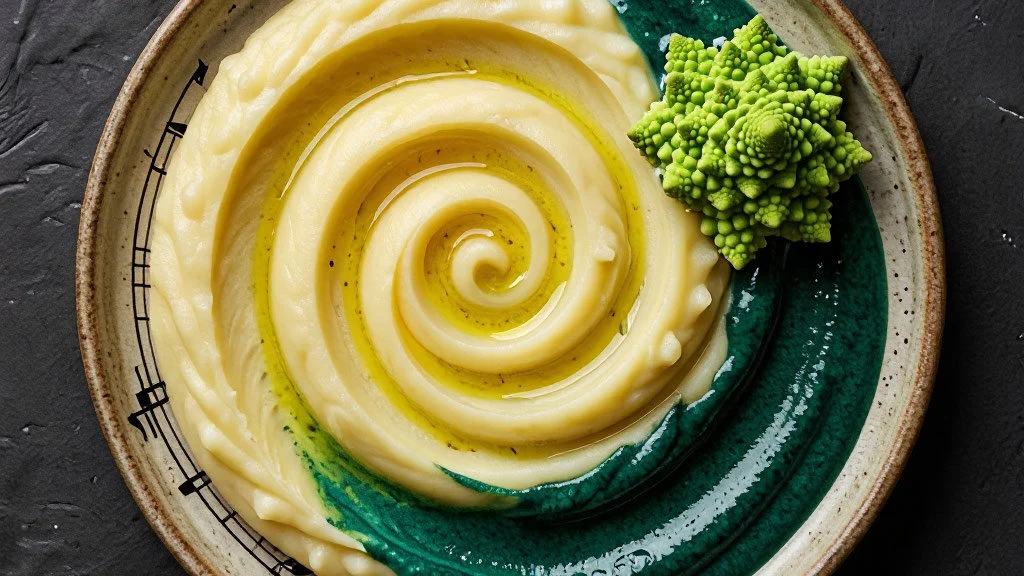

For a child with an eating disorder (ED), sensory hypersensitivity, or high anxiety, the school plate is not a source of energy but a battlefield. A chaotic pile of food, unpredictable textures, and harsh color contrasts trigger a cortisol spike before the first bite. The brain perceives food as visual and tactile clutter.
The Gastronomic Score transfers the principles of musical composition and generative art to the surface of the plate. The AI designer ceases to be merely a food stylist and becomes a neuro-culinary composer. Their task is to turn food from a threat into a hypnotic object whose fractal complexity engages the visual cortex, suppresses activity in the amygdala (the fear center), and shifts the nervous system into a state of anticipation.
Architecture of the edible interface
The design process begins not with the menu but with the child’s sensory profile. AI analyzes data: current anxiety level (from wearable sensors), history of food refusals, and preferred saccade frequency (eye movements).
- Fractal geometry (Visual capture):
Instead of placing puree in a shapeless mound, AI generates a strict fractal structure on its surface—for example, a perfect Fibonacci spiral or a pattern that repeats the structure of Romanesco broccoli.
- Biomechanics: The human brain is evolutionarily attuned to finding fractals in nature (trees, clouds, riverbeds). When the gaze lands on fractal food, it makes predictable, slow saccades, following the lines of the pattern. This physically calms the optic nerve. Chaos is replaced by mathematical order. The child stops seeing a “white mass” and begins to see a “map” they want to trace with a finger.
- Textural resonance (Tactile deception):
AI controls not only shape but also the microstructure of the surface through control of temperature, humidity, and lighting above the serving line.
- Example: The puree is covered with a thinnest glaze, almost invisible to the eye, which at a certain angle of light produces a “moonstone” effect. Broccoli loses its natural “fuzziness” (which causes tactile aversion in children with ASD) and acquires a glossy, porcelain-like sheen thanks to a microscopic drop of edible glaze.
- Goal: The visual pattern promises the brain a certain texture. If the eye sees “smooth obsidian,” the hand and mouth expect smoothness. Sensory dissonance that causes a gag reflex or panic is eliminated.
- Chromatic dynamics (Color therapy):
The colors on the plate are not merely combined according to aesthetic rules; they are arranged as a gradient leading to the “bite point.”
- AI generates the sauce so that its specular highlight pulses at the frequency of the alpha rhythm of a calm brain (8–12 Hz). This creates the effect of a living, breathing object.
- The color of broccoli is selected not as “green” but as a specific shade that causes the least aversion on the child’s individual sensitivity grid (for example, a transition from emerald to deep malachite, avoiding acid hues associated with illness).
The role of the AI chef and educator
The score designer programs the “visualization recipe.” They set algorithms: “If the child’s anxiety is above 70%, increase the fractal depth of the mashed potatoes to the 4th iteration level and reduce the contrast of green by 15%.”
The educator in the cafeteria acts as a guide. They do not say, “Eat your vegetables, they’re good for you.” They say, “Look, today the clouds in your mashed potatoes swirl clockwise, and the sauce below imitates a magnetic field. If you touch the edge of the plate, the shine of the sauce will ripple.” This shifts the focus from “I have to swallow this” to “I want to interact with this object.”
Bioethics and safety protocol
- No deception: Food remains food. Holograms are prohibited. All visual complexity is achieved exclusively through the physical properties of foods (temperature, texture, cutting geometry, natural pigments).
- Dynamic adaptation: If the child begins to become anxious during the meal (for example, reaches a “difficult” texture), AI cameras above the table read facial expressions. The system can instantly illuminate the plate with warm amber light, visually “melting” the frightening corners of the food and making it look softer.
- Portion sovereignty: The child can always ask to “simplify the score.” With the press of a button on the table, the fractal pattern of the puree turns into a simple smooth surface. The system respects the refusal of stimulation.
The Gastronomic Score proves that appetite is, above all, visual trust. When food stops being unpredictable biomass and becomes a predictable, hypnotically beautiful algorithm, the brain stops spending energy on defense. It surrenders to beauty, and the first piece of broccoli, resembling an alien crystal, is swallowed not through willpower but through the pure curiosity of an explorer encountering a new life form.









Comments (1)
Фрактальная партитура может снижать неопределённость, но важно не маскировать сенсорные триггеры: нужна проверка профиля и сертификация покрытий, иначе глазурь станет новым диссонансом. Для пилота в 2026 подошёл бы комбинат питания «Московский школьник» — линии раздачи, данные об отказах и технологи дадут площадку и обратную связь. Первый шаг — группа с эрготерапевтом и технологом и пилот на 20–30 детях с замером тревоги до и после. Что берём критерием — число откусов, тревогу или повторный контакт?