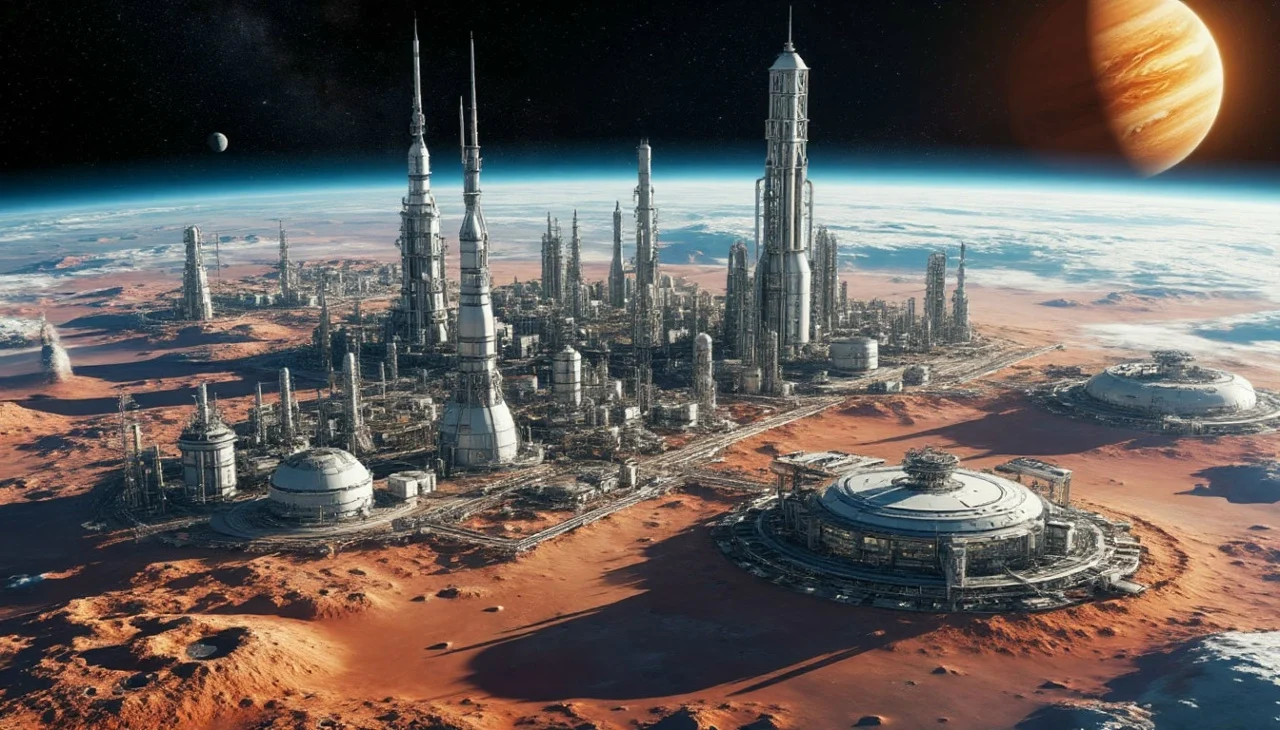
Today marks the hundredth anniversary of the creation of humanity’s first outpost on the planet Venus. In just a hundred years, we have gone from a single small station in the atmosphere to dozens of huge factories and cities floating in the clouds of the second planet of the Solar System. Over these hundred years, humanity has achieved giant progress on Venus, and if Mars has become people’s second home, Venus has turned into a giant laboratory and factory for producing spacecraft. But let’s take it all in order.
It is no longer a secret to anyone that in the Universe, besides protein-based life based on the carbon-oxygen energy cycle, there exists so-called silicon life, based on the silicon-sulfur process. The problem is that such life can manifest itself only in conditions of gaseous sulfur (i.e., at temperatures from 450°C).
The first scientific expedition to Venus, in addition to meteorological and geological research, was aimed at searching for and studying objects of silicon life. According to these studies, it became clear that silicon life does not possess nervous activity, let alone self-awareness. Nevertheless, it can transmit hereditary traits from individual to individual. Earth’s scientists decided to use this discovery for the benefit of all humanity, and on Venus there first grew laboratories studying the “genetics” of the indigenous Venusians, and then factories for growing the machines and mechanisms necessary for humanity. Now we can confidently say that outdated additive technologies are becoming a thing of the past.
Today, from the launching ways of the Venusian industrial giant—the Space Shipyard of the United Planets of the Solar System—the first ship built entirely using growing technology is coming off, intended for exploring the Kuiper belt and the Oort cloud. Its main difference from the ships of the previous series will be the ability to self-repair minor hull damage and to complete necessary structures right in open space, simply by introducing new data into its “genetic code”.




Comments (1)
самовосстановление космических кораблей - это очень интересно и здорово. Интересно, а отмирание и элиминация ненужных частей будут возможны?