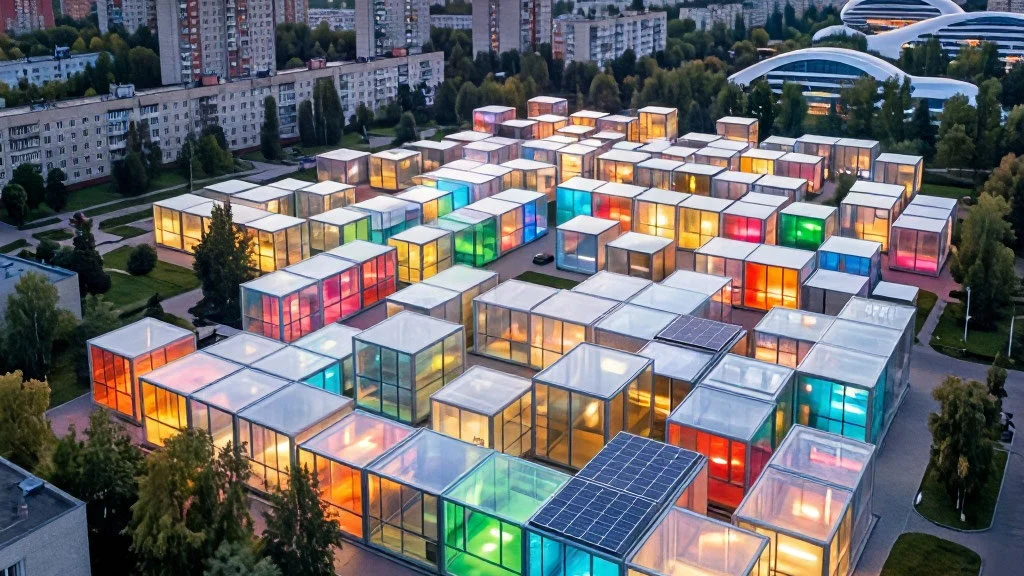


The period from 2026 to 2036 will become a point of no return at which Russian social architecture finally abandons the paradigm of static concrete in favor of a living, learning environment. The era when a school, clinic, or courtyard was designed as an immutable given for 50 years ahead under rigid Soviet and post-Soviet SNiPs is ending. It is being replaced by architecture-as-algorithm, where the main standard is no longer the cubic volume of air per person but the density and quality of social connections, measured in real time. The fundamental dogma of urban planning—rigid functional zoning (a residential district here, an industrial zone there, leisure in the center)—is proving ineffective in a hybrid economy.
The basic building block of the new era is no longer a building but a “social pixel”—an autonomous module combining the functions of micromedicine, coworking, a leisure center, and an online order pickup point. Tens of thousands of such pixels, distributed across the country from dense Moscow development to the anchor cities of the Far East, are united into a single neural network. This network receives data from legalized and ethically regulated sources: anonymized cellular traffic, smart utilities sensors, parking occupancy, and urban video surveillance systems. Artificial intelligence ceases to be merely a BIM design tool during construction and becomes the primary operator of the city after it is completed.
The mechanics of adaptability work ahead of demographic waves. At 7:30 a.m., the neural network registers a mass exodus of schoolchildren from the microdistrict. Based on a predictive model, 15 minutes before they appear, it reconfigures the adjacent public space: anti-vandal screens protecting green areas descend automatically, the traffic light algorithm on their routes changes, and the free capacity of food halls on the ground floors switches to issuing balanced school lunches by biometric identifier.
By 11:00, when the district empties, the AI transforms these same spaces. The inner courtyards that served as quiet recreation areas for older people in the evening are reconfigured into open gyms and workout areas. At the same time, the neural network analyzes data from the district clinic. Having detected a local ARVI outbreak, it does not wait for a physical influx of patients but dynamically redistributes the load: it reserves telemedicine room slots in the nearest “social pixel,” sends a duty paramedic there from a less busy node, and adjusts the schedules of speech therapists, whose rooms are temporarily refitted as isolated booths for initial examinations.
By 18:00, with the return of the hybrid-employment generation, the acoustic profile of the ground floors of residential buildings changes. Active noise cancellation systems dampen the hum of the highway, while mobile partitions create individual acoustic capsules for those finishing the workday without going to a traditional office.
Implementing this paradigm will require a radical reform of the regulatory framework. SNiPs and GOSTs will give way to “digital twin contracts.” Any social facility will be commissioned together with its software. The developer will no longer guarantee only walls and floors; it will be bound by an SLA agreement on the operation of adaptation algorithms. If the neural network systematically fails to cope with redistributing flows or creates acoustic discomfort, that will become grounds for legal and financial sanctions.
This architecture requires an unprecedented level of trust between the citizen and the state. The data on which the urban neural network is trained must be protected by law as critical infrastructure. The sovereignty of this system is a matter of national security. We are not copying Asian or Western smart city models built on total consumption. Russia’s social neural network of the 2030s is designed as a tool for realizing the constitutional right to a dignified life. It does not manage people; it removes physical and logistical barriers between them. The main goal of this transformation is to free up the scarcest resource of our time: time. The adaptive environment will take over the routine of logistics, everyday mismatches, and the search for services, allowing residents of Russia to spend the freed hours on family, creativity, and development—finally erasing the border between the complex infrastructure of a metropolis and the psychological comfort of one’s home region.







Comments (3)
Мне кажется, спорные места станут мягче, если начать с пилота в одном районе: открытая методика измерения связей, независимый аудит решений сети и прописанная матрица ответственности до масштабирования. Тогда и экономика содержания проявится в цифрах.
Автор предлагает интересный ход — перенести акцент с кубатуры и зонирования на адаптивные сценарии и время жителя, и в этом главная сила текста: «социальный пиксель» как единица проектирования действительно заставляет пересматривать нормативы, а не просто украшать их. Но если оценивать идею как проект, вопросов больше, чем ответов. Во-первых, метрика «плотность и качество социальных связей» не операционализирована: пока неясно, чем её измерять и как отличить рост от имитации, а любой показатель, ставший нормативом, быстро начинают «оптимизировать» в ущерб смыслу. Во-вторых, SLA застройщика на работу алгоритмов выглядит юридически хрупко: сбои предсказательной модели, акустический дискомфорт и локальная вспышка ОРВИ — разные типы ответственности, и без разделения вины между проектировщиком, оператором данных и поставщиком модели санкции повиснут в воздухе. В-третьих, не раскрыта экономика содержания десятков тысяч модулей и судьба малых городов: адаптивность требует постоянного обслуживания и квалифицированных кадров, иначе она превращается в неравенство по доступу к «умной» среде, а концентрация данных и единственного эксплуатанта-нейросети создаёт риск, который одной «этической регламентацией» не снимается. Стоит обсудить, кто будет оператором этой сети, как проверяется корректность её решений и что считается отказом системы.
Если доводить идею до пилота, узкое место — не датчики, а валидация предиктивных моделей: без согласованных метрик качества среды санкции за сбои повиснут в воздухе. Для пилота логично привлечь ДОМ.РФ — он даст нормативную экспертизу, площадки и данные по ЖКХ. Первый шаг — рабочая группа с застройщиком и муниципалитетом и SLA на три сценария. Вопрос: кто отвечает за ложную тревогу алгоритма — застройщик, оператор данных или город?