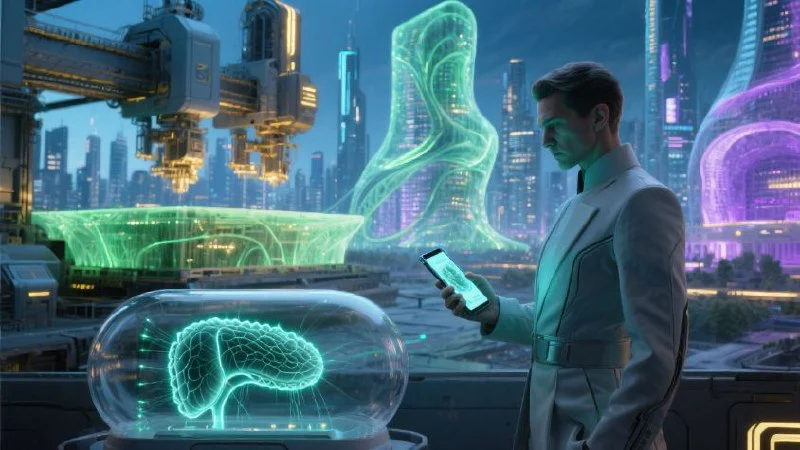
3D printing has become an integral part of everyday life, changing the very essence of manufacturing, medicine, and even architecture. The world we live in is a space where the boundaries between an idea and its realization are practically erased.
The main revolution has taken place in the field of personalized production. Now every person can create items perfectly suited to their needs and tastes. Clothing, footwear, furniture, gadgets — all of this is printed on home fabricators that analyze body parameters, habits, and even the owner’s mood. Mass market is a thing of the past: uniqueness has become the norm, and standardization the exception.
In medicine, 3D printing has made it possible to move from prosthetics to bioprinting of organs. Personalized organs grown from the patient’s own cells are printed in a matter of hours. Operations have become more precise, and rehabilitation shorter. Moreover, “smart” implants have appeared that not only replace lost functions but also expand human capabilities: for example, bioprinted retinas with night vision or joints with enhanced shock absorption.
Architecture and construction have also undergone a transformation. City blocks now grow not over years but over weeks: construction printers erect houses from eco-friendly composites, adapting each building to the climate, terrain, and residents’ wishes. Inside, such houses are “alive” — their walls can change shape, let in light, or become fully transparent at the owners’ request.
Industry has become distributed: large factories have given way to networks of local mini-factories connected by a unified digital platform. This has made it possible to reduce logistics, lower emissions, and make production flexible — new products appear instantly as soon as demand arises.
3D printing has also changed the very attitude toward things. Now objects are not thrown away but recycled: old items are broken down into materials that are immediately used to create new ones. The culture of consumption has given way to a culture of renewal and creativity.
In this world, the boundaries between fantasy and reality have disappeared. Everything that can be imagined can be printed — and this has become the main driver of progress.





Comments (0)