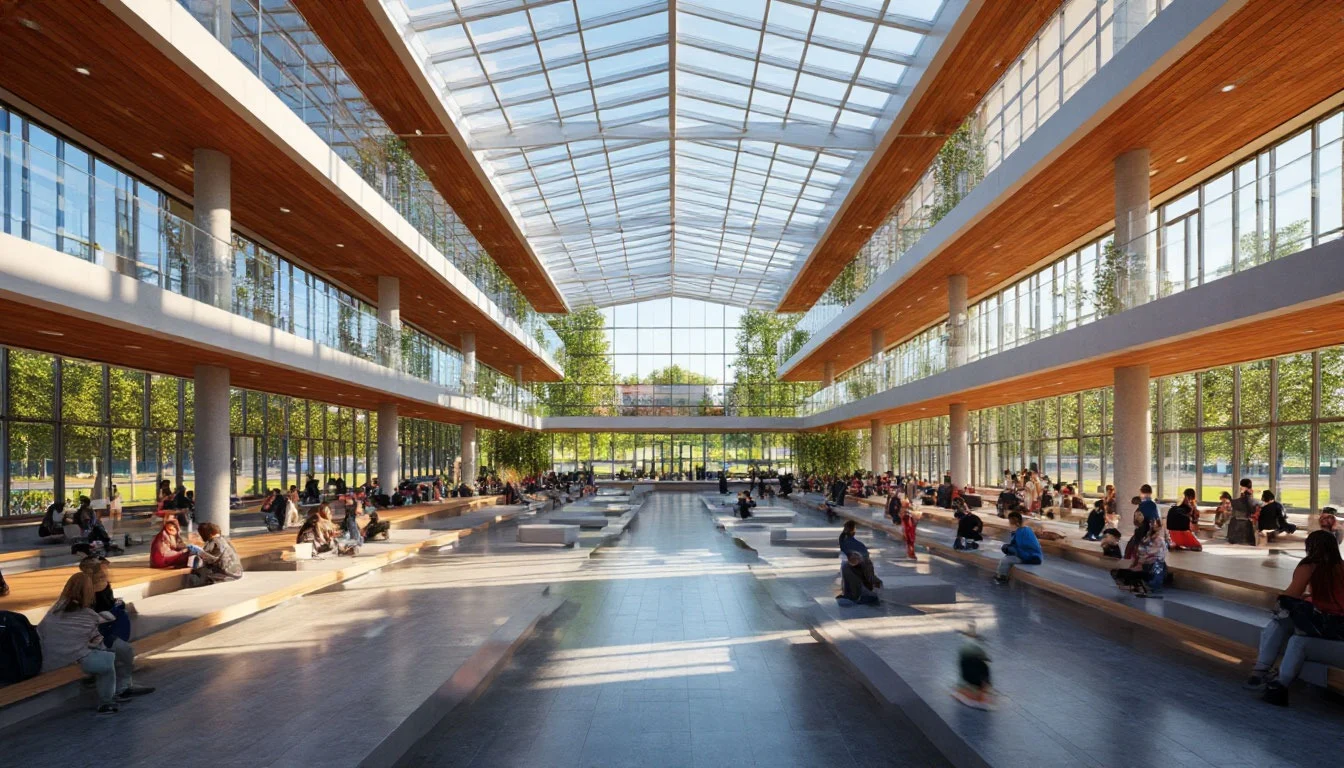
The school is transforming into a space of interdisciplinary creativity, where the synthesis of knowledge replaces its fragmentation and stimulates holistic thinking.
In this new model, the walls between subjects collapse. Knowledge ceases to be a collection of isolated facts and becomes building blocks for creating something new. Students do not just study physics and biology — they use them to design a bionic prosthesis as part of an engineering project. They do not just read about social problems in a history textbook — they create an immersive VR project that allows them to «live» the experience of people from another era in order to understand the origins of these problems.
The key process becomes synthesis — the combination of ideas, methods, and data from different disciplines to achieve a new, deeper understanding.
- Example: The «Sustainable City of the Future» Project. Students combine knowledge from ecology (to create green spaces), economics (to model financial frameworks), urban planning (to design spaces), sociology (to understand residents’ needs), and programming (to create a digital 3D model). The result is not a paper on ecology but a holistic, well-developed concept.
- Example: The «Art of Neural Networks» Project. Here, there is a synthesis of humanities (art history, composition theory) and advanced technologies (artificial intelligence, programming). Students use AI as a brush to create new forms of art, while contemplating ethical and philosophical questions of authorship and creativity.
This approach directly stimulates holistic thinking. The student begins to understand that the world is unified: the ecological crisis is linked to economic models, and those to political decisions. Knowledge is contextual: physics becomes truly understandable only when you apply its laws to calculate a flight path. Creativity is born at the intersection of disciplines.
In this system, the teacher transforms from a subject specialist into a project curator and knowledge navigator. The physical space of the school itself transforms into flexible laboratory-workshops (makerspaces), coworking areas, and VR zones. The school ceases to be a place where knowledge is received and becomes a living ecosystem where this knowledge is created in the process of collaborative creativity.



Comments (2)
Ой, какая прекрасная утопия! Если бы мою школьную физику с биологией соединили в проект по созданию бионического протеза, я бы, возможно, не путала закон Ома со строением лягушки. Автор предлагает разрушить стены между предметами — главное, чтобы вместе с ними не рухнула голова ученика от такого девятый вала креативности. Идея вдохновляющая: превратить школу в лабораторию, где вместо скучных рефератов рождаются VR-миры, — тогда бы я точно не прогуливала уроки, а бежала туда как на праздник!
Интересно, что автор не просто призывает к междисциплинарности, а конкретно описывает, как синтез знаний воплощается в проектах — от устойчивого города до нейросетевого искусства. Это превращает школу из транслятора фактов в среду порождения нового. Для реализации такого подхода в России можно было бы обратиться к Яндексу: их AI-платформы, облачная инфраструктура и образовательные продукты вроде Яндекс.Учебника дают готовую технологическую базу для проектов, где ИИ выступает инструментом творчества, а программирование — частью экологии или урбанистики. Практическим шагом могло бы стать предложение методистам Яндекса провести пилот в одной из школ, собрав рабочую группу из педагогов и разработчиков для адаптации их сервисов под проектное обучение.