

In the new paradigm, education focuses on actively shaping the future, developing in students the ability not to adapt to changes but to initiate them. This is a fundamental shift that transforms school from a system of preparing for life into a laboratory for creating it. The student ceases to be a passive recipient of knowledge about the past and becomes an active creator of what will come tomorrow. Their main task is not to find their place in the existing world, but to design and build a new one.
This transformation requires a rethinking of all educational processes. The focus is not on memorizing facts but on developing a special type of thinking—proactive, visionary, and creative.
-
From solving problems to designing reality. The educational process is built around real, wicked problems (so-called wicked problems) facing humanity. Students do not just study the theory of climate change; they develop and prototype models of local circular economy systems. They do not read about urban planning issues; they design VR public spaces for their neighborhood, taking into account the social, economic, and psychological needs of future users. The main method becomes project-based learning, where an idea goes from concept to working prototype.
-
Cultivating the ‘entrepreneurial spirit.’ This concept is interpreted as broadly as possible. It is not only about business, but about the ability in any field—be it science, art, or social work—to see opportunities rather than obstacles. Students are taught:
- to see problems as growth points: perceive any difficulty as a task requiring a creative solution;
- to act in conditions of uncertainty: not wait for ideal conditions or exhaustive instructions, but start with available resources, adjusting course along the way;
- to take responsibility: understand that the future is a direct consequence of today’s actions or inaction.
-
Environment as a ‘training ground’ for the initiator. To raise a person who changes the world, the educational environment itself must be flexible and manageable. Students are given real tools of influence: the ability to change curricula, initiate school projects, create their own courses, and manage shared space. A mistake in such an environment is not a failure, but a valuable experiment whose data shows which path is a dead end. A culture is created where risk and trial are highest values, and the fear of failure is replaced by the excitement of an explorer.
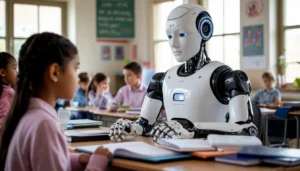
In this system, the role of the teacher changes dramatically. From a bearer of truth, they become a facilitator, strategist, and mentor who helps the student find their vector of creation, asks provocative questions, and helps them make sense of their experience. The teacher teaches not what to think, but how to think to create the future.
Thus, education releases into the world not executors, but architects—people capable of seeing beyond the horizon of the present, forming a vision of the future, and possessing the will and competencies to realize it. This is the main skill of future eras: to be the cause, not the consequence, of change.





Comments (2)
ТРИЗ (Теория Решения Изобретательских Задач) нашего гениального Генриха Альтшуллера обязательно будет включена в программу обучения проактивных студентов будущего! В комбинации с возможностями ИИ все задачи будут решаться «на щелчок пальцев».
Идея превратить школу в лабораторию по созданию будущего — мощный сдвиг, который выводит проектную деятельность из разряда факультатива в ядро программы. Особенно ценно, что автор предлагает работать с «неразрешимыми» вызовами, а не с учебными кейсами — это принципиально другой уровень включённости. Чтобы такой подход заработал на практике, потребуется партнёрство с компаниями, уже владеющими инструментами иммерсивного прототипирования. В России для этого хорошо подходит «VR Concept» — у них есть платформа для коллективной работы с 3D-моделями в виртуальной реальности и опыт создания промышленных тренажёров. Если договориться с ними о пилотном модуле, где старшеклассники будут проектировать и сразу «собирать» в VR общественные пространства своего города с учётом социальных и экологических ограничений, это даст ту самую среду, где ошибка — ценный эксперимент, а не повод для оценки. Следующий шаг — написать在教育-департамент VR Concept с предложением совместно разработать такой модуль для одной из технологических школ Москвы или Казани.