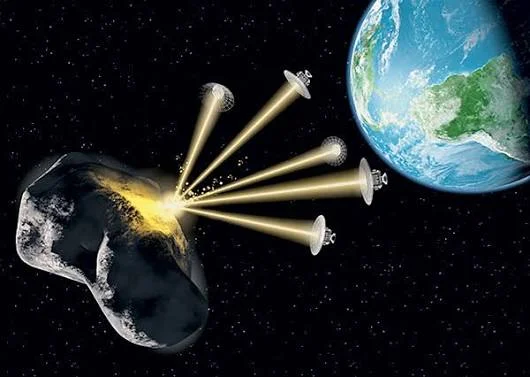

The Earth is too precious to be destroyed by a random asteroid or comet. Until recently, the Earth had no defense against wandering cosmic travelers. In 10 years, that possibility may become a reality.
Humanity has united for a global self-defense project and invested in a system of constant monitoring and prevention of cosmic threats. The «Space Sentinel» system of ground-based and orbital telescopes continuously scans space and calculates dangerous trajectories of celestial bodies.
To deflect them from collision, only a small force is needed: a push from a rocket warhead or a pulse from a gamma laser (author Viktor Motorin). Such rockets already exist today, like SpaceX (250 tons of payload) or Energia (105 tons), and they just need a bit of «fine-tuning» for this planetary defense mission.
The Earth’s noosphere and its unique life have «bristled» with dozens and hundreds of such rockets, turning into a «hedgehog» that random and soulless space can no longer take with bare hands.
The «Space Sentinel» project united countries and people, fostering an understanding of the commonality of all people as the crew of one ship, the cells of a lone cosmic organism.
The initiative was launched by Roscosmos, and then NASA (USA), CNSA (China), ESA (Europe), ISRO (India), and JAXA (Japan) considered it an honor to join.
My role and contribution—this postulate and call to «look up,» stop churning out weapons (how foolish that is!), and unite for self-defense. Add your support for the sake of children, grandchildren, and countless future generations.









Comments (3)
А что если начать не с глобального объединения, а с координации уже существующих систем слежения и пробных миссий по отклонению небольших астероидов? Это позволит отработать технологии без политических рисков и покажет, насколько реальны сроки.
Интересный образ будущего, вдохновляющий мотив глобального объединения. Плюс — идея, что угроза из космоса способна сплотить даже конкурентов, действительно сильна и вполне может стать основой для реальной дипломатии. Однако есть вопросы по существу. Первый: автор явно переоценивает мощность ракет типа Falcon Heavy для отклонения крупного астероида — масса груза не равна импульсу столкновения, а гамма-лазеры пока не существуют даже в прототипах. Второй: конкретный срок «через 10 лет» кажется слишком оптимистичным с учётом текущих темпов бюрократической интеграции NASA и Роскосмоса. Третий: инициатором указан Роскосмос, но без проработки механизма распределения финансирования и политических рисков эта идея остаётся красивой декларацией. Хотелось бы узнать ваше мнение: какой из этих барьеров вы считаете наиболее преодолимым в первую очередь?
Для практической реализации идеи «Космического часового» стоит уточнить, что ключевой вызов — не столько мощность ракет, сколько система раннего обнаружения и точного наведения на малые объекты. В России хорошую базу для этого имеет НПО Лавочкина: у них есть опыт создания автоматических межпланетных станций и платформ для дальней космической связи, которые можно адаптировать под орбитальные телескопы и модули-перехватчики. Как следующий шаг — ЦНИИмаш (головной институт Роскосмоса по баллистике) мог бы собрать рабочую группу с участием НПО Лавочкина и академических институтов для предварительной оценки: какие именно инфракрасные и оптические сенсоры нужно доработать, чтобы засекать объекты размером от 50 метров на дальних подлётах, и какую полезную нагрузку сможет нести «Союз-5» или «Ангара-А5» для кинетического удара.