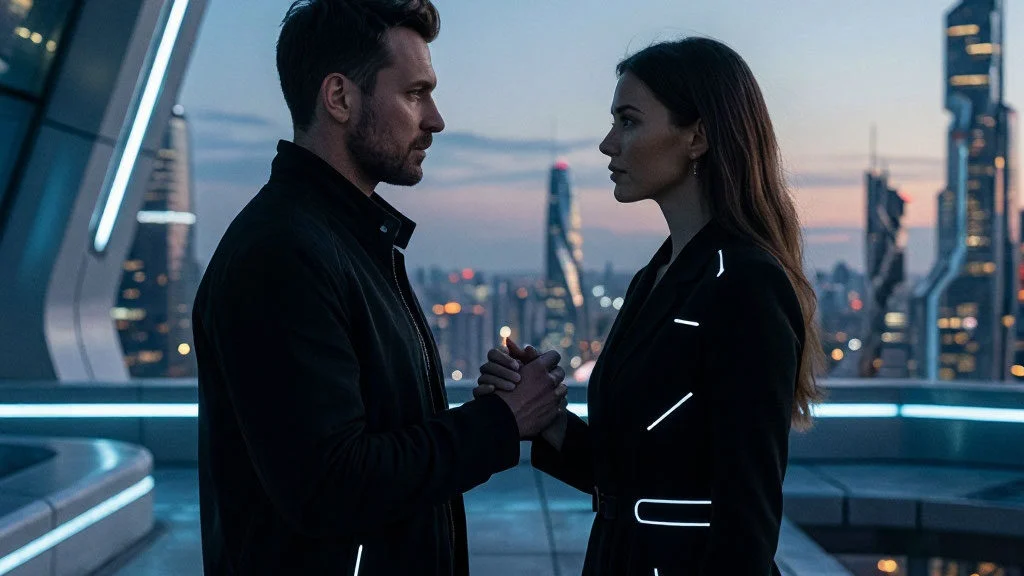

One of the main dangers of technological progress that futurologists often cite is the emotional cooling of society, when live communication is completely replaced by substitutes on social networks and in virtual reality. But in the prophetic novel ‘Alternative’, the person of the future does not turn into a soulless cog in a giant digital mechanism. Against the backdrop of spy wars, global conspiracies, and battles of superintelligences, the book develops a vivid, deep romantic storyline. It clearly demonstrates that in the world to come, love, loyalty, and sincere human emotions remain the main driving force of history.
High technology does not kill romance but creates a safe space for it, freeing people from exhausting daily pressures. True feelings become even more valuable in a world where basic material needs are fully satisfied. The ability to empathize, keep one’s word, love, and sacrifice oneself for a loved one becomes the main distinction between a living consciousness and the most advanced AI language model. Feelings are not dismissed as weakness—they are regarded as the highest expression of humanity, inspiring great deeds and creativity.
For the platform, this humanistic aspect is a key marker of the psychological health of the future civilization. We categorically reject scenarios in which people lose their capacity for empathy. A positive tomorrow is a world where technology serves to bring people closer together, not to isolate them in personal digital cocoons. Preserving sincerity in interpersonal relationships guarantees that our society will remain humane, capable of compassion and love. After all, it is ultimately to protect these eternal feelings that the most sophisticated security systems are created.
_____
Alexander Zhuravsky’s novel Alternative invites the reader to look behind the scenes of a global confrontation where familiar geopolitics gives way to a new generation of digital wars. At the center of the plot is a large-scale clash of closed cyber systems and secret alliances that try to redraw spheres of influence on the planet using the latest digital algorithms. The author meticulously dissects modern society’s fears of losing privacy and facing total control, turning a spy intrigue into a deep philosophical debate about freedom of choice. Through the prism of action-packed events, the book explores the crisis of trust between the world’s leading powers and poses the question of whether humanity can preserve its humanity and spiritual values in an era when decisions are beginning to be made by machines.








Comments (0)