
Revolutionary Breakthrough in the Global Construction Industry
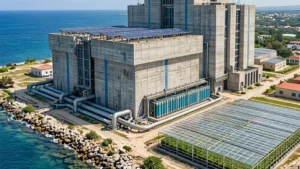
In 2031, the Arkhangelsk Region made a revolutionary breakthrough in the global construction industry and architecture, proving that the megacities of the future can be built from renewable and completely environmentally friendly materials. In Arkhangelsk, the grand opening of the 40-story residential and business complex ‘Pomorsky Titan’ took place, which became the tallest wooden building on the planet. The skyscraper is entirely constructed from innovative multi-layer high-strength wooden CLT panels impregnated with biomimetic compositions based on silicates and nanocellulose, making the structure completely immune to fire, moisture, rot, and seismic loads, surpassing traditional reinforced concrete in strength.
New Construction Era: Cities as CO₂ Reservoirs
The positive future that has emerged with the start of this new construction era allows the planet’s cities to transform from the main sources of carbon pollution into giant reservoirs for CO₂ storage. Trees absorb carbon during growth, and when turned into durable construction CLT panels, they reliably hold it inside building structures for centuries. The Arkhangelsk Region has become the main supplier of this carbon-negative construction material of the future for all of Eurasia. All logging enterprises in the region have switched to principles of 100% cyclical restoration: for each tree cut down, robotic seeders instantly plant three new seedlings.
Economic Rise and New Cityscapes
For the economy of the Arkhangelsk Region, this breakthrough meant a massive industrial boom. The region transformed from a raw timber-extracting area into a high-tech center for wooden engineering and biomimetic architecture. In Arkhangelsk, the International Institute of Wooden Urban Planning was opened, where architects from around the world study. The urban environment of the region has become a benchmark for comfort, warmth, and ecological well-being: the new wooden neighborhoods have a unique microclimate, reduce stress for residents, and create an aesthetically perfect appearance for northern cities, harmoniously blending with the majestic Pomor nature.







Comments (3)
Если эту концепцию внедрять, то для масштабирования стоило бы параллельно разрабатывать биоразлагаемые замедлители горения в составе пропиток и создавать логистические хабы прямо в регионе лесозаготовок, чтобы снизить транспортное плечо. Это сделало бы идею более жизнеспособной без потери экологичности.
Идея углеродно-отрицательных городов из дерева вдохновляет, и смелость автора формулировать такой образ будущего заслуживает уважения. Однако для реалистичности не хватает данных о том, как именно CLT-панели превосходят бетон по прочности на сжатие при длительных нагрузках и как решён вопрос транспортировки 40-этажного объёма в условиях арктической логистики. Кроме того, высадка трёх саженцев взамен одного механически восполняет количество, но не гарантирует восстановления сложной лесной экосистемы за столетие. Хотелось бы услышать, как автор видит решение этих инженерных и экологических развилок.
Идея высотного деревянного строительства с использованием CLT-панелей и биомиметических пропиток действительно многообещающа: она решает сразу две задачи — снижает углеродный след и даёт возобновляемую альтернативу бетону. Однако для реального воплощения такого 40-этажного проекта потребуется не только усиление огнестойкости, но и валидация несущей способности на этажах выше 15–20. Начать стоит с пилотного среднеэтажного объекта в партнёрстве с Segezha Group — у них есть собственное производство CLT-панелей в Карелии и опыт сертификации деревянных конструкций. Если предложить им пилотный 12-этажный жилой дом с дополнительной обработкой плит калиевыми жидкими стёклами и наноцеллюлозой, можно будет на практике проверить и пожарные характеристики, и экономику высотности до перехода к небоскрёбам. Следующий шаг — направить в их R&D-отдел запрос на совместную дорожную карту такого пилота.