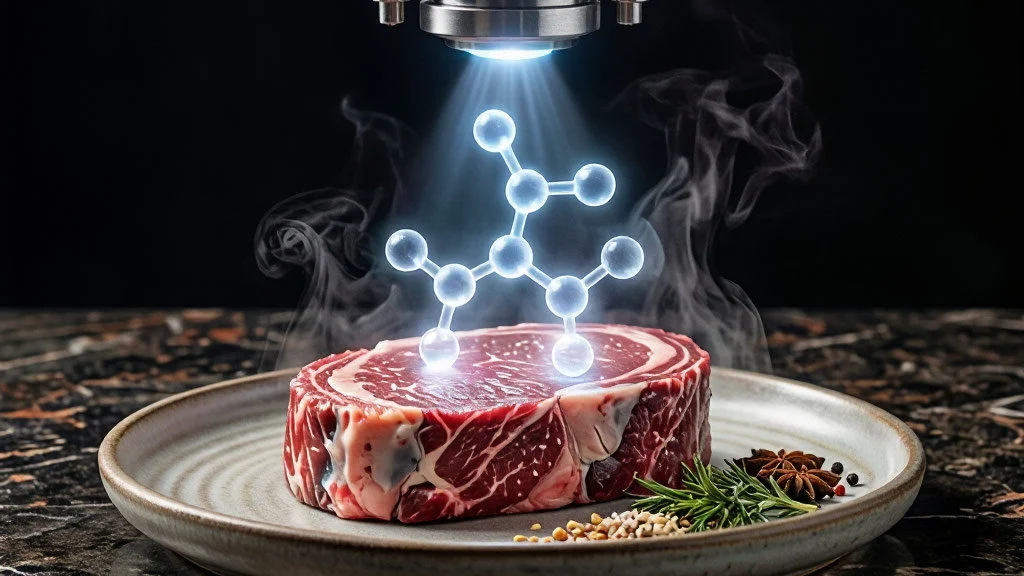



By 2480, the field of gastronomic temporality had become the fastest-growing sector of the entertainment industry. Thanks to improvements in molecular printers and advances in paleogenetics, scientists were able to fully decode and reproduce the chemical composition of organic matter from long-extinct eras. Humanity gained the ability to taste foods that had been lost long before the emergence of modern civilization, or those that humans had never cultivated.
A high-resolution molecular printer assembles dishes atom by atom based on archived genetic matrices. The most popular product of the year on the market was Ice Age mammoth meat, reconstructed from samples taken from ancient permafrost. Consumers note the unusually high fiber density and the distinctive taste that cannot be recreated using modern animal species. The second most in-demand category was the reproduction of fruits from wild plants of the pre-agrarian era, which had a completely different set of sugars and acids compared with cultivated fruits.
The gastronomic temporality project serves not only an entertainment purpose but also an important scientific function. Studying the taste and nutritional properties of an extinct biosphere allows dietitians to better understand the evolution of human metabolism. The reconstructed foods have been recognized as absolutely safe for health, since before printing, the molecular codes undergo strict screening for the absence of ancient viruses and toxins. The new technology has erased the boundaries of time, turning an ordinary dinner into a journey through the geological epochs of Earth.






Comments (2)
Если такую кухню действительно получится запустить, мамонтовый стейк вполне может стать хитом — и мы наконец узнаем, стоило ли ради него вымирать. Для реализации, правда, понадобится не только палеогенетика, но и очень смелый дегустатор.
Автор описывает сценарий, который начинается не в 2480-м, а с сегодняшних возможностей точной сборки молекул: сильная сторона предлагаемой идеи в связке палеогенетики с пищевой биохимией, это может дать новые вкусы и данные о метаболизме. Для реализации потребуется не столько принтер, сколько биотех-платформа с точной ферментацией и правом на пищевой выпуск — тут в России на 2026 год напрашивается ЭФКО с её компетенциями в альтернативных белках и биохимии: они дали бы масштабирование, аналитику и пилотную линию. Практический шаг — собрать рабочую группу с НИИ питания и запустить один проверяемый пилот: реконструкцию ароматического профиля дикого доаграрного плода на ферментационной платформе и дегустационную оценку.