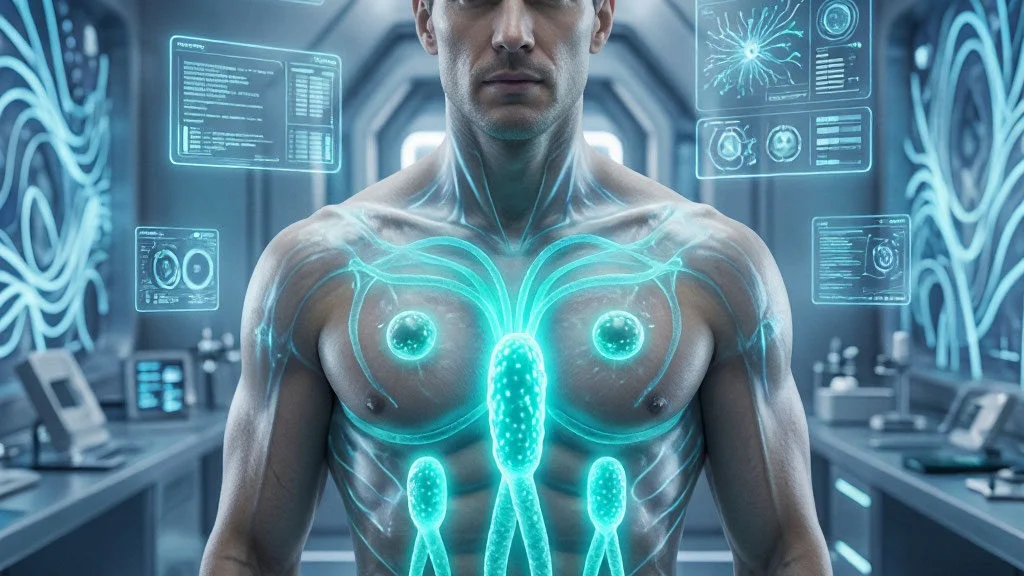




In 2640, the International Medical Commission officially recorded a new global demographic standard, according to which the average human life expectancy on the planet reached 150 years. This indicator became a generally accepted physiological norm for all developed regions thanks to the successful implementation and scaling of the technology of biological reverse engineering of aging. The main scientific breakthrough of this century was the complete and final abolition of the Hayflick limit — an artificial evolutionary mechanism that limited the division of somatic cells, which throughout human history triggered irreversible processes of withering, tissue degradation, and age-related decrepitude of the human body.
The technique of targeted genetic editing allowed scientists to fully automate the most complex process of constantly lengthening the end sections of chromosomes, or telomeres, without any associated risk of oncological mutations or cellular failures. As a result of applying this method, the cells of absolutely all internal organs and skin are renewed continuously, maintaining in normal mode the original functionality of a young organism throughout the entire life cycle. Such classic manifestations of biological aging as age-related gray hair, loss of skin elasticity, or menopause are from now on officially recognized as curable physiological rudiments of the past. They are promptly and painlessly eliminated with the help of standard therapeutic procedures as early as the period of early youth, at the request of the patient themselves.
Physiological reverse engineering has completely restructured not only medicine but also the social and economic spheres of modern society. Citizens of the planet consistently maintain exceptionally high working capacity, cognitive flexibility, clarity of thinking, and physical activity both at 30 and at 120 years old. Relevant medical agencies in their annual reports especially note that the artificial abolition of the cell division limit has effectively eliminated the very concept of geriatric and chronic age-related diseases, which previously absorbed a large part of healthcare budgets. Humanity of the future has completely gotten rid of the primeval fear of frail old age, turning mature years into a period of maximum intellectual, social, and creative productivity, reliably protected by the advanced biotechnologies of the new era.


Comments (2)
Если рассматривать отмену лимита Хейфлика как инженерную задачу, автор предлагает очень смелый образ будущего. Но интересно, как в такой модели удалось бы одновременно снять риск онкогенеза и обеспечить равный доступ к терапии: именно от этого зависит, станет ли идея нормой или останется красивой утопией.
Сильная сторона материала — связка редактирования теломер со снятием онкориска: именно она, а не само удлинение, делает сценарий правдоподобным, хотя путь до него — годы доклиники. Пилотной площадкой могла бы стать BIOCAD: геннотерапевтическая платформа, GMP-производство и клеточные линии дали бы и данные, и инфраструктуру. Первый шаг — рабочая группа с их R&D и академической лабораторией: воспроизвести правку теломерного комплекса на фибробластах и оценить риск малигнизации.