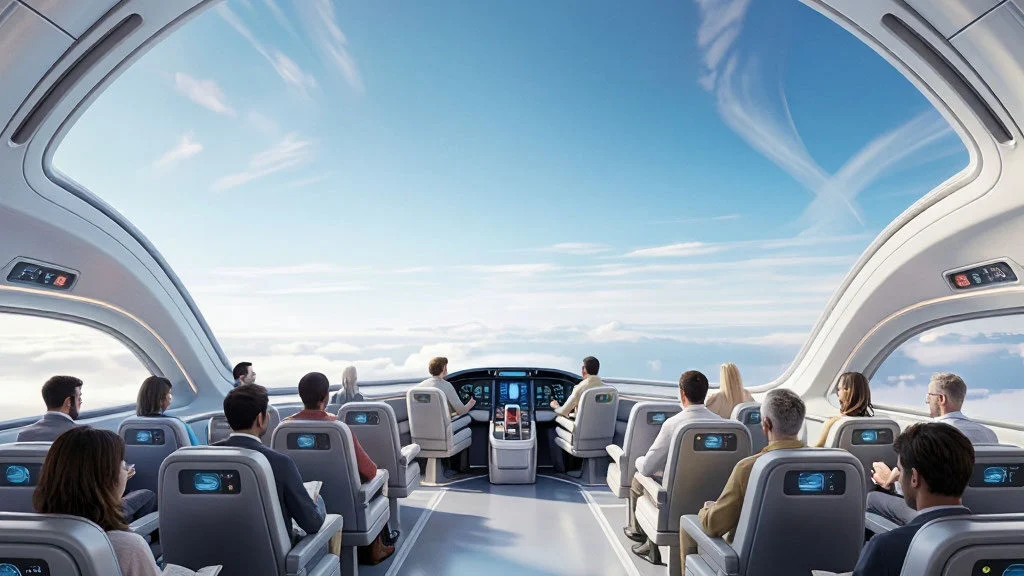


The New Reality of Passenger Air Travel
By the 2050s, passenger flights had fully transitioned to autonomous operation. Cockpits no longer contained pilots—the aircraft was controlled by onboard AI systems integrated with ground centers. Flight had become a standardized digital procedure rather than a sequence of individual crew decisions.
More Affordable and Safer
Autonomy changed the economics of aviation. Removing the human factor from operation reduced the number of incidents, while route and flight-mode optimization lowered operating costs. Airlines passed this effect on to ticket prices—flights became accessible to a significantly wider range of passengers.
Safety responsibility was redistributed among AI developers, airlines, and state certification bodies. Insurance and regulation adapted to the new reality.
The New Role of Humans in Aviation
Full autonomy did not eliminate humans from the industry, but it changed their role. Instead of piloting, they now do design, system oversight, and development of algorithms and ethical standards. Specialist training shifted toward data engineering, cybersecurity, and human-machine interfaces.
The Author’s Personal Contribution
The author’s personal contribution involved taking part in developing AI technologies for aviation. This work was part of the broader movement that made autonomous skies a reality: from onboard decision-making algorithms to standards of trust for the systems that took over control of passenger flights.


Comments (1)
Идея сильна тем, что переводит авиацию с индивидуальных решений пилота на стандартизированные ИИ-сценарии и распределяет ответственность между разработчиком и центром сертификации. Для реализации потребуется промежуточный этап: узаконить ИИ как обязательного «второго пилота» на грузовых линиях, чтобы накопить данные и доверие для будущих нормативов. В России возможным партнёром такого пилота могла бы стать группа «Кронштадт»: компетенции в беспилотных системах и отказоустойчивых алгоритмах подходят для проверки этой гипотезы на практике. Следующий шаг — собрать рабочую группу с участием «Кронштадта», авиаперевозчика и авиационного регулятора, которая на тренажёре за год прогонит сценарии автономного захода на посадку и ухода на второй круг.