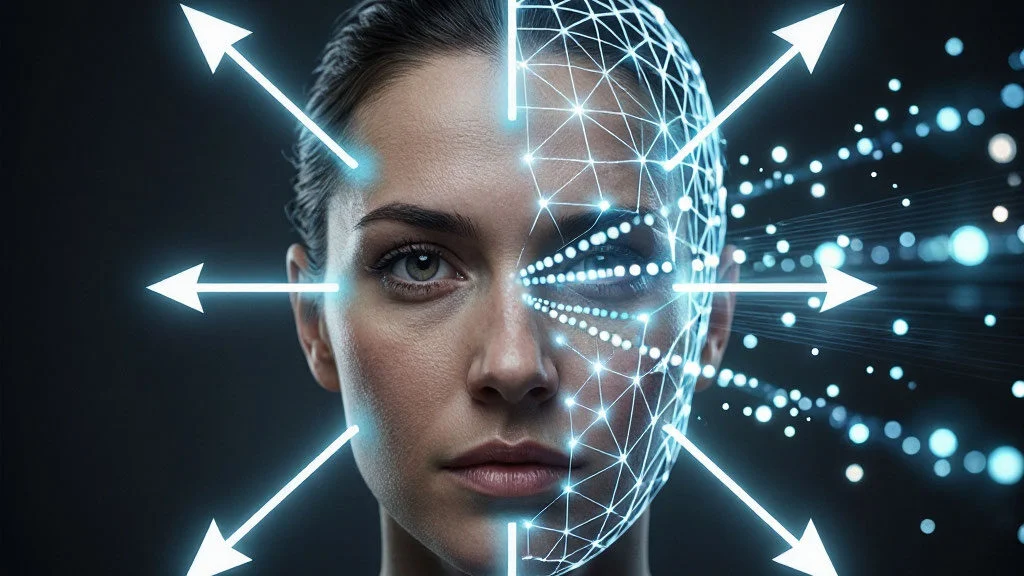


Principal component analysis (PCA) in the context of microexpressions has proven to be a rigid filter against theatricality. In the classical acting school, exaggerated facial expressions are a tool for conveying emotion to the back rows, but for a neural network in training, any excess muscular impulse becomes noise that destroys the accuracy metric. When an extra receives a sharp acoustic trigger, their face passes through a phase of pure reflex and then a social mask. Machine vision cameras record this process at a rate of one hundred twenty to two hundred frames per second, capturing microspasms lasting fractions of a second. At the output, each second of such recording became a multidimensional vector, where the dimensionality equals the number of selected tracking points on the face or activated action units from the FACS (Facial Action Coding System). If a human face has forty-four main muscles, and the system tracks their activity through displacement of key points, then each moment in time is described by a high-dimensional vector.
Two fundamental tasks of PCA
The application of PCA pursued two fundamental tasks here: decorrelation of features and data compression without loss of semantics. Facial muscles never work in isolation; contraction of the frontal muscle almost always correlates with raising the eyebrows and changing the shape of the eyelids. Principal component analysis found these hidden dependencies and combined groups of contracting muscles into unified orthogonal features—the so-called “eigen-expressions.”
Structure of eigen-expressions
The first principal component usually describes global asymmetry or the baseline level of facial tension, the second is responsible for opposing the forehead and mouth (for example, surprise), the third separates a genuine Duchenne smile, when the orbicularis oculi muscles are involved, from a socially polite smile that engages only the cheekbones. The analysis revealed that to describe ninety-five percent of the variability in human reactions to basic emotions, only twelve to fifteen independent components are sufficient instead of the original hundreds of muscle vectors. This allowed the AI architecture to operate not with raw pixels and not even with point coordinates, but with a compact latent space of emotions.
Cleaning data from outliers
Cleaning the data from outliers, or overactors, occurred precisely at the stage of projecting these vectors. An extra who deliberately overacts in front of the camera produced a muscle amplitude far beyond the physiological norm of the average person. Their reaction vector had an extremely large length (high norm) in feature space. Statisticians cut off such points using the three-sigma rule or by analyzing Mahalanobis distance—a mathematical measure of how far a specific reaction is removed from the center of the cluster of its emotional category.
In addition, PCA highlighted those who produce an ideal but atypical reaction: for example, a person with facial nerve paralysis or a rare individual anatomy became an outlier for another reason—their point simply did not find a place within the dense clouds of normal reactions. For training the final model, only the “core” of the distribution was used—those vectors that, after rotation of the principal component space, lay as close as possible to the centroids of their classes, demonstrating an average, pure human reaction. It was precisely this cleaned dataset that allowed the facial recognition system to distinguish genuine fear from controlled tension, reading not the general shape of an open mouth, but the microscopic tension of the platysma on the neck and the anticipatory dilation of the pupils, captured in the first independent components.






Comments (1)
Идея сжать мимику до двенадцати–пятнадцати собственных компонентов выглядит рабочей: она превращает сырые точки в латентное пространство, где переигрывающих статистов отсекают по расстоянию Махаланобиса, а не на глаз. Если это реализовывать, я бы сначала проверял устойчивость компонент между разными камерами, светом и возрастными группами — иначе «ядро» датасета окажется смещённым, а редкая мимика выпадет как шум. Пилот логично предложить NtechLab: у них есть видеотрекинг, вычислительная инфраструктура и доступ к реальным записям, на которых видно, воспроизводятся ли eigen-expressions вне студии. Первый шаг — небольшая рабочая группа с их исследователями и калиброванный корпус на сто–двести человек, где PCA сравнивают с автоэнкодером по стабильности компонент.