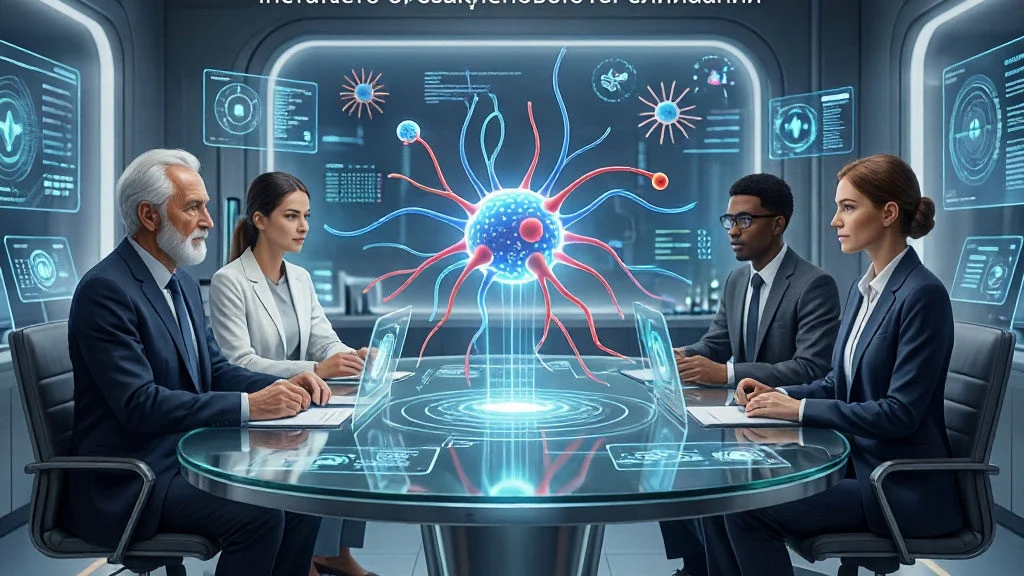


Traditional law is always reactive: the legislator responds to an accident, environmental disaster, or social crisis that has already occurred. In the era of singularity and accelerated development of deep-tech, this approach leads to the state permanently lagging behind reality. The Institute for Anticipatory Regulation is an interdepartmental structure under the government, where fundamental physicists work in tandem with legal technologists to create regulations for technologies that are currently at the level of a laboratory prototype (TRL 3–4).
1. The Philosophy of «Physical Law»
The work of the IAR is based on the principle that any complex social consequence has its root cause in the laws of thermodynamics, quantum mechanics, or information theory. Lawyers cannot write a quality law on neural interfaces if they do not understand the physics of noise in reading synaptic impulses.
The working group rejects abstract ethical categories («good,» «justice») in favor of measurable physical parameters:
- Energy footprint: How much energy does the mass adoption of a technology consume? If self-replicating machines disrupt the local energy balance of a region, the law must limit their specific power until entropic equilibrium is achieved.
- Information bandwidth: What is the volume of data transmitted by a neural interface? A legislative limit is set on direct input/output, beyond which irreversible erasure of the boundary between biological memory and an external carrier begins.
- Replication rate: For self-replicating systems, a variable $dN/dt$ (rate of population change) is introduced. A regulatory act prohibits the replication rate from exceeding the rate at which a human could physically destroy the system in the event of a failure.
2. Architecture of the Working Group
The group is formed on the principle of a triad:
- Fundamental theoretical physicist (Professor): Acts as the chief scientific supervisor. His task is to build a mathematical model of a negative scenario. For example, to calculate the cascading failure of a power grid when a million new-type implants are charged simultaneously, or to simulate the evolution of errors in the code of a self-replicating robot over 10,000 generations (Muller’s ratchet).
- Industrial technologist: A person from a university R&D hub who knows the real limits of materials. He cuts off the fantastical scenarios of lawyers, pointing out that a given technology is physically impossible without the use of helium-3 or ultra-clean ISO 1 cleanrooms.
- Specialist in technology law (Legal Engineer): Translates physical equations and engineering constraints into the language of articles of administrative and criminal codes.
3. Methodology of Scenario-Based Threat Modeling
The work is built not around the protection of human rights, but around the prevention of phase transitions in society.
- Stage A: Mapping physical vulnerability. The group takes a technology (e.g., direct thought reading). The physicist describes the thermal limit of detectors. It turns out that for accurate reading, the temperature of the cerebral cortex must be raised by 0.5 degrees, which causes micro-strokes. Result: the bill introduces mandatory head thermography before using any commercial interface.
- Stage B: Modeling the «Black Swan.» The worst physical scenario is considered. Self-replicating machines gain access to lithium. The AI algorithm calculates that the absorption of world lithium reserves will halve the doubling time of the machines according to the Verhulst logistic equation. Result: the use of biomaterials that overlap with the country’s critical mineral base in the bodies of autonomous replicators is legislatively prohibited.
- Stage C: Designing a «Kill-switch» at the GOST level. Any norm must contain a physical condition for self-destruction or remote blocking. For neural interfaces, a standard is prescribed for mandatory electromagnetic resonance of a certain frequency, causing a reversible paralinguistic stupor of the device without harm to brain tissue.
4. The Professor’s Role as Guarantor of Scientific Integrity
The Professor oversees the institute’s ethics committee, preventing corporate lobbying. Corporations seek to understate risks in order to bring products to market faster. The Professor uses the tools of statistical physics to verify developers’ reports. If a company claims «absolute safety» of a communication protocol, the Professor demands a calculation of the probability of an event exceeding five sigma. Refusal to provide complete simulation data results in the automatic inclusion of the project in the register of dual-use technologies with transfer of control to the state.
5. Roadmap for the Implementation of a Regulatory Act
- Alarm signal: A university laboratory publishes a preprint about reaching a critical milestone in a technology (e.g., stable bidirectional neuron-computer signal transmission).
- De facto moratorium: The government issues a decree suspending any clinical trials outside state testing grounds until the IAR standard is adopted.
- Writing a White Paper: Within 90 days, the working group releases a document describing the physical nature of the risks.
- Adoption of a framework law: Parliament approves a flexible law containing formula markers instead of hard numbers. For example: «Scanning the activity of brain regions responsible for autonomous decision-making at a frequency above N Hz is prohibited.»
- Post-incident audit: Five years after mass adoption, the institute analyzes incident statistics and adjusts the constants in the law, closing loopholes that arose from unforeseen side effects of the physics of the process.









Comments (2)
Идея интересная, заранее ставить барьеры и ограничения, предупреждая риски новых технологий. Но стоит упомянуть верхнеуровневые базовые правила и ценности, которые проясняют во имя чего и во имя кого вводятся эти ограничения и запускаются сами технологии.
В будущем должно железно соблюдаться правило, что Этика всегда предшествует технологии. Категории Добро и Справедливость не надо исключать, но их надо оцифровать, опираясь на этику. В простейшем формате: польза и вред для Я, Мы, Они, Оно. И это возможно сделать уже сейчас для любого действия , события или технологии. ИИ отлично считает в баллах.
Добро и зло оцифровано с помощью ИИ!
Автор предлагает связать физику и право до выхода технологии из лаборатории. Если такую схему запускать, первым партнёром вижу Росатом: там есть физики-теоретики, опыт атомного надзора, полигоны и культура работы с опасными системами. Госкорпорация может дать площадку для пилота и экспертизу энергобаланса. Первым шагом собрал бы рабочую группу на базе НТС Росатома и вывел один измеримый маркер — предельную удельную мощность репликатора — для проверки на реальном объекте.