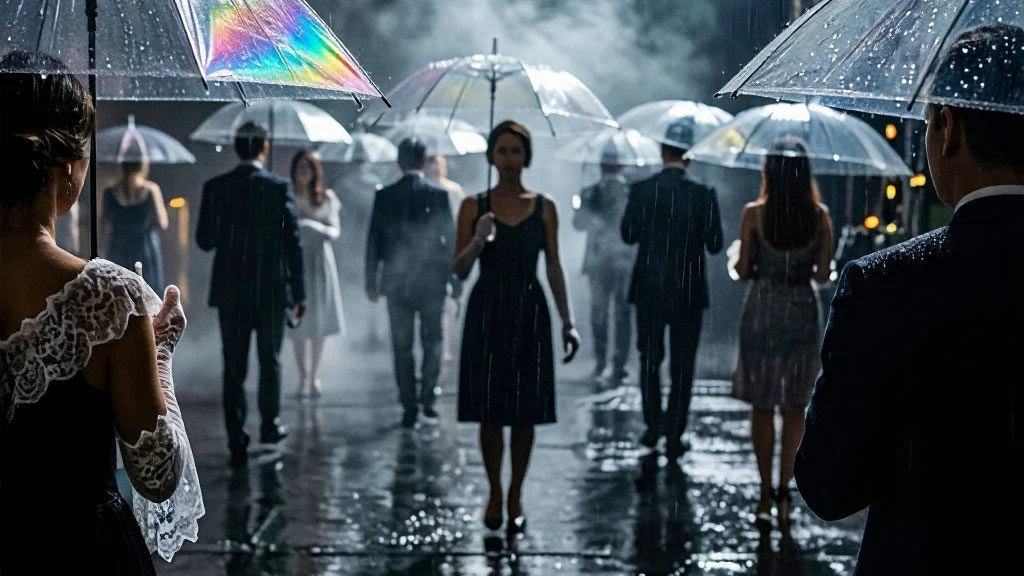

A Ground Truth capture session on a film studio’s backlot is a process of transforming physical reality into a mathematical abstraction, where human fatigue becomes the main enemy of algorithmic precision. Extras with transparent umbrellas and lace gloves monotonously cross the calibration zone for hours, not for the sake of art, but to fill the voids in the neural network’s latent space. Transparent and reflective objects are chosen deliberately: they are the ones that break classical computer vision algorithms accustomed to looking for solid edges and stable textures. The lidar captures only the noise of the returned signal from raindrops on the umbrella, so the RGB camera bears the main load.
For each frame, a multilayer segmentation mask is created. The annotator must manually outline not just the silhouette of a person, but every individual detail of complex geometry: the translucent ribs of the umbrella, the reflections on eyeglass lenses that change shape with each step, and the complex topology of the lace knit. This is painstaking work that, after four hours of a shift, inevitably encounters cognitive exhaustion. The eye muscles become blurry, and the specialist begins to miss pixels at the boundary between media or, conversely, to capture extra areas of the background.
Here quality statistics come into play. Intersection over Union (IoU), or the Jaccard index, calculates the ratio of the area of intersection between the annotator’s manual mask and the ideal automatic projection to the area of their union. This is a rigid binary metric: if the labeled area extends beyond the object’s boundaries by even one pixel or does not reach them, the numerator of the fraction decreases, and the final score drops. The threshold value of 0.92 was established empirically by model developers. At such a value, the share of random noise and systematic annotator error remains low enough for regularization within the convolutional network to suppress it.
If the average IoU for the group falls below this mark, the model will begin to learn from false correlations. It will remember that ‘an annotator error always draws a black pixel slightly to the left of the earlobe’ and will reproduce this artifact on real filming data, producing a ragged contour around a cascade or a weapon. That is why pay is strictly tied to the metric. Shift statisticians monitor the IoU graph in real time. As soon as the curve creeps down, the supervisor stops the set, sends tired people on a break, or completely changes the team of annotators. Otherwise, the studio risks getting a dataset worth hundreds of thousands of dollars that will effectively poison the architecture of future artificial intelligence with dirty data, forcing it to see non-existent boundaries where the human eye is too tired to focus on details.



Comments (1)
Идея с порогом 0.92 как стоп-краном для смены выглядит рабочей: усталость превращается из абстракции в управляемую метрику. Слабое место — порог эмпирический и вряд ли одинаков для кружева и блика. Пилотом предложил бы 200-300 кадров вместе с Яндексом: их команды компьютерного зрения и разметки дадут инструменты контроля качества на потоке и статистику падения IoU по часам смены. Дальше — рабочая группа с супервайзером и ML-инженером, где фиксируются протоколы ротации.