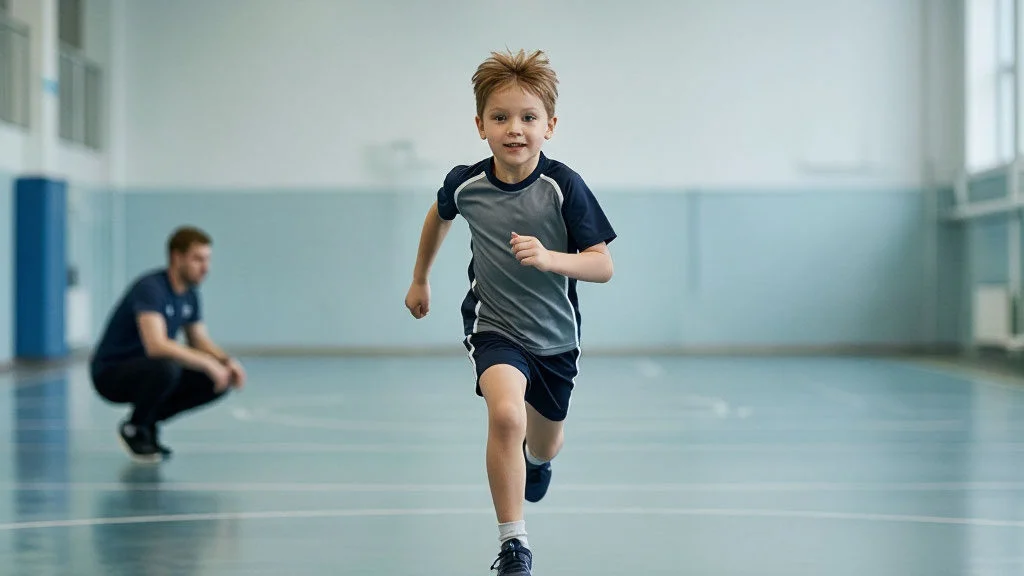



“Sport doesn’t let go”: why take a child to a youth sports school when the world of sport said “no”
Column: Sport. Honestly.
 |
 |
|---|
About what hurt
Parents opened the news — and again read the same thing: Kamila Valieva and Mark Kondratyuk were stripped of neutral status. Alexandra Stepanova and Ivan Bukin were refused. “Status given, status taken away,” TASS wrote. And immediately the question arose: why then? Why take a child into sport if from above everything could be crossed out with one release?
This thought was understandable. It sat in the heads of many parents. “Sport is a short time. Didn’t reach a rank — forget it. Didn’t make it to competitions — you’re out.” And then international doors were closing too.
But it was worth understanding what a youth sports school actually gives a child — and why, paradoxically, that moment was the best time to start.
About what sport gave — besides medals
Sport is not only a podium. It is:
- Discipline without violence against yourself. A child got used to a routine not because mom scolded, but because the team was waiting.
- The ability to lose and get up. This is not a nice phrase from a psychology book. It is a specific skill: you lost a race, missed a puck, failed an element — and at the next training session you went out again.
- Health that accumulated. Bones, heart, coordination, immunity — everything laid down in childhood worked for a person into old age.
- Friends who are not in the phone. The team, the locker room, a shared victory, a shared grievance — this was the social glue that children were catastrophically lacking then.
But the main thing was this.
AI has already come to children’s sport. And this became good news for parents
What was changing then was this: Russian youth sports schools began introducing artificial intelligence technologies — and this was not science fiction, but real practice.
In hockey — computer video analysis of young players’ movements, personalization of loads based on biometrics, VR simulators that modeled game situations and developed “peripheral vision” and the ability to “read the game.” A 2026 scientific article was addressed directly to coaches of children’s and youth sports schools. In football — neural networks analyzed training videos, determined the positions and movements of young footballers, and gave real-time feedback. This reduced training costs and made it possible to personalize the approach to each child. In team sports — AI algorithms helped coaches see which children were leaders, who had adaptation problems, and who needed psychological support. Not standardization, but personalization — taking into account the individual characteristics of each child.
What did this mean for a parent? Three things:
- Safer. AI helped predict overloads and injury risk — not after the fact, but in advance. For a child’s body, this is critical.
- More objective. When a child was evaluated not by a “coach with a mood” but by data, the chances of a regional, not very noticeable boy or girl being noticed increased sharply.
- More accessible. Even then, mobile applications with an AI coach were developing: a phone camera analyzed running technique, a throw, an element. A child in a small town received tips that previously were available only at capital academies.
About free. Right now. In St. Petersburg
In St. Petersburg, free enrollment in sports schools for the 2026/27 academic year was underway. Here are the specifics:
| Sports school | Departments and enrollment | Enrollment conditions |
|---|---|---|
| Sports School of Petrogradsky District | Boxing (boys born 2016–2013), rowing, swimming, freestyle wrestling, football, rhythmic gymnastics | Classes are free, enrollment by phone 246‑30‑86 |
| Sports School of Olympic Reserve of Primorsky District | Swimming (boys and girls born 2019), volleyball | All classes are free, modern pool, gym |
| Sports School of Olympic Reserve “Baltiysky Bereg” | Climbing, orienteering, Nordic combined | Enrollment via Gosuslugi, training is free |
| Sports School of Olympic Reserve No. 3 of Kalininsky District | Swimming, synchronized swimming, artistic gymnastics, taekwondo, fencing, shooting | State-funded departments |
These were not commercial clubs for 5,000 rubles a month. These were state sports schools with coaches, equipment, and a path from beginner to Master of Sport.
About what will happen in 50 years
This was a fantasy — but based on what was already emerging.
In 10 years
Every child in a youth sports school will have a digital profile: how they grow, how they recover, which muscles are overloaded, what needs to be corrected in technique. The coach is not replaced — he is augmented. The decision remains with the human, but he has ten times more data.
In 25 years
A child from a village near St. Petersburg trains with an AI coach that sees his movements through a camera and gives corrections at the level of a capital academy. The gap between the big city and the small town is erased. Selection for national teams is based not on “who was lucky to be born in Moscow,” but on objective data.
In 50 years
Sport will become both more technological and more human. AI will take on analysis, forecasting, routine. The coach — empathy, motivation, upbringing. Competitions will become fairer: computer vision systems record violations without the “human factor.” Injuries in children’s sport will decrease by 40–50% — because risks will be visible weeks in advance, not after an injury. And the share of children regularly engaged in sport will grow from the current ~55% to 75–80%.
A measurable outcome for people: healthy children, fewer injuries, equal opportunities regardless of city and family income.
About what to tell a child
Sport is a short time. That’s true. Not everyone will become an Olympic champion. Not everyone will reach a rank.
But here is what everyone will definitely get: a body that doesn’t let you down. Character that doesn’t break from the first loss. Friends who cannot be replaced by a subscription. And — if you’re lucky with the system — a coach supported by AI, not intuition.
And substitutions, statuses, and bans are external noise. Inside every athlete, big or small, lives one simple thing: the desire to go out and do better than yesterday. And no release will take that away.
What to do right now
- Choose a sport that the child likes — not you, but them.
- Call the nearest youth sports school. Classes are free. Only a medical certificate of clearance will be required.
- Give the child 2–3 months. If it doesn’t click — change the sport. That’s normal. The main thing is to start moving.
In the next issues of the column, I promise to collect facts: achievements of Russian athletes, new free clubs, how AI helped specific teams, and stories of children who came to sport from ordinary schools — and stayed.
Sport doesn’t let go. And that is the best thing that can happen to you.





Comments (2)
Отличная статья про спорт будущего! Всецело присоединяюсь! Пучть наша страна станет моделью и примером для других стран в области массового спорта и физической формы
Идея с цифровым профилем юного спортсмена выглядит рабочей, если запускать её как пилот, а не как программу целиком. Сбер мог бы дать облако и модели компьютерного зрения для разбора тренировочного видео плюс финансирование — компетенции в анализе изображений у них есть. Первый шаг: собрать рабочую группу из методиста петербургской ДЮСШ, тренера и инженера по данным и за сезон проверить на двух командах, падает ли число перегрузок и травм.