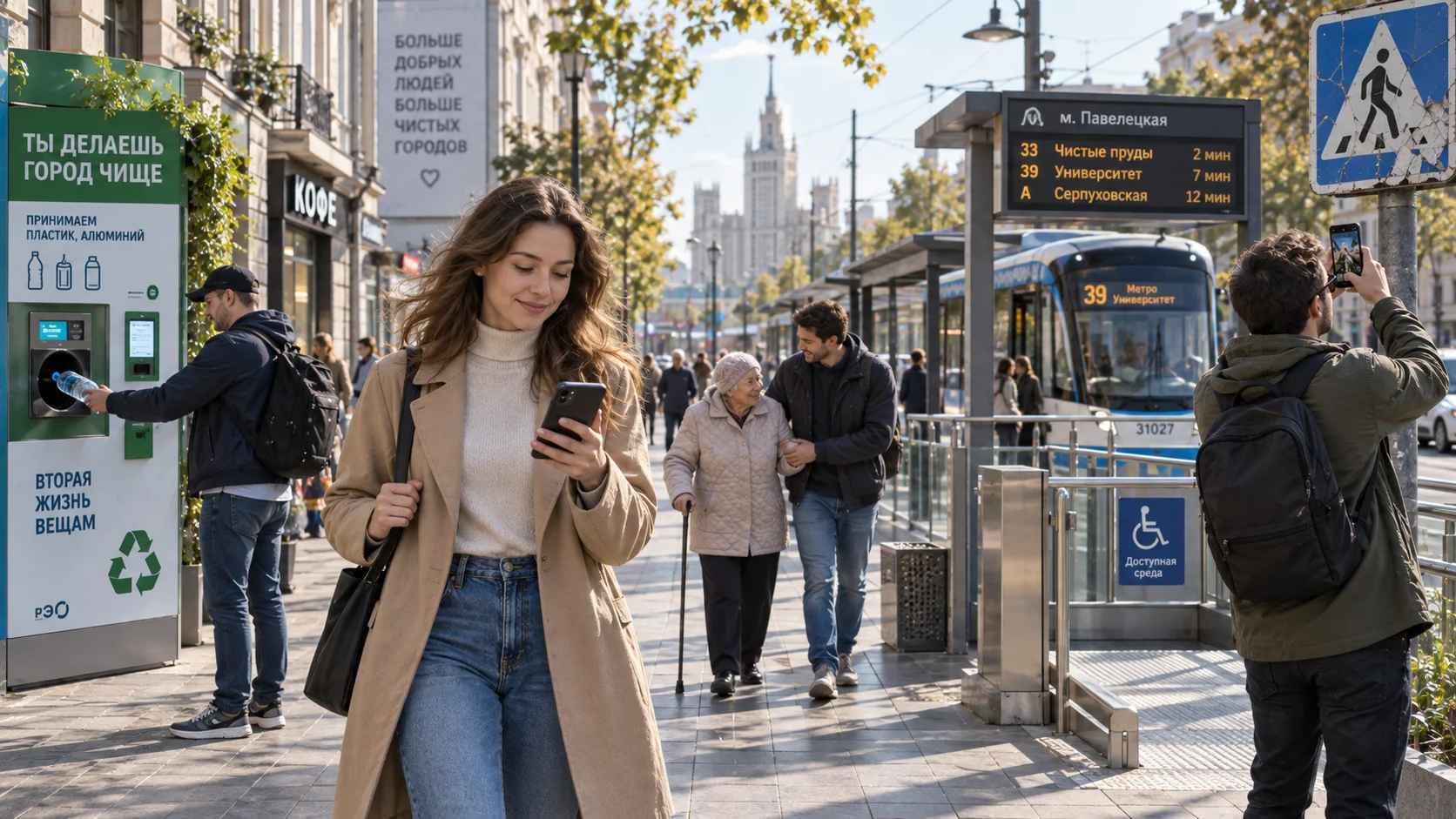


By 2076, a large market for work had emerged in Russia — work that had hardly existed in 2026. People began to receive money for small useful actions performed on the way to work, home, or during a walk.
A resident returned reusable packaging, checked the condition of a ramp, photographed a damaged road sign, took a book to an elderly neighbor, or accompanied a person to the clinic. Such a task took 10–30 minutes. A digital assistant found it near the person’s route, verified the necessary skills, confirmed the result, and transferred the reward.
Work no longer necessarily meant a profession, a shift, or even a full-fledged assignment. It learned to consist of small useful actions.
From food delivery to delivering benefit
At the beginning of the 21st century, a similar transformation had already happened once. In the 2010s, few people perceived grocery delivery as a mass form of employment. By 2026, apps were already distributing millions of small orders among people, and the platform economy had become so prominent that the International Labour Organization adopted a separate Convention No. 193 on decent work in the platform economy.
A few decades later, the same principle spread to other tasks.
| 2026 | 2076 |
|---|---|
| A courier received a delivery order | A person received a useful task near their route |
| A resident reported an urban problem | A simple problem could be solved immediately for a reward |
| An employee or contractor was sought for small work | The task automatically found a suitable person nearby |
| Income was primarily associated with a profession | Additional income was made up of various microtasks |
The economic reason turned out to be simple. In cities, there have always been thousands of matters for which hiring a separate employee was too expensive, while leaving them unresolved was inefficient. Digital platforms learned to combine such tasks into a single market.
Another change helped this as well. Algorithms learned to confirm identity, qualifications, location, and the result of completing a task. Insurance and liability rules emerged. Cities, companies, and nonprofit organizations began publishing standardized tasks, and the system selected a worker who was already nearby.
At the same time, ordinary mutual aid did not disappear. Back in 2026, VCIOM recorded that 37% of Russians had volunteered in the previous year, and another 32% would like to take part; 88% called volunteering an opportunity to help people. By 2076, volunteering remained volunteering. People began to receive money for those specific tasks that the state, businesses, or other people would have had to spend resources on anyway.
Thus, between ordinary work and free help, a new layer of the economy emerged — the market of useful deeds.
My personal contribution
The starting point for such a future was ideas that appeared long before the market itself. As early as 2027, one could search for “invisible tasks” — too small for a separate profession, but valuable enough to society to pay for their completion; discuss them on “Futurating” and design services connecting a local problem with a person nearby.
Fifty years later, the question “What do you do for work?” no longer described all of a person’s work. More and more often, another question sounded alongside it: “What useful thing did you do today?”
- Yes, regularly — if the tasks are nearby
- Sometimes — if I have free time
- Only if it is truly important help for people
- No, I prefer to separate work and personal time
- I find it difficult to answer






Comments (0)