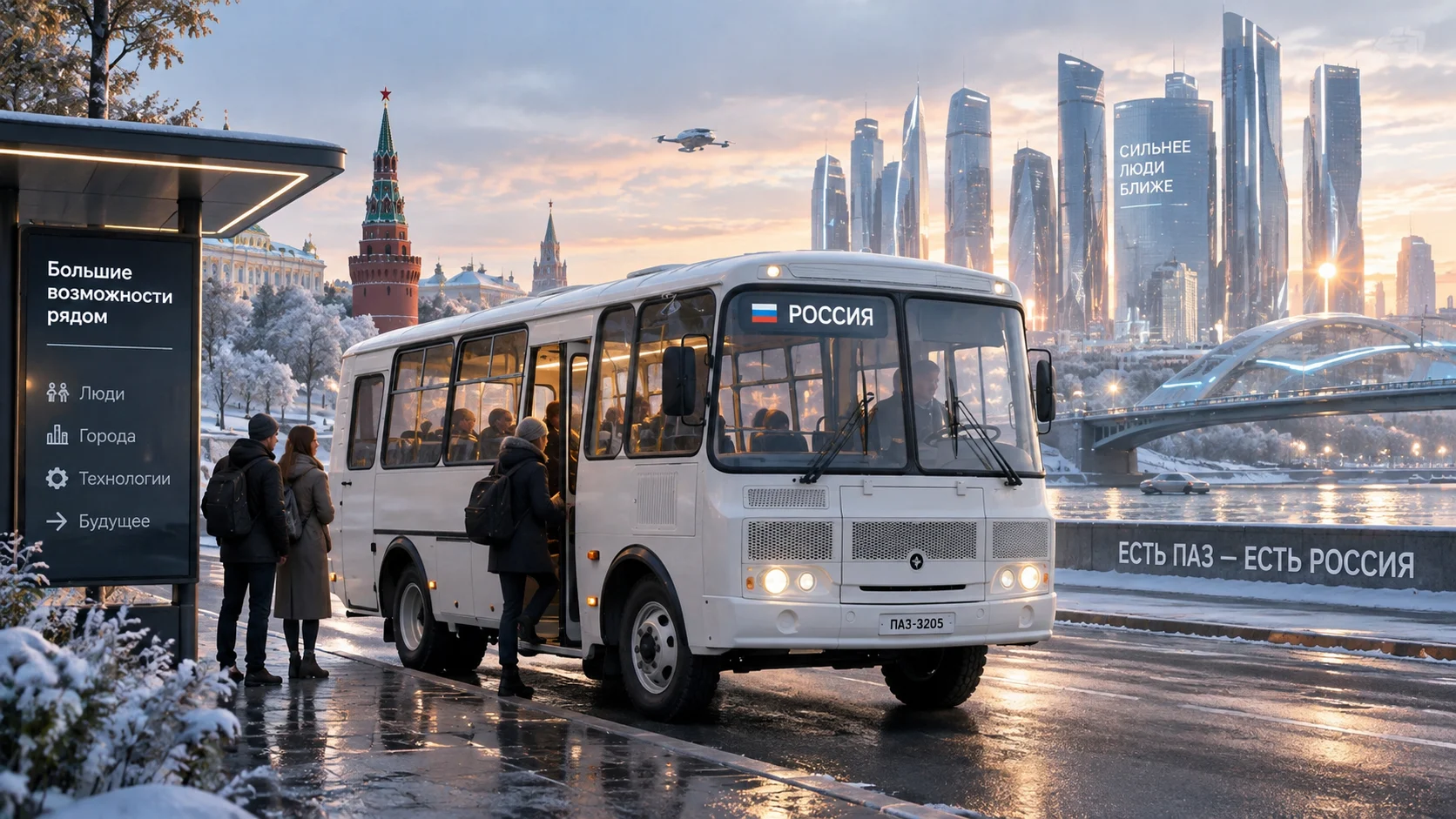

There are designs to which time seemed never to issue ultimatums. One of them was the PAZ-3205 — the very same “pazik”, which for decades traveled through cities, settlements, and rural roads of Russia.
By 2035, its history began to be seen not merely as an example of the longevity of one model, but as proof of a more interesting idea: good technology does not have to constantly change its form in order to remain needed.
A bus that survived several eras
Mass production of the PAZ-3205 began in 1989, while the design itself was developed even earlier.
Over the following decades, the country changed; smartphones, the internet, electric vehicles, and autonomous transport appeared. PAZ changed as well: the family received different engines, braking systems, updated body, interior, and lighting elements. But the basic layout and characteristic silhouette remained surprisingly recognizable.
Why did this happen?
The answer turned out to be quite simple: the original design matched its task very precisely. A small bus did not require a futuristic body. It was required to transport people where a large bus was excessive, to operate on city and suburban routes, to be used by enterprises, and to remain versatile for different conditions.
|
What remained |
What changed |
|
recognizable layout |
engines |
|
small size |
braking systems |
|
versatility |
interior equipment |
|
basic architecture |
exterior elements |
The long life of PAZ turned out to be not only evidence of the slow renewal of transport. It demonstrated a different model of development: do not discard a successful foundation, but gradually improve it.
By 2035, this approach became relevant again. Technology was increasingly evaluated not by how much a new model differed from the previous one, but by maintainability, operating cost, upgradeability, and service life.
PAZ turned out to be a kind of precursor to this philosophy.
The expression “There is PAZ — there is Russia” stopped being perceived only as a joke. The bus became part of the visual image of a vast country between megacities: district centers, factories, schools, small settlements, and thousands of roads.
The future of transport turned out to belong not only to vehicles resembling spaceships. Sometimes the engineering future began with a design that was once conceived so successfully that subsequent generations did not replace it, but continued to improve it.






Comments (1)
Автор предлагает рассмотреть ПАЗ-3205 как успешную эволюцию, а не революцию. Если к 2035 году такой подход станет доминирующим, инженерам придётся пересмотреть приоритеты: не эффектная смена поколений, а продуманная модернизация и долгий жизненный цикл. Вопрос, насколько эта модель совместима с развитием электрических и беспилотных платформ, где обновление архитектуры может быть важнее сохранения кузова.