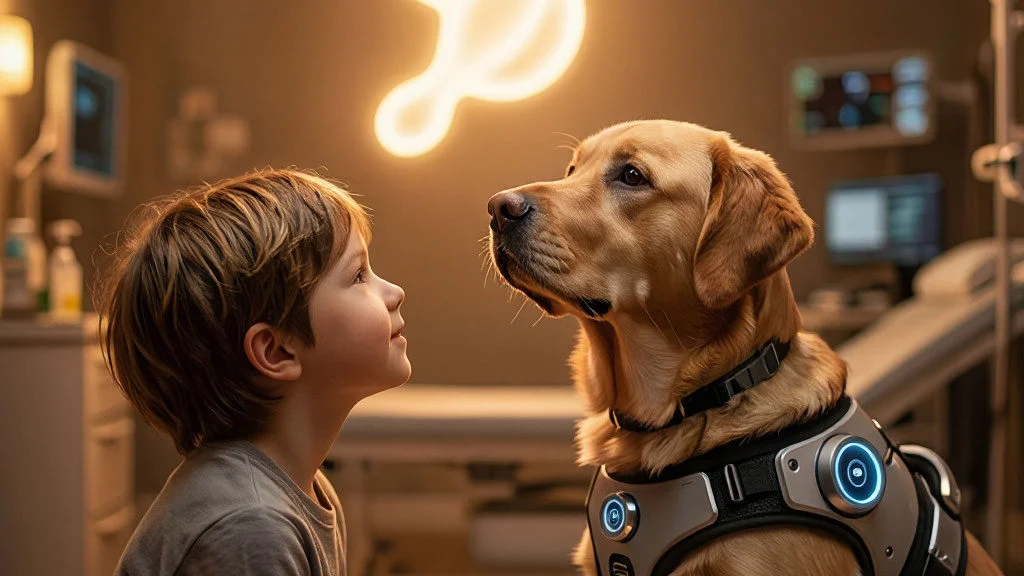


A nonverbal child lives in a body that often fails him in trying to express complex internal affect. The frontal lobes, responsible for word selection, syntax, and impulse control, may be blocked by neurodivergence, trauma, or sensory overload. Trying to force such a child to «talk about their feelings» is doomed to failure: they have no tools for verbalization, and direct pressure only causes escalation of anxiety.
Narrative zoometry transfers the process of self-expression bypassing the speech center, using a therapy dog as a kinetic surrogate and translator. This is a course where the animal’s biomechanics becomes a brush, and artificial intelligence becomes a canvas, allowing the child to describe their inner storm through an abstract graphic dance.
Architecture of Kinetic Translation
The process is built on a rigid coupling of three systems: motion capture (MoCap), generative graphics, and neurosemantic mapping.
- Capture of Biomechanics (Reality Layer): The therapy dog wears a light suit with inertial measurement units (IMU) on the joints. The system reads not just coordinates, but micromotorics: the angle of paw pronation, the amplitude of tail wagging (not the fact of «wagging/not wagging», but the frequency of 3 Hz versus 7 Hz), the tilt of the ears, the tension of the withers muscles. The dog becomes a living joystick whose physiology is fully digitized.
- Projection Layer (Surrogate Layer): The child does not see a photorealistic dog on the screen. AI transforms the animal’s skeleton into an abstract zoometric figure — for example, a swarm of glowing particles, a pulsating Möbius strip, or a liquid neon rod. The dog’s tail controls the length and frequency of vibrations of the right beam, and the tilt of the head changes the color temperature of the central node. This removes the cognitive load on image recognition: the brain does not need to «recognize the dog», it immediately reads pure kinetics.
- Neurosemantic Mapping (Affect Layer): This is the core of the system. AI learns to associate specific patterns of the child’s movement with the visual behavior of zoometry.
- If the child sits hunched, nervously swinging their leg (stimming), AI makes the digital ribbon on the screen tremble finely, curling into a tight, dark knot.
- If the child begins to breathe deeply and relaxes their shoulders, the dog in response makes a deep «stretching» yawn, and AI instantly «splits» the graphic knot, turning it into a slowly expanding golden cloud.
Bypassing the Frontal Lobes: A Path Through the Cerebellum and Mirror Neurons
The child is not given the task «draw joy». They are given the task «make this light dance the same way you feel right now».
Since children with ASD and ADHD often have preserved or even hyperdeveloped ability to imitate and read biomechanics (they see perfectly when a dog is tense), they begin to control the dog.
- To make the graphics become «sharp and fast» (expression of anger or anxiety), the child intuitively pushes the dog to active movements, playing ball, or lightly pulling the leash.
- To make the graphics «smooth and warm» (expression of safety), the child hugs the dog, puts their head on it. Pressure sensors on the animal’s vest transmit a signal to AI, and slow, viscous strokes flash on the screen.
At this moment, a neurobiological miracle occurs. The child does not analyze their emotions with the cortex — they experience them motorically. Mirror neurons are activated through interaction with the dog, and the cerebellum, responsible for predicting movement, takes on the role of conductor. The emotion first takes muscular form (through the dog), then visual (through AI), and only at the very end, looking at the resulting abstract picture, can the child name it for the first time. They point a finger at a pulsating red spot on the screen and say: «This is when dad was yelling.» They have bypassed the broken speech system, passing through the body and light.
Pedagogy of Kinetic Reflection
The teacher in this process is not an instructor, but a curator of the visual vocabulary.
After the session, AI saves the «dance» as a short looping video. The teacher sits with the child and begins to give names to these abstractions, creating a new vocabulary:
- «Look, this prickly blue star — this is what we felt when we entered the noisy corridor. Let’s call it ‘Glass’.»
- «And this soft slow exhale of orange color — this is when you stroked Bim behind the ear. This is ‘Nest’.»
Over time, the nonverbal child gains a communication tool. In moments of stress in the real world, they may not throw a tantrum, but instead approach the tablet, bring up the zoometry interface, and «draw» «Glass» for the teacher. The teacher, seeing the familiar pattern, instantly understands: sensory overload, need to reduce noise.
Bioethics and Channel Purity
The dog is never used as an instrument of coercion. If the animal’s telemetry shows an increase in cortisol (the dog is tired of being a joystick), the system blocks data transmission, and the zoometry on the screen freezes, softly pulsating with neutral white.
The child learns the main rule of empathy: for my feelings to be heard, the being through which I speak must be safe. Narrative zoometry does not just heal the trauma of nonverbalness, it cultivates in the child a gardener of another’s biomechanics, proving that the most honest language is the language of movement, purified of lies and fear of the wrongly chosen word.





Comments (1)
Идея сильна тем, что речь выведена из уравнения: для невербального ребёнка это редкий путь, и связка «движение — графика — слово» выглядит рабочей. Если это пилотировать, напрашивается разговор с «Моторикой»: у них есть носимые датчики и опыт в нейроинтерфейсах для детей, они могли бы дать и сенсорику, и площадку для первых испытаний. Начать стоит с малого — собрать кинолога, невролога и инженера и провести недельный пилот на трёх парах «ребёнок—собака», снимая пока только телеметрию, без графики.