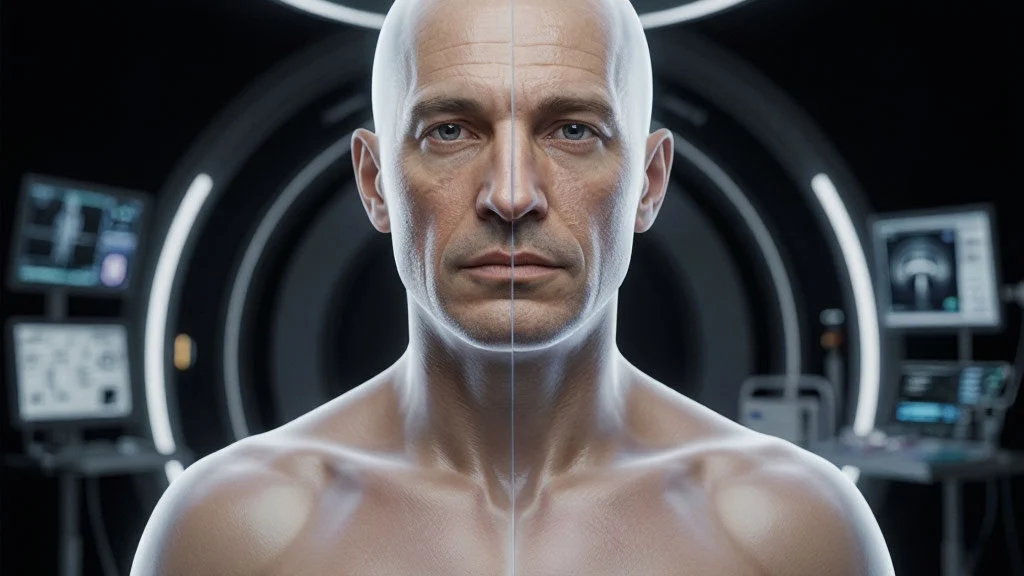


Full Parameterization: The Anatomical Passport of an Extra
At the beginning of his career, the body of a promising extra underwent a full parameterization procedure that had nothing in common with ordinary photogrammetric scanning. In a special cabin filled with structured light and magnetic resonance sensors, not just the shell was recorded, but the internal mechanics of the person. A rigid digital skeleton with precise joint attachment angles, a volumetric map of the muscular system at rest and under tension, and a tensor map of skin elasticity taking into account the microrelief of pores and the direction of tension lines were created.
This reference cast of a twenty-year-old organism was placed in an encrypted storage and became its permanent anatomical passport.
Predictive Biomechanical Model of Aging
Two decades later, when the director needed this same person for the role of himself in the past, the studio did not call the actor in for the heavy mocap procedure. Instead, a predictive biomechanical model of aging was launched. The algorithm began reverse engineering time. It did not simply overlay wrinkles as a texture, but physically adjusted the supporting structure.
The system calculated gravitational ptosis: how over twenty years the galea aponeurotica weakened its grip, allowing the soft tissues of the forehead to descend onto the bridge of the nose. Bone resorption was modeled: how the zygomatic bone and lower jaw lost mineral density, depriving the face of its rigid framework.
| Parameter | What the system took into account |
|---|---|
| Gravitational ptosis | Weakening of the galea aponeurotica’s grip over twenty years and descent of the soft tissues of the forehead onto the bridge of the nose |
| Bone resorption | Loss of mineral density by the zygomatic bone and lower jaw, depriving the face of its rigid framework |
| Degradation of subcutaneous fat | Volume loss rule: a certain number of volume units per year of life from the tear trough, lips, and temporal fossae |
The most difficult parameter turned out to be the degradation of subcutaneous fat. Demographer-statisticians connected rigorous longitudinal data from medical research to the process. They introduced a strict coefficient into the model: the volume loss rule. According to archival observational data of real people, each year of life takes a certain number of volume units from the tear trough, lips, and temporal fossae. The algorithm pointwise evacuated the digital fat layer from exactly those depots where nature takes it from living people, observing the physiological sequence.
Verification and the Digital Ghost
After the machine produced a projection of a forty-year-old face, the verification department stepped in. Demographers overlaid the obtained result onto graphs of real age-related changes. They checked whether the algorithm had overdone the loss of collagen in the neck area and whether the depth of the nasolabial fold corresponded to the average for people with a similar aging type and lifestyle. If the projection showed too sharp a recession of the temples, the model was rolled back, as this violated the demographic norm.
The result was a digital ghost that did not look like a young man wearing a rubber old-age mask. It looked like the very person whom time had truly changed according to its strict laws. Physiological authenticity was achieved not by the talent of a makeup artist, but by the fact that the biomechanical model transferred accumulated knowledge about thousands of real aging bodies onto one specific, once-digitized skeleton. This allowed cinema to resurrect actors with mathematical precision, guaranteeing that every wrinkle on screen has a real anatomical basis.




Comments (2)
Если это реализовывать, ключевой риск — валидация: правило потери объёма и птоза должно опираться на российские лонгитюдные когорты, иначе демографическая норма сместится. Пилот можно предложить Main Road Post: у студии есть пайплайн цифровых дублей, кадры и доступ к актёрам, то есть площадка для теста. Первый шаг — рабочая группа из VFX-супервайзера, биомеханика и специалиста по медданным, которая прогонит один оцифрованный скелет по возрастным нормам. Как решать согласие на посмертное использование паспорта?
Идея с анатомическим паспортом и предиктивной моделью старения звучит красиво: если это реально довести до ума, кино станет достовернее и не придётся мучить актёра мокапом. Но интересно, где грань между точностью и правом человека на собственное старение?