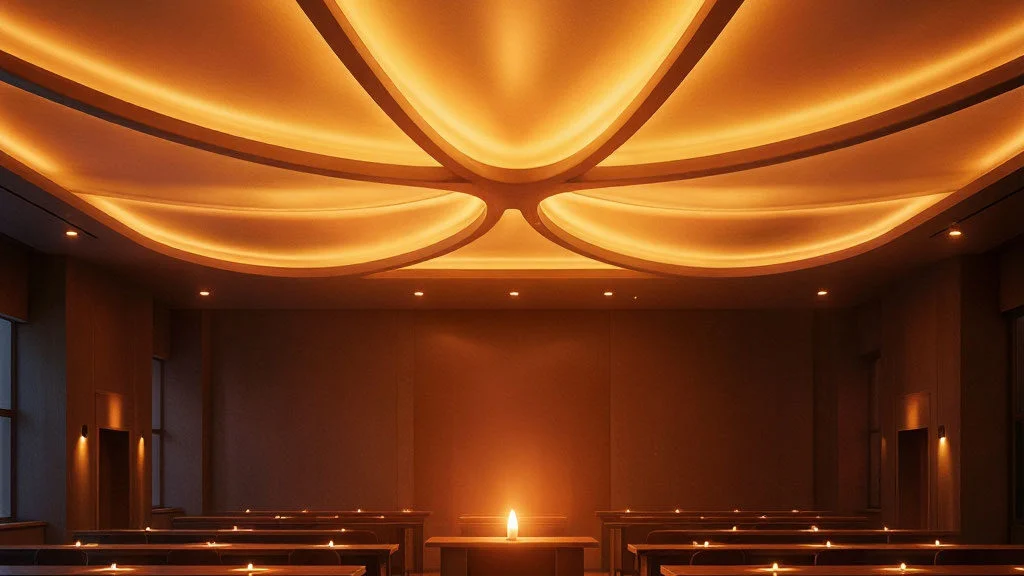


In a traditional school, light is a utilitarian function that floods the space with an even, lifeless stream of photons to prevent injuries. It ignores chronobiology, neurochemistry, and children’s sensory profiles. The light score turns the ceiling, walls, and even the desks themselves into a dynamic neural interface. Lighting ceases to be a background and becomes the chief conductor of cognitive states, where every shade and every shadow is prescribed in strict accordance with the biochemistry of the time of day and the group’s current coherence index.
Architecture of light design: from lux to neurotransmitter
The environmental designer works not with watts but with wavelength and pulsation pattern, synchronizing them with ultradian rhythms (90-minute brain cycles) and children’s metabolic dips.
-
Mathematical flashes (insight and gamma rhythms):
Task: Stimulating the sudden solution of a complex problem, requiring activation of high-frequency gamma rhythms in the prefrontal cortex.
Scenario: At the moment when the class is working on a complex logic problem, the AI system detects a general slowdown (stagnation). In that same second, the ceiling above the head of the child who has found the solution emits a “cold flash.” This is not the abrupt switching on of a lamp, but an instantaneous (50 ms) jump in color temperature to 6500K (the color of a clear northern sky) with an intensity of 1200 lux strictly within the cone of their vision.
Biomechanics: Sharp cold light suppresses melatonin production and causes an instant release of norepinephrine. For the child, it feels like a physical “blow” of insight. Seatmates see only a soft peripheral glow, without being distracted from their work. Light literally illuminates the insight. -
Amber correction (sensory decompression after lunch):
Task: Relieving postprandial drowsiness (food coma) and sensory overload, dampening amygdala activity.
Scenario: After lunch, when blood sugar levels fluctuate and the sensory system is overloaded by the noise of the cafeteria, the class sinks into “amber mode.” The lighting gradually (over 3 minutes) shifts to a spectrum of 1800K–2200K — the color of the setting sun or burning wax.
Biomechanics: Deep amber light with zero blue-spectrum content stimulates melatonin production in microdoses sufficient for calming but insufficient for falling asleep. It physically “warms” the space, reducing the galvanic skin response. For children with ASD, it works like a visual weighted blanket, dampening the echo of lunchtime noise. -
Rhythm of writing (theta rocking):
Task: Maintaining monotonous attention while writing text or solving repetitive examples.
Scenario: The light above the desks begins to make a barely noticeable pulsation (micro-breathing) at a frequency of 4–7 Hz (theta range). The amplitude of brightness change is only 2–3%.
Biomechanics: The eye does not consciously register this, but the visual cortex synchronizes with this rhythm, drawing motor actions (moving the pen) into a meditative, automatic flow. This prevents attention from “falling” into drowsiness and keeps the hand from fatigue tremor.
The role of the score designer
This specialist is no longer an electrician. They are a neurokineticist. Their working tool is a timeline, where the X-axis plots the time of the school day and the Y-axis plots spectral coordinates.
They program “transition zones.” For example, the zone between mathematics and literature. Mathematics requires analytical rigor (cold, directed light from above). Literature requires empathy and imagination (warm, diffused light from the sides, imitating the light of a fireplace). The designer prescribes a smooth morphing of light: within 60 seconds, the harsh shadows from the lamps disappear, the light “flows” from the desks onto the walls, and the geometry of the classroom visually softens, preparing the brain for a change in cognitive mode.
Integration with architecture and ethics
- Dynamic windows: The classroom windows are electrochromic panels. If there is bright sunlight outside causing glare (an enemy for children with ADHD), the system does not simply lower blinds but changes the transparency of the glass, turning it into a soft diffuser that floods the room with even light.
- Light traps: In the corners of the classroom intended for “time-outs” during sensory overload, the light is always 5% warmer and 30% dimmer than in the center. A child going there physically enters a cocoon that visually absorbs their anxiety.
- Bioethical protocol: The system never uses stroboscopic effects or abrupt temperature changes of more than 1000K without a preliminary audio signal. Light must not be an instrument of disciplinary punishment (blinding). Its sole function is homeostasis of the nervous system.
The light score makes architecture visible. The child begins to understand their state not through introspection, which their brain may not support, but through the visual environment. If an amber half-light surrounds them, they receive legal, shameless permission to slow down. If cold blue floods them, it is a challenge from the system: “I am giving you energy; use it for a breakthrough.” The school ceases to be a concrete box with lamps and becomes a living organism whose blood vessels are filled with light pulsing in time.









Comments (2)
Мне близка идея световой партитуры: если спектр и ритм действительно синхронизировать с ультрадианными циклами, это может поддержать когерентность класса. Но пока неясно, как индивидуальные сенсорные профили уживутся с общим сценарием — здесь нужны осторожные пилоты.
«Световая партитура» упирается не в оптику, а в обратную связь: чтобы ИИ ловил «застой» и когерентность группы, нужны надёжные и этичные прокси, а не ЭЭГ на каждом ребёнке. Холодную вспышку 6500К при 1200 лк я бы дозировал, иначе часть детей получит головную боль вместо инсайта. Пилот реально собрать со «Световыми технологиями»: у них есть производство перестраиваемых по спектру светильников, драйверы и опыт школьных объектов — это даст железо и инженеров. Первый шаг — рабочая группа с одной школой, один класс и протокол на восемь недель с тестами до и после плюс дневник самочувствия. Как в пилоте планируется измерять когерентность группы — камерами, поведенческими маркерами или всё же носимой ЭЭГ?