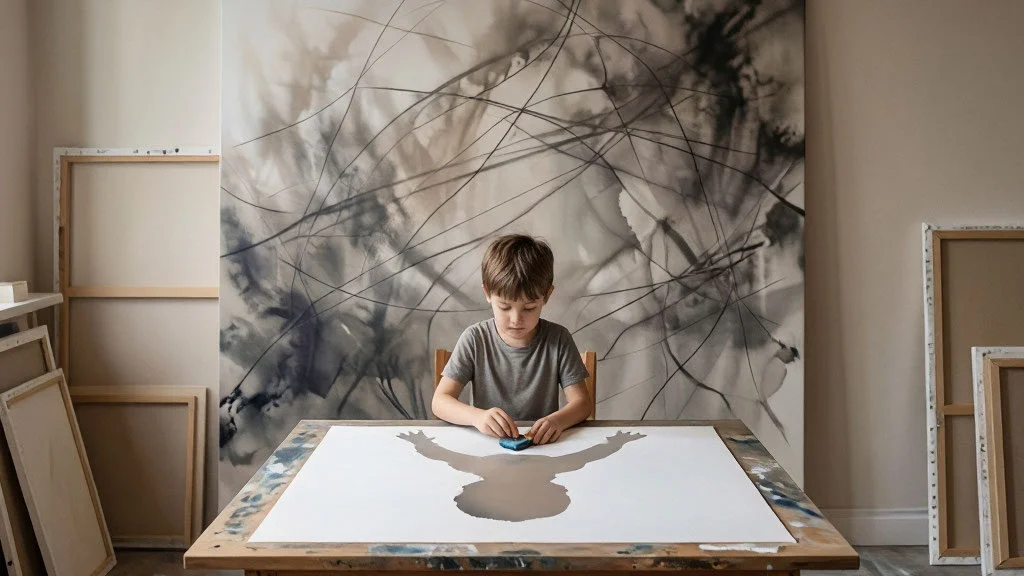


Traditional creativity pedagogy is built on deficit: you need to add more color, more detail, more meaning to fill an empty page. For a child with heightened anxiety, ADHD, or sensory overload, a blank sheet is not an opportunity but a threat. It demands immediate, chaotic expansion, which quickly leads to visual clutter, cognitive fatigue, and a sense of guilt over a “ruined” work.
Negative space design inverts this instinct. It teaches that in an era of excess, the scarcest and most valuable resource is emptiness. The artist’s main tool becomes not a generator (brush, pixel, polygon) but a filter (eraser, mask, transparency mode). Pedagogy is built on finding neurobiological calm through the surgical removal of visual noise.
The architecture of subtraction: from visual smog to a clean signal
The learning process begins not with a blank sheet but with a deliberately overloaded canvas. An AI designer generates “visual noise” — a dense, chaotic texture resembling a thick forest, boiling water, or dense urban development in fog.
-
Stage: Archaeology of form (Tool — Mask):
The child is not told, “Draw a cat.” They are told, “The cat is already here; it is simply buried under extra lines. Your task is to excavate it.”
Using the Lasso or Layer Mask tool, the child begins not by drawing a contour but by cutting away pieces of noise. This action has a low entry threshold and does not require shading skills. It is akin to meditative scraping or archaeological excavation.
Biomechanics: The movement of the mask across the screen is rhythmic. It engages the motor cortex in a mode of monotonous repetition, which physiologically lowers heart rate. Removing pixels provides immediate, clean feedback: “I made the space cleaner.” -
Stage: Calibrating silence (Tool — Eraser with variable hardness):
Once the rough form is found, the child moves on to details. Here the AI changes the physics of the digital eraser.
- If the child erases too aggressively (fast, nervous strokes), the eraser becomes “fragile” and begins to remove pieces of the main form. The system gives a tactile signal (tablet vibration) — “you are destroying, not cleaning.”
- When the child’s breathing (read via a wearable sensor) slows, the eraser becomes “soft” and velvety. It leaves behind a smooth gradient from black to gray, teaching the nervous system micromotor control. The child understands: to create ideal emptiness, you must become calm yourself.
- Stage: Birth from absence (Tool — Transparency and Light):
In negative space design, form is defined not by where paint is present but by where it ends.
The child learns to work with the Opacity slider. Instead of drawing a window, they make part of the wall 10% opaque. Instead of drawing light, they darken everything around the source until it “lights up” through contrast.
This teaches the prefrontal cortex to think in categories of relationships rather than objects. An anxious brain prone to catastrophizing (adding frightening details) learns that the brightest light is simply the absence of an obstacle before the sun.
The pedagogy of emptiness: the teacher’s role as corrector
In this paradigm, the teacher is not a critic of the result but a guardian of silence.
- They do not say, “Add shadows under the eyes.” They say, “Look at the forehead. There are too many events there. Remove three lines that do not carry information about form.”
- The teacher uses AI to analyze “attention density.” If a child spends five minutes erasing the same pixel (getting stuck, perfectionism), the system gently blurs the rest of the canvas, physically forcing the child’s gaze to shift to another area.
- The main compliment in this system is not “how beautifully you drew” but “how quiet it became in this corner when you removed the noise.”
Bioethical shift: from productivity to hygiene
Negative space design changes the metric of success. What is assessed is not the complexity of the final image but the Calmness Index — the mathematical ratio of remaining useful information to removed visual clutter.
For a child with anxiety, this becomes the first legitimate experience of “underfinishing.” They learn that work is finished not when there is no free space left on the page, but when removing the next line would make the image worse.
This is a transfer of the Zen Buddhist aesthetics of ma (interval) into a digital environment. The child discovers that their anxiety is often simply visual noise in their own perception. Design teaches them to be not an author who is forever proving something to the world, but a gardener who finds peace in simply pruning the excess, leaving light free to fall unobstructed.








Comments (1)
Идея сильная, но узкое место — обратная связь по дыханию: у детей датчики шумят от движения, и «хрупкий ластик» рискует наказывать за возбуждение вместо обучения регуляции, а Calmness Index легко станет новым баллом, которого тревожный ребёнок побоится не набрать. Для пилота логичен Яндекс Учебник: методисты, школы-партнёры и платформа, чтобы встроить упражнение отдельным модулем и собрать данные. Первый шаг — письмо в их образовательное направление с предложением пилота на двух школах и группе нейропсихологов. Как вы предлагаете валидировать индекс, чтобы он не превратился в новую шкалу «правильности»?