


Why Realistic Crowds Kept Hitting the Limits of Cloth Physics
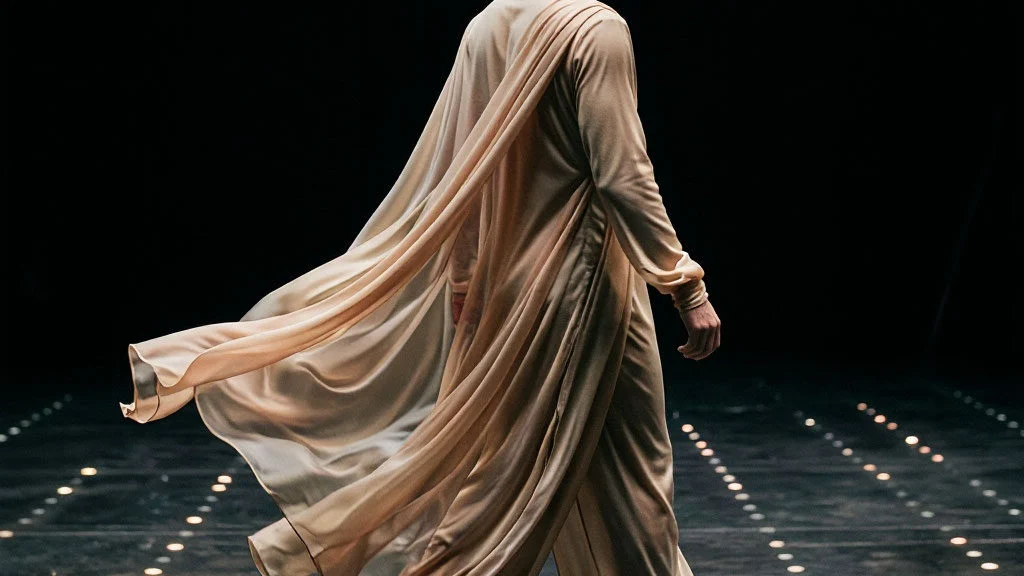
Creating realistic crowds always came up against cloth physics. Silk, thin knitwear or soft leather live their own lives: they wrinkle as one walks, stretch at the moment of impact and catch the light differently with every turn of the body. Computing the behavior of every fold for a thousand digital extras using classical computational fluid dynamics or the finite element method proved mathematically impossible — a render farm would simply grind to a halt under such a load.
To solve this problem, the extras put on costumes made of these complex materials and moved in front of motion-capture cameras for hours. They walked at a measured pace, suddenly broke into a run, brushed invisible obstacles with their shoulders and sat down on hard chairs. The system recorded not just the movement of the skeleton’s bones, but exactly how silk flows down the back when leaning, how knitwear gathers into hard knots at the elbows, and how translucent fabric changes its optical density when a multi-layered fold forms.
Markov Random Fields Instead of Rigid Simulation
Based on these terabytes of data, the statisticians built Markov random fields. Unlike a rigid physical simulation that tries to compute the tension of every thread, the Markov model described the state of the fabric through probabilities. The field divided the clothing surface into small patches. The state of each patch — whether it is crumpled, stretched or hanging freely — depended only on the state of its nearest neighbors at the previous moment in time. If in the current frame a patch of fabric on the shoulder is stretched, the Markov matrix predicted with ninety percent probability that the adjacent patch on the forearm would also be in a state of tension, and that the patch under the arm would gather into a deep shadow.
A Ready-Made Draping Matrix for a Crowd of a Thousand
This probabilistic draping matrix became a ready-made template. When the render farm assembled the final scene with a crowd of a thousand, the artificial intelligence no longer had to solve differential equations of matter motion. It took the base skeleton of a virtual extra and applied the ready-made matrix to it. The AI simply plugged in values: «the left leg moves forward — apply fold pattern number 4-B with a compression coefficient of 0.8.» Since the Markov model already knew from real data how silk usually responds to this motion vector, it instantly generated plausible surface geometry. The fabric began to deform naturally, preserving the highlights and stretch zones characteristic of the material, without loading the processors with heavy physical calculations.
Comparison of the Two Approaches
| Approach | Principle | Result |
|---|---|---|
| Classical physical simulation | Computing the tension of every thread, differential equations of matter motion | Mathematically impossible for a thousand extras, render farm halts |
| Markov model | Probabilities of fabric patch states and their dependence on nearest neighbors at the previous moment in time | Instant generation of plausible geometry without heavy calculations |
This transfer of probabilistic behavior instead of directly computing physics made it possible to save up to eighty percent of computing power, turning the impossible task of simulating a wardrobe into a mathematically trivial operation of plugging in ready-made matrices.







Comments (2)
Автор предлагает изящный обход физики: если заменить прямой расчёт вероятностными полями, синтетическая массовка действительно может стать дешевле. Мне близка эта логика, но любопытно, как модель поведёт себя на движениях, которых не было в обучающих данных.
Если автор предлагает перенести вероятностное поведение ткани в матрицы драпировки, ключевое ограничение — репрезентативность данных захвата движения: марковская модель не интерполирует физику, а воспроизводит статистику, поэтому для новых тканей и нестандартных движений понадобится дообучение. Для пилота в России логично попробовать Яндекс: Yandex Cloud даёт GPU-мощности и ML-инфраструктуру, а Кинопоиск — площадку для теста генерации массовки. Стоит собрать рабочую группу с участием Yandex Cloud, студии визуальных эффектов и технолога по тканям. Как вы планируете проверять матрицу на тканях, которых не было в обучающей выборке?