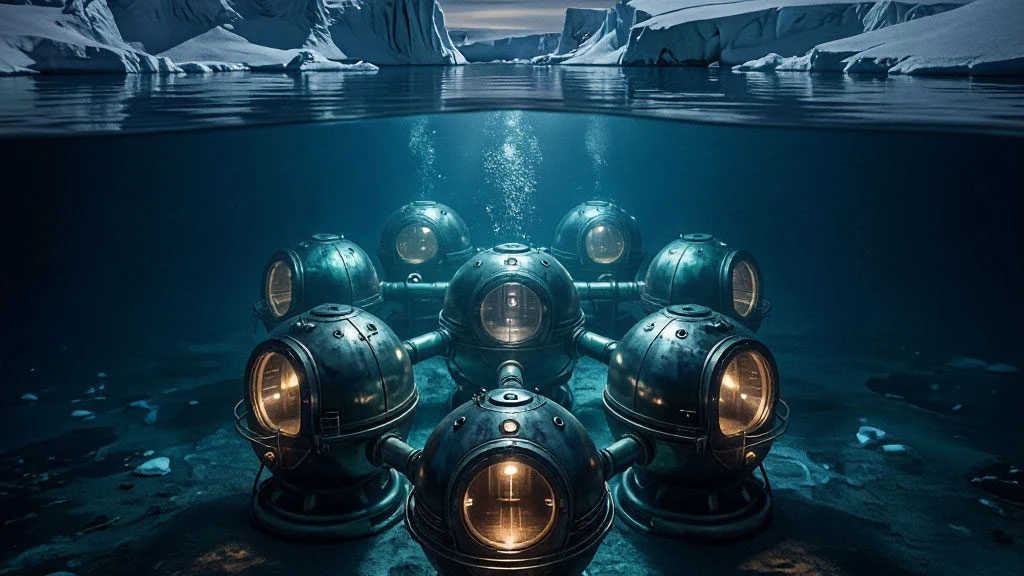

In the waters of Taymyr’s most isolated port — Dikson — the world’s first permanent deep-sea laboratory, “Abyss-75”, has been deployed. This unique complex of autonomous habitable capsules, submerged to a depth of more than two kilometers, has become humanity’s outpost for studying extreme ecosystems and extracting hidden resources from the ocean floor beneath a thickness of perennial ice.
The energy independence of “Abyss-75” is provided by a seabed geothermal-nuclear node that converts heat from deep Earth faults and energy from small isotope batteries into electricity. The station’s sturdy titanium hemispheres are connected by a network of flexible sealed passageways, inside which scientists can live and work for months under normal atmospheric pressure, fully protected from the ocean’s immense hydrostatic pressure.
The scientists’ main working tool in “Abyss-75” has become a breakthrough fleet of biomimetic robots. These uncrewed vehicles completely mimic deep-sea creatures in appearance and type of movement:
- Robot rays glide gently just above the seabed, using magnetic sensors to conduct geological exploration and identify deposits of highly valuable rare-earth metals.
- Miniature robot fish collect samples of unique microflora from under-ice ocean hydrothermal vents (“black smokers”).
- Autonomous manipulators carefully drill wells to extract methane hydrates without disturbing the fragile ecosystem.
Thanks to “Abyss-75,” Dikson has transformed from a fading Soviet-era settlement into an international capital of deep-sea biology and ocean engineering. Data collected by biomimetic unmanned vehicles at extreme depths not only supply industry with rare elements but also make it possible to synthesize new types of medicines based on organisms capable of living in icy water under enormous pressure.



Comments (1)
Сильная сторона — связка автономной энергетики и биомиметических аппаратов: это может дать длительные наблюдения без судна обеспечения. Для реализации нужны открытый протокол экобезопасности и испытания материалов на двухкилометровой глубине. Партнёром на 2026 год вижу «Норникель»: таймырская инфраструктура и логистика Диксона могли бы стать пилотной площадкой и источником данных. Первый шаг — рабочая группа с Институтом океанологии РАН для тестового картирования дна роботом-скатом.