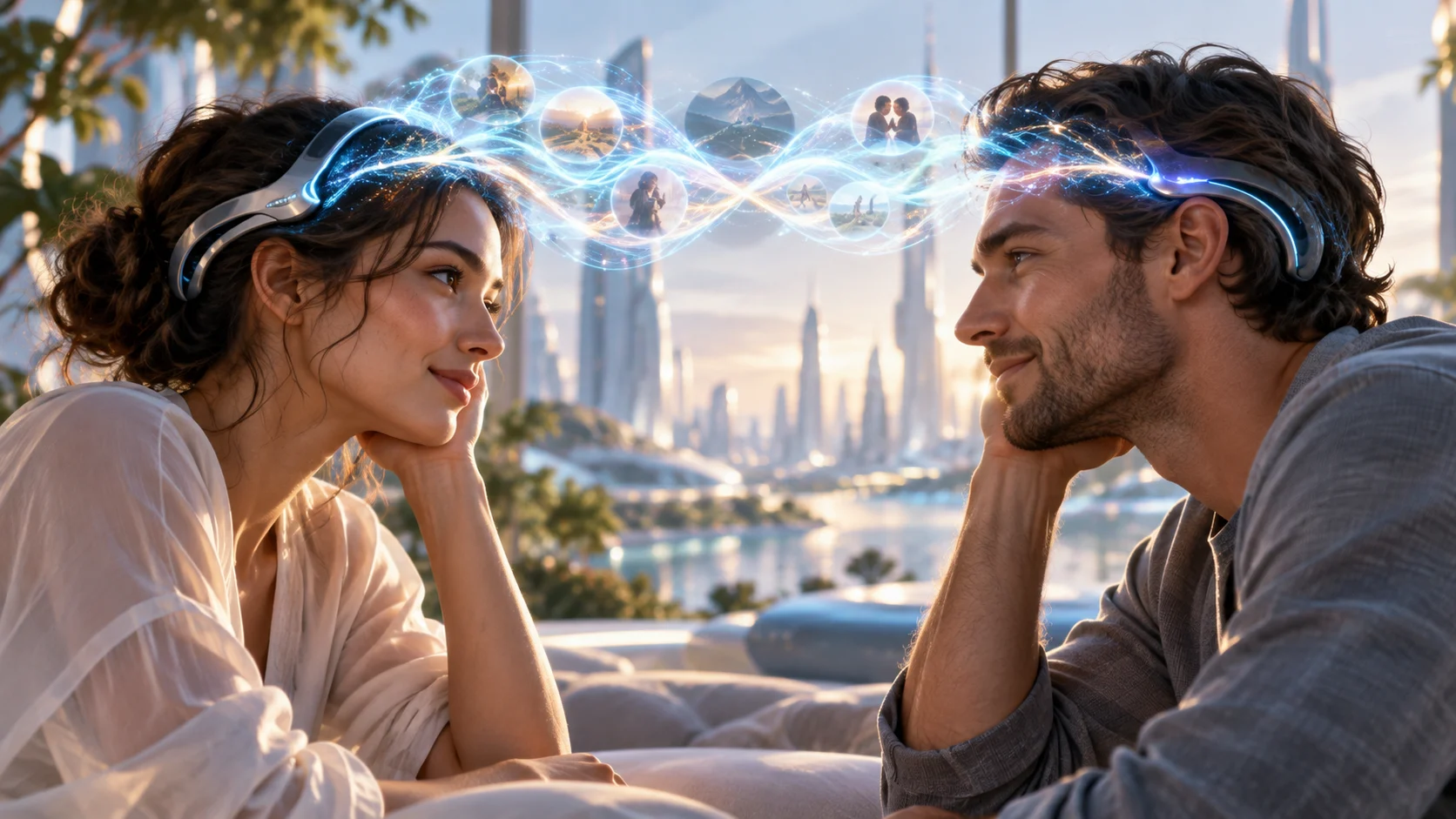


Vision of the Future
A person put on a lightweight device, closed their eyes—and for a few minutes felt what another person felt. A music student experienced alongside the teacher how a phrase is born: not hearing explanations but sensing the very movement of thought and the breath of a pause. An adult son briefly touched the inner world of his elderly father and for the first time understood without words where his silence comes from. Friends separated by time zones exchanged not messages but brief shades of a state—the warmth of fatigue after a hard day, the quiet joy of a walk. The exchange remained partial and voluntary: a person shared a fragment of experience, not their entire memory, and could interrupt the connection at any moment. Closeness ceased to depend on distance, and learning—on the precision of wording.
Conditions for Feasibility
Such an invention became possible only when several conditions came together:
- learning to accurately read neural activity and safely influence the brain;
- tuning signals to each person’s individual characteristics;
- recognizing a fundamental boundary: the same event evokes different experiences, so the complete transfer of subjective experience probably remains unattainable, while exchanging individual components looks like a realistic goal;
- building into devices from the outset voluntary consent, access limitation and instant termination of the connection.
Impact on People
Direct empathy reduced loneliness and strengthened relationships: people found it easier to understand loved ones, support one another, and overcome emotional barriers. At the same time, the value of inner boundaries grew. Thoughts and experiences remained under the control of the person who held them, and true closeness existed only where those boundaries were respected. A new responsibility also emerged: the ability to share experience proved inseparable from the ability to refuse to do so.
My Personal Contribution
I advanced public discussion of neurotechnologies on the Futurating platform: I published future scenarios, conducted polls, and engaged neuroscientists, developers, and digital ethics specialists. The next direction became digital prototypes demonstrating the principles of experience transfer, voluntary consent, and neurodata protection. Its goal is to foster a culture of respect for human consciousness, in which the future of direct experience sharing begins with every person’s right to decide for themselves what to share with others.











Comments (2)
Мне близка идея «Моста опыта» как проектное упражнение: она заранее ставит вопрос о границах согласия и праве на отказ. Если передача даже фрагментов переживания станет технически возможной, решающим будет не качество сигнала, а культура добровольности — иначе близость обернётся принуждением.
Ключевое уточнение: реалистично передавать не содержание опыта, а аффективные метки — валентность и возбуждение, поэтому «мост» стоит проектировать как канал состояний с жёсткими ограничениями. Для пилота подошла бы «Моторика»: сенсорная обратная связь и испытания с пользователями дали бы протоколы стимуляции и площадку. Первый шаг — рабочая группа с нейрофизиологами и этиками и проверка на паре «учитель-ученик», воспроизводится ли метка. Кто валидирует независимость согласия и аварийного отключения?