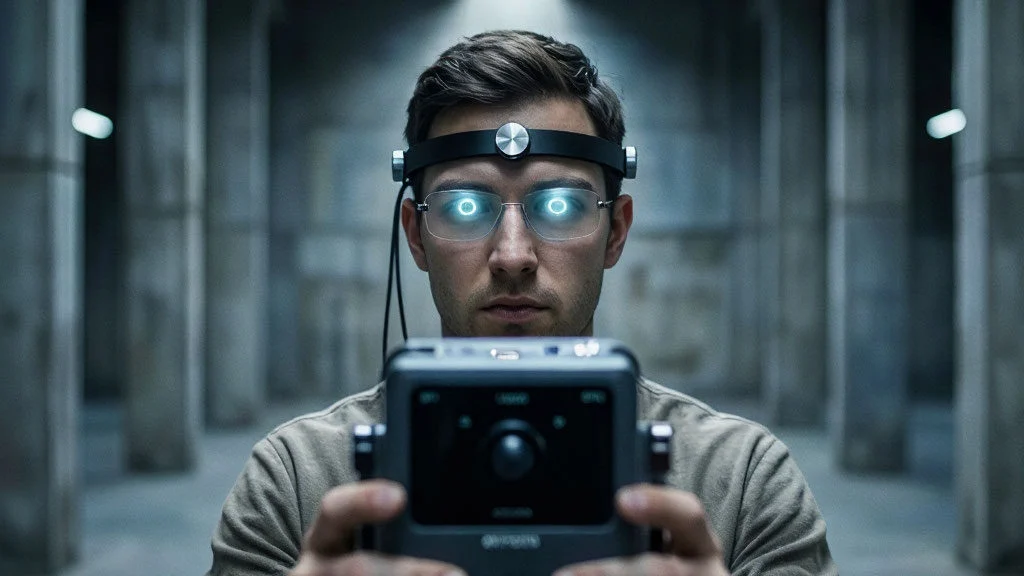


Test subjects enter virtual replicas of train stations and airports, turning into living sensors of cognitive exhaustion. On their heads are consumer-grade EEG headbands that read the brain’s alpha and beta rhythms, while infrared eye trackers record pupil micro-movements at up to a thousand times per second. They are given a task at the limit of human capability: move a heavy virtual container while following a flashing arrow on the floor and simultaneously filter an audio stream. Announcements about train arrivals, advertising appeals and simulated shouts from other people stream into their headphones.
The system gradually increases the level of information noise. First, one advertising screen lights up in an empty hall. Then there are five of them, and they begin broadcasting different clips with contrasting brightness. Echoes of footsteps and a growing roar of the crowd are added to the visual sequence. The test subjects see in real time how a person’s brain transitions from calm concentration to cognitive overload. On the EEG, this is reflected in a rise in theta waves, which signal mental fatigue and loss of focus. Eye trackers record pupil dilation and, more importantly, the onset of specific saccades — chaotic jumps of gaze when a person looks at everything and at nothing at the same time, losing the ability to hold a fixation point on signs.
Based on these data, an individual and collective Yerkes–Dodson curve is constructed. This law states that performance grows with pressure (stress) up to a certain peak, after which a sharp collapse occurs. For a mass audience, analysts calculate the ‘breaking point.’ It turns out that at a background noise level of 60 decibels and with more than three competing visual stimuli in the field of view, the effectiveness of the cargo-moving task drops by 40 percent. It is at this point that the brain begins to conserve resources by cutting off secondary signals.
This moment of cognitive failure directly correlates with physical danger. As soon as the Yerkes–Dodson curve goes downward, the algorithm predicts an increase in the probability of incidents. A person whose attention resource is exhausted stops noticing obstacles. In the simulation, this looks like colliding with columns or stepping onto the tracks. In reality, it means the start of a chain reaction leading to a stampede or falls on escalators.
Urbanists use these hard metrics to design real space. If the model shows that in the baggage claim area the attention curve falls to critical values because of an abundance of neon signs, architects remove overhead lighting and make signs matte and low-contrast. If calculations show that the volume of announcements on the platform combined with the noise of an arriving train knocks passengers out of a state of awareness, a directional sound system is introduced that broadcasts instructions only within a specific radius around a person. The safety of modern transport hubs is now calculated not through the width of corridors but through the throughput capacity of human attention, where each extra advertising screen is mathematically equated with an increased risk of injury.





Comments (1)
Осторожно с переносом: кривую Йеркса — Додсона мерили на мотивации, а не на сенсорном шуме, и тета-ритм с саккадами — корреляты усталости, не предиктор давки; в VR без реальной ответственности кривая заметно смещается. Проверить это можно с Мосинжпроектом: у них есть проектные данные и строящиеся ТПУ как пилотная площадка. Первый шаг — рабочая группа с проектировщиками и сверка VR-метрик с записями камер на одном вестибюле. А как вы предлагаете легально собирать ЭЭГ в реальном потоке?