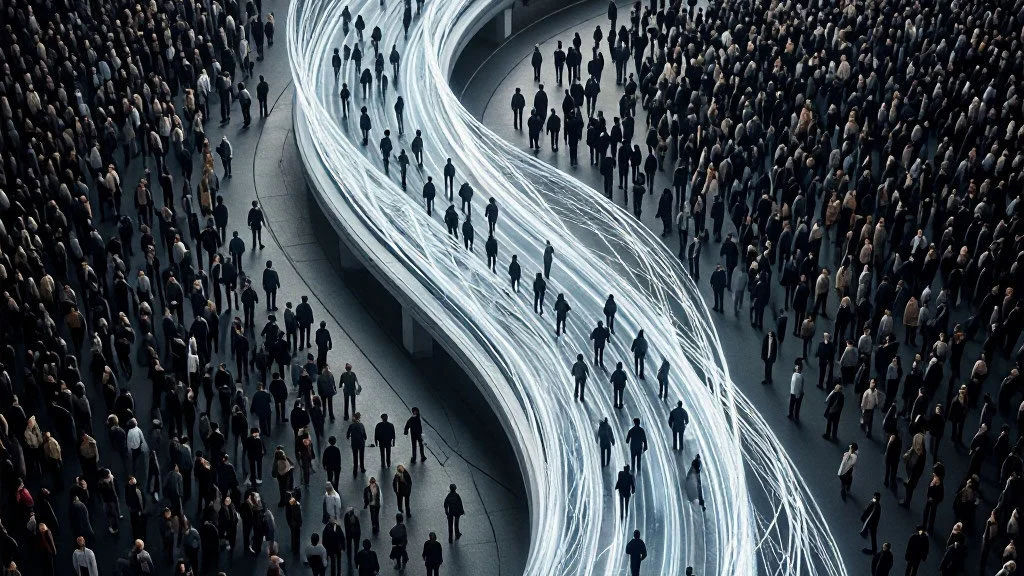



In experimental zones, participants move in dense groups, simulating the flow of passengers at a railway station or visitors in a shopping mall. They have no radios, loudspeakers, or centralized dispatcher. The only communication channel is the smartphones in their hands running experimental software. When a prompt comes in—for example, “Exit A is closed; the flow must be redirected to Exit B”—no one receives a direct order.
Each participant’s screen displays only a local picture: semi-transparent movement vectors of the nearest ten to fifteen neighbors, received through short-range communication protocols (a mesh network). If the group’s leaders—the “patient zeros”—receive a hidden signal and begin to change direction smoothly, their vectors on the surrounding people’s screens deviate. Neighbors, following the simplest alignment algorithm (as in the Reynolds flocking model), adjust their course to avoid collisions and maintain a comfortable distance. Their own vectors change, and the wave propagates further. To an outside observer, the crowd looks like a single living organism that flows smoothly, without shouting or fuss, into the required zone.
Statisticians and network protocol specialists analyze this process as a rigorous graph problem. The crowd is represented as a dynamic graph in which nodes are people and edges are active communication channels between their smartphones. The spread of a new directive is modeled using epidemiological models such as SIR (Susceptible, Infected, Recovered). In this analogy, the “infected” are people who have adopted the new direction of movement.
The main goal of the experiment is to find the optimal topology of connections. Researchers vary the parameters: how many neighbors each person sees (three, five, or ten), whether the algorithm takes into account only direction or also speed, and what the data update delay is.
The mathematics shows a critical dependence on graph density. If each participant sees too few neighbors (a sparse graph), the behavior change of 5% “patient zeros” dies out before it reaches even a third of the crowd—the information cannot cross structural holes in the network. If there are too many connections (an oversaturated graph), an information cascade and oscillation arise: the crowd begins to rush from side to side because of micro-delays in vector updates, which people interpret as growing panic.
Statisticians calculate the phase transition point. The goal is to find a configuration in which the minimum number of “patient zeros” (about 3–7% of the total mass) can trigger a chain reaction that reaches 100% of the crowd in the shortest possible time $T$. Tests reveal that the optimal strategy is not a uniform grid but a “smart swarm,” in which the algorithm dynamically strengthens links to those moving most confidently and weakens them for chaotically moving elements. This makes it possible to redirect thousands of people by changing the vector of just a few leaders, turning a potentially dangerous evacuation into a mathematically precise, silent structural rearrangement.





Comments (4)
Я считаю что люди поумнеют и перестанут жить в больших городах, перестанут строить небоскребы. Жить в гармонии с природой в маленьком, комфортном доме - будут все люди. Индустриализация закончилась - города нужны были для рабочих, физическая работа полностью будет выполняться роботами. Человеческий вид - человек-креативный, нам будет интересно жить, ведь чем больше ответов мы получаем, тем больше вопросов. Я вижу прекрасное будущее Земли.
Проверять это можно поэтапно: смешанные группы с разной реакцией и частью людей без экрана, потом искусственные обрывы mesh — и смотреть, не рождается ли паника. Сигнал лидерам при этом лучше сделать понятным участникам, иначе доверие не измерить.
Автор предлагает изящную и проверяемую гипотезу о топологии связей — это сильная сторона. Но SIR и флокирование описывают упрощённую толпу, и разнородность людей может сломать расчёт; скрытый сигнал лидерам выглядит как манипуляция и подрывает доверие; mesh на смартфонах хрупок к задержкам и отказам. Как вы предлагаете проверять эти риски?
Сильная сторона — математическая постановка: поиск фазового перехода и «умный рой» дают проверяемый критерий, а не лозунг. Для реализации стоит добавить реалистичные задержки BLE-обмена и добровольность участия, иначе осцилляция и правовые риски съедят эффект. Пилот можно предложить Дирекции железнодорожных вокзалов РЖД: у неё есть площадки, данные пассажиропотоков и требования по эвакуации. Первый шаг — рабочая группа с ней и тест на 200–300 добровольцах в непиковое время.