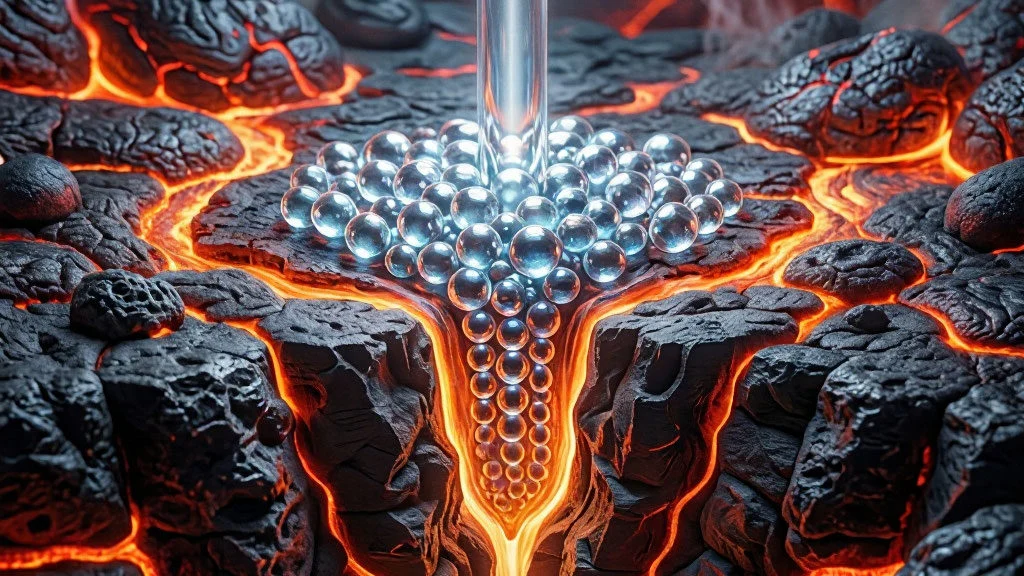


Biointegrated sensors open access to data from «hell» — zones where ordinary electronics cannot be lowered. In acidic horizons where steel dissolves, or in ultra-deep formations with heat above two hundred degrees, silicon chips and lithium batteries fail within minutes. Conventional measurement there is blind. The solution is to use engineered life as a measuring instrument.
Engineered bacteria, encased in protective microcapsules of ultra-strong silica or zirconium, are pumped into the formation. These tiny organisms are designed as living gauges. Their metabolism is rewired so that when external conditions change, their internal chemistry changes as well. For example, for every hundred-atmosphere increase in pressure or every ten-degree rise in heat, the bacterium begins producing a special light-emitting protein. When heavy metal ions are detected or water salinity changes, the wavelength of its glow changes.
Colonies left in the borehole become a distributed smart network inside the rock. They require no external food, drawing energy from the environment itself, and can live there for decades.
Transmission of information to the surface happens without wires or radio, which fade in the rock. A fiber-optic light guide is installed inside the borehole or through an observation hole. A beam from above travels down, illuminating the bacterial colony. The bacteria respond with their own light response — a faint glow. The fiber-optic light guide catches this return beam and delivers it to a light counter at the surface.
The machine at the surface reads the color of this glow. From the color shift and light intensity, the real-time system builds a map: «In block A, heat reached 210 degrees, pressure reached 1,200 atmospheres, and hydrogen sulfide flow has been detected.»
This turns the borehole from a blind pit into a live nerve node. The geologist receives information about the chemistry and nature of the formation at points that were previously completely closed off. If the bacteria detect a dangerous pressure increase, the system can automatically release kill fluid.
In the future, such living gauges will multiply themselves. Upon entering a zone with suitable conditions, the colony will divide, spreading on its own through the most difficult fissures and holes, providing full oversight of the entire basin volume without the need to lower any instruments there. This fusion of engineered life and sound will make the subsurface completely clear to the observer.



Comments (1)
Идея с бактериями-мерниками сильна тем, что снимает главное ограничение — не заглянуть в агрессивный пласт без электроники. Но для реализации нужна калибровка: сверять свечение с эталонными датчиками и продумать инактивацию колоний после замера. Пилот логично предложить «Татнефти» — у неё есть действующие скважины, опыт микробиологических методов повышения нефтеотдачи и полигон для испытаний. Первый шаг: собрать рабочую группу с её НТЦ и поставить опыт на одной обсервационной скважине параллельно с оптоволоконным DTS, чтобы расшифровать цвет свечения.