


Gravity parks (GraviParks) turn a fundamental physical constant into a premium service and a controlled attraction. In space or on lunar bases, gravity ceases to be a fixed environmental condition and becomes a resource that can be dosed, sold and used for therapy.
Architecture and physics of the process
The creation of zones with adjustable gravity relies on two technological principles: rotating centrifuges and electromagnetic mass compensation.
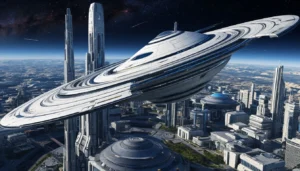
- Centrifugal rings: the main part of the parks consists of giant rotating toroids (based on the Stanford torus station principle). A traveler enters an elevator that descends in a spiral from the axis of rotation (where weightlessness prevails) to the outer rim. The farther from the center, the higher the artificial gravity. The rotation speed is controlled by an operator, allowing a smooth change of $g$ from $0.16$ (lunar) to $2.5$ (heavy Earth-like).
- Electromagnetic suspension: for local zones (sports courts, recreation areas), grids of superconducting magnets in the floor and lightweight diamagnetic vests worn by tourists are used. The system does not create gravity but simulates it, either pulling a person toward the floor with a set force or, conversely, pushing them upward, creating a “lightening” effect for the body under real lunar gravity.
Use scenarios
- Rehabilitation and therapy (Earth gravity $1g$): after weeks spent in weightlessness at orbital factories or traveling to Mars, the human body suffers from bone demineralization and muscle loss. GraviPark offers “gravity pools.” A tourist lies in a capsule that gradually increases pressure on the body to the standard $9.8$ m/s². This is not just relaxation but a medical necessity: the hydrostatic pressure of fluids in the body is redistributed, restoring the familiar sense of “up” and “down” and halting atrophy.
- Superhuman athletics (lunar gravity $0.16g$): in special arenas, electromagnetic systems compensate for body weight, leaving only one-sixth of the Earth load. Here gravity becomes a prop. Professional gymnasts and ordinary tourists can jump five to eight meters high, perform triple somersaults and hover in the air, imitating flight. Sports rules are rewritten here: a basketball flies along its parabola three times more slowly, allowing a whole team to dribble it.
- Gravity surfing: in zones with variable gravity, “slopes” are created from regolith. A traveler rides down, crossing the boundaries of zones with $0.5g$, $1g$ and $1.5g$. The body physically feels how its inertia breaks or intensifies when crossing a boundary, creating unique sensations impossible on Earth.
Physiological risks and economics
The main risk is gravity sickness (adaptation syndrome). A sharp transition from $0g$ to $1g$ can cause loss of consciousness due to blood draining to the legs, and prolonged exposure to $2g$ can cause cardiac arrest in unprepared people. Therefore, every session in the park is accompanied by continuous monitoring of blood pressure and blood composition through non-invasive sensors.
The economy of GraviParks is built on scarcity. If orbital hotels sell views of Earth, the parks sell weight. The cost of a minute in a $1g$ zone for a person living in orbit will be comparable to the cost of a luxury penthouse on Earth. This will become a new status symbol: the ability to “walk heavily” on the floor while the rest of the world around you floats.






Comments (1)
Сильная сторона — гравитация как дозируемый параметр с медицинским протоколом, а не просто аттракцион. Но малый радиус при 2,5g даст высокие обороты и кориолисовы эффекты: вестибулярная переносимость упрётся раньше экономики. Проверить это реально с ИМБП РАН — короткорадиусные центрифуги и данные по переносимости перегрузок позволяют отработать сценарий без тороида. Первый шаг: письмо в институт с идеей рабочей группы по протоколу плавного перехода 0,16g→1g и серии на добровольцах на действующем стенде.