

Between 2026 and 2036, Russia is moving from an extensive model of concentrating resources in 15–20 metropolitan areas to a strategy of building an “architecture of a distributed country.” Geopolitical challenges, the need to ensure technological sovereignty, and the development of the resources of Siberia, the Arctic, and the Far East make further demographic compression of the country around the Moscow and St. Petersburg agglomerations impossible. The state is betting on a network of 100–150 anchor settlements. However, the main mistake of past programs for developing small territories was the attempt to transplant a truncated model of metropolitan life onto provincial soil. The architecture of the 2030s proceeds from a fundamentally different paradigm: an anchor city is not a scaled-down copy of Moscow but a unique physical interface integrated into the federal digital ecosystem.
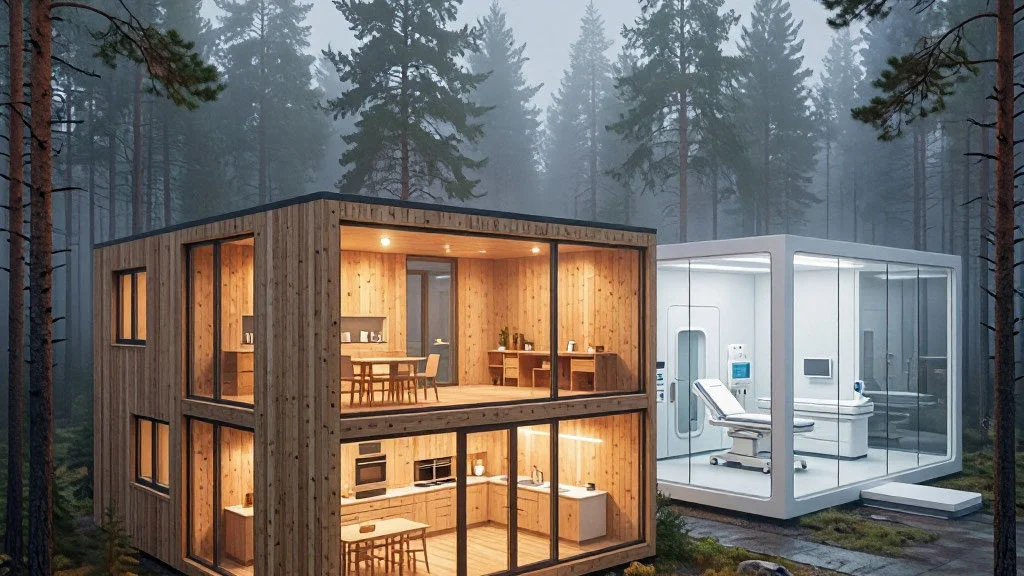
The social architecture of a distributed country is built on the principle of “abundant digitalization with ascetic physical infrastructure.” Given a shortage of qualified personnel—narrow specialists such as surgeons, rare engineers, and IT architects—the physical volume of buildings ceases to be a measure of environmental quality. A standard district hospital in a city of 50,000 people no longer tries to accommodate every narrow specialization. Instead, it is designed as a high-tech terminal. Its architecture is a sterile, minimalist cube with an ideal microclimate, intended for telemedicine. The huge funds that would previously have gone into building and maintaining hundreds of square meters of resident doctors’ offices are redirected toward creating communication channels with signal latency of less than 10 milliseconds and purchasing robotic manipulators. The local paramedic beside the patient becomes the hands and eyes of a professor from the National Medical Research Center. Architecture here serves the main task—providing ideal ergonomics for this physical intermediary by eliminating any vibration, extraneous sound, and visual clutter.
The same principle applies to education and culture. A school in an anchor settlement is designed not as a box with classrooms but as a campus with hybrid auditoriums. Its physical center is not the gymnasium but a transformable amphitheater-studio from which children connect to MIPT lectures or Russian Museum lessons in ultra-high resolution. Architecture compensates for geographic remoteness through the effect of presence: auditorium walls are covered with seamless screens, and surround-sound systems create an acoustic illusion of being in a metropolitan hall. At the same time, the school’s recreation areas, which open onto a real rather than virtual landscape—taiga, tundra, or the Volga floodplain—are designed as digital-detox zones where architecture works with natural materials and tactility.
Residential architecture in a distributed country rejects both the panel five-story building and the high-rise “human anthill.” The response to a harsh climate and a shortage of labor is modular timber construction (CLT panels) and the creation of autonomous micro-apartments of increased density, united by shared “social boilers.” The architecture of an apartment building now includes large, heated communal spaces on the ground floors—shared kitchen-dining rooms, laundries, workshops, and playrooms. This makes it possible to radically reduce the area of individual apartments to 20–25 square meters without losing quality of life. Physical housing becomes a capsule for sleep and personal hygiene, while all social life is moved into a shared, architecturally considered zone, which solves the problem of loneliness and forms new neighborly connections.
The transport architecture of small towns is also undergoing a revolution. Instead of widening roads for private cars, which young people use to escape to megacities, a network of dedicated lanes for unmanned logistics capsules and light rail is being designed. Bus stops cease to be places for waiting in the wind; they are designed as warm info-hubs with storage lockers, from which a cargo drone will pick up a parcel and deliver it directly to an apartment door.
The main challenge of deurbanization is retaining young people. Architecture addresses it by creating “social elevators without territorial restrictions.” In anchor cities, federal centers for extreme sports, open server farms for gamers with zero ping, and technology parks with residencies of major corporations are being designed. The space around them is styled in a high-tech aesthetic that contrasts with the historical or natural surroundings, creating a visual magnet for Generation Alpha.
By 2036, the success of the architecture of a distributed country will be measured not by the volume of housing commissioned but by the zero gap in the quality of public services between a resident of the capital and a resident of Kodinsk or Verkhnyaya Salda. The physical environment will cease to be a factor pushing people out of the regions. It will become a reliable, technologically advanced, and aesthetically attractive shell for life, where remoteness from Moscow is compensated by instant access to the country’s best intellectual resources, and the harshness of the climate by absolute architectural comfort and safety.





Comments (2)
Продуманный целостный образ! Полностью поддерживаю!
Идея с «избыточной цифровизацией при аскетичной физике» рабочая, но узкое место — эксплуатация: телемедицина с задержкой менее 10 мс требует локальных ЦОДов и персонала, которого в опорных пунктах нет. Для пилота модульного жилья можно привлечь «Сегежа Групп»: их CLT-панели дадут серийность и логистику в Сибири. Первый шаг — рабочая группа с региональным минстроем и проверка на одном проекте, как квартиры 20–25 м² с общими кухнями проходят нормы. Вопрос: кто оператор цифровой инфраструктуры опорного города — регион или федеральный интегратор?