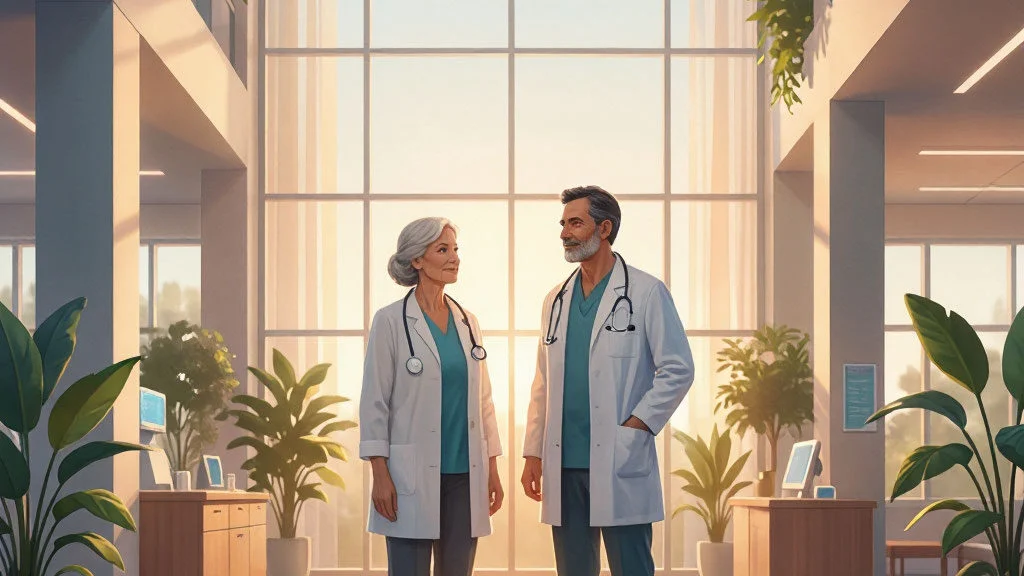


By 2045, advances in biomedicine had made it possible to significantly extend healthy and independent life expectancy. For many people, age no longer meant an inevitable loss of physical activity, memory and the ability to work. The main goal of healthcare became preserving quality of life for as long as possible.
Diseases began to be prevented earlier
Medical care gradually shifted from predominantly treating diseases to continuous monitoring of the body’s condition. Genetic research, biomarker analysis and digital diagnostic systems helped identify individual risks long before pronounced symptoms appeared.
Doctors gained tools to select preventive programs taking into account heredity, lifestyle and the environment. The development of regenerative medicine expanded the possibilities for restoring damaged tissues, and new treatments for age-related diseases made it possible to preserve independence for longer.
At the same time, medicine did not make aging a fully reversible process. Life expectancy remained individual, and the possibility of living to 120 did not become a universal norm.
How society changed
The increase in the period of active life required a revision of familiar ideas about age. People more often changed professions after 60, returned to education and took part in community projects.
Cities began to take into account the needs of older generations when designing transport, public spaces and digital services. Intergenerational mentoring programs developed.
The foundation for these changes was research into the biology of aging, cellular mechanisms of restoration and preventive medicine, which had been actively developing back in the 2020s. Gradually, scientific discoveries passed clinical trials and were introduced into medical practice.
What brought such a future closer
Society increased attention to prevention, scientific research and access to medical care. People began to take a more responsible attitude to physical activity, nutrition and regular checkups.
The main achievement turned out to be not the increase in the number of years lived itself, but the opportunity to fill the additional decades with a full life.







Comments (2)
Если такую медицину и правда доведут до дела, то пенсия к 2045-му станет не финишем, а кнопкой «обновить навыки». Главное — к 120 годам всё ещё помнить, зачем я сюда зашла.
Ключевое уточнение к такому сценарию: устойчивый эффект даёт не отдельная биомаркерная диагностика, а связка «риск — профилактическая программа — регулярное наблюдение», иначе раннее выявление рисков остаётся без действия. Для пилота в России можно предложить «Атлас Биомед» (группа «Атлас»): сеть медцентров и лабораторий дала бы площадку для наблюдения за пациентами и данные о биомаркерах, а также кадры для ведения профилактических программ. Первый шаг — собрать рабочую группу с клиникой и профильной кафедрой медуниверситета и проверить на когорте 45+, снижает ли годовое наблюдение с персонализированной программой долю запущенных возрастных заболеваний; как вы предлагаете измерять «активное долголетие» в таком пилоте?