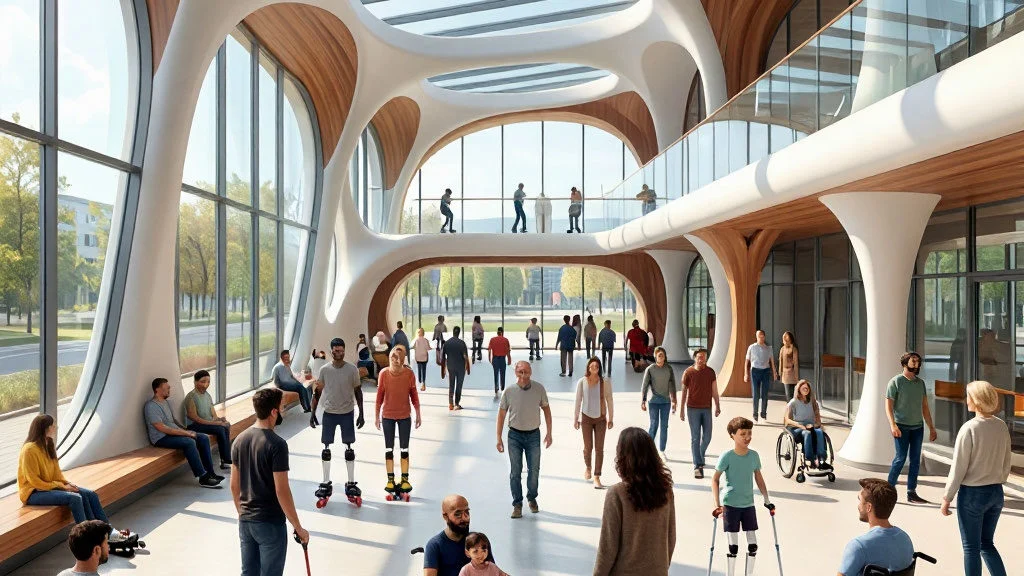



By 2040, society had become more cautious about attempts to derive a single image of the ideal human being. The development of biotechnologies and digital systems for assessing capabilities did not lead to a common standard of personality. On the contrary, individual differences came to be seen as a normal basis for human development, not as a deviation from a mandatory model.
Diversity no longer stood in the way of development
In education and professional training, people began to pay closer attention to the different ways in which abilities manifest. Exam results, physical data and automated assessments were supplemented by observation of motivation, experience and learning dynamics. This allowed people to develop along different trajectories without constant comparison to a single ideal.
In medicine, health-support technologies continued to improve, but their task became expanding human autonomy rather than mandatory conformity to an external standard. Discussions of new methods included questions of consent, accessibility and the right to refuse intervention.
The meaning of this approach was discussed on 13 November 2026 at the III International Symposium “Creating the Future”. In a special episode of the show “The Sofiko Challenge” with the participation of the Vyzov Foundation, Konstantin Severinov said that people will remain different as science develops, and that the very idea of an ideal will change.
The right to be different became a practical principle
To move from an attractive formula to everyday practice, schools revised their criteria for success, employers developed different ways of assessing skills, and technology developers checked whether algorithms reinforce existing biases.
At the same time, abandoning a single ideal did not mean abandoning high goals. People continued to strive for mastery, knowledge and achievement, but gained more freedom to choose their own path and assess progress relative to their own capabilities.
Public discussions raised questions that had previously been avoided: who defines the norm, who benefits from a particular standard, and what happens to people who do not fit it. Such conversations helped make the rules fairer.
Contribution
ANO “Image of the Future” on the Futurating platform gathered different visions of the human of the future. The authors of the postulates described desired changes, and participants rated their attractiveness, likelihood and possible personal contribution. The discussions helped identify contradictions between technological progress and human freedom before such decisions became widespread.








Comments (1)
Отказ от единого идеала не отменяет критериев, а требует многомерной валидированной оценки — иначе алгоритмы просто переупакуют прежнюю норму. Если идею реализовывать, для пилота подойдёт «Северсталь»: площадка и данные о разных траекториях сотрудников помогут проверить, как оценка учитывает мотивацию и динамику, а не только тест. Первый шаг — рабочая группа из HR, методологов и разработчиков на одном подразделении. Вопрос: кто валидирует критерии и как убедиться, что модель не воспроизводит старый стандарт?