Humanity has turned its attention beyond Earth, and a veritable «gold rush» has swept across the entire Solar System. Countless technological and engineering «miracles» are now possible even in open space, driven by the rapid development of AI, which is becoming dominant in planetary and interplanetary governance.
On Mercury, colonist settlements constantly move around the equator along giant rails at the planet’s rotation speed, so as to remain always in the «terminator» zone (the day-night line separating the illuminated (bright) part of a celestial body from the unilluminated (dark) part). This ensures that the Sun never fully rises above the horizon, thereby maintaining optimal temperature and brightness.
On Venus, the first phase of large-scale terraforming has already begun. Automated ships have been sent to water-rich comets, redirecting them into the planet’s upper atmosphere, while genetically engineered extremophile bacteria are being dispersed across the surface. Because of its much denser and more hostile atmosphere, this process is happening far more slowly than on Mars. Nevertheless, many people have achieved practical immortality, and human activity is becoming increasingly oriented toward long-term prospects. There are already citizens buying land on the surface of Venus in preparation for lives lasting centuries and millennia.
Earth’s Moon is the most densely populated of all the colonies. Millions of permanent residents currently live there. Entire cities have grown up around the original Apollo landing site. Large numbers of citizens are involved in expanding infrastructure and technological research.
Mars recently declared its independence from Earth. Its surface is dotted with domed towns and crisscrossed by super-high-speed automated rail transport networks. The terraforming effort is on schedule, and several giant orbital mirrors are already operational.
Hundreds of asteroids are currently being mined. Great advances in nanotechnology and related fields are aimed at using every atom of asteroids, leaving nothing unprocessed. Precious metals are collected for industrial use, while volatile substances, such as water, can be delivered wherever they are needed. Some planetoids are now riddled with mines and quarries, and their surfaces are being turned into enormous power stations and homes to scientific stations.
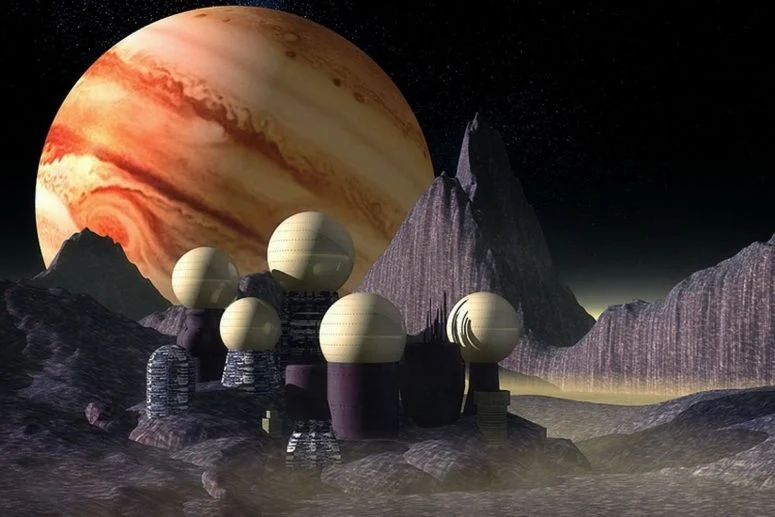
Meanwhile, Jupiter is receiving a steady influx of builders—led by cyborgs and non-biological intelligences, including some made of 100% nanotechnology. These individuals are better adapted to radiation belts and harsh environmental conditions. While planets are used for extracting metals, minerals, and water ice, gas is mined on Jupiter. Floating cities and giant resource-processing plants are beginning to appear in its upper atmosphere.
A similar situation exists in the Saturn system. Its largest moon, Titan, now has a permanent base, while Enceladus has great potential as a future source of water for the Solar System. Saturn’s rings now feature luxurious hotels orbiting near them, offering a breathtaking view of the planet. Guests can step out into open space and drift among the slowly moving ice fragments.
Even on the distant planets Uranus and Neptune there are gas extractors—although development is progressing somewhat more slowly because of the distance, as communication and logistics are rather burdensome.
Pluto and the Kuiper belt are still ignored from the perspective of commercial development, but uncrewed probes have now thoroughly catalogued them, paving the way for future exploitation and settlement.
The number of citizens wishing to travel to neighboring star systems is growing exponentially.
References:
This concept was featured in Blue Mars, by Kim Stanley Robinson
Colonization of the outer Solar System, Wikipedia



Comments (0)