When thinking about the future, it is important to understand that technological forecasts are often inaccurate, and most popular scenarios are either fiction or a reflection of current trends rather than real breakthroughs. However, if we take a systematic approach to analysis, we can identify several key areas that will determine humanity’s development over the next 50 years.
In the next 10–15 years, the world will see not so much a technological breakthrough as a reassembly and optimization of existing technology packages. It will be a time of localization, autonomization, and revival of old industrial and post-industrial technologies. No breakthrough discoveries should be expected before 2035—the main task will be to learn how to manage technological degradation and efficiently use available resources.
By mid-century, the sixth technological paradigm will begin to take shape. Its foundation will be technology packages such as:
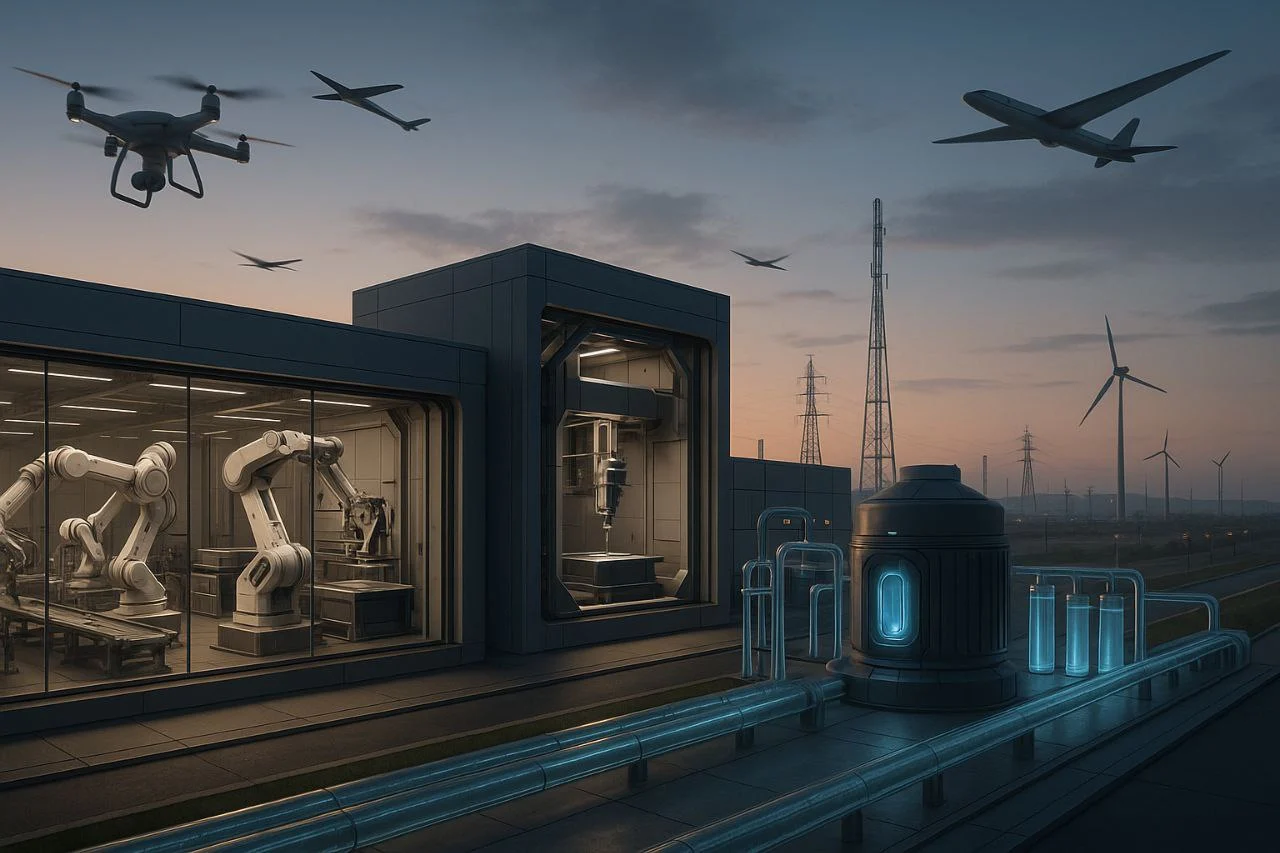
— Robotics and unmanned manufacturing — industrial robots controlled by artificial intelligence will enable flexible production, where a single plant can produce a wide range of products without the need to build separate lines.
— Additive technologies (3D printing) — large-scale adoption of industrial 3D printing from various materials, which will compress production cycles and require new engineering competencies.
— Nuclear technologies — development of a closed nuclear fuel cycle, small modular reactors, and nuclear engines, including for spacecraft.
— Recycling and closed-loop industrial systems — water treatment, closed production cycles, minimizing emissions, and efficient resource use.
— Geotechnologies — managing precipitation and climate, searching for water and mineral deposits at great depths, and full spatial monitoring using drones.
These technologies are already partly implemented or are at the stage of engineering challenges that do not require fundamental scientific breakthroughs.






Comments (0)