
Three centuries ago, humanity made a huge leap forward thanks to the development of quantum computing technologies. This breakthrough led to the formation of completely new educational disciplines built on the principles of quantum logic. During this period, the foundations of future education were laid, radically different from the traditional approach.
Before the advent of quantum education, learning was a linear process of knowledge transfer, occurring sequentially and gradually. However, with the development of quantum technologies, the situation changed radically. New ways of perceiving and assimilating information emerged, where classical ideas about causality, time, and even the very nature of reality turned out to be outdated.
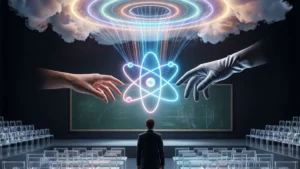
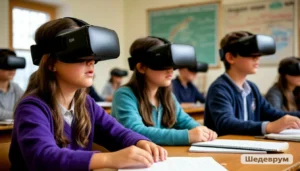
One of the key innovations was the use of quantum environments for modeling complex processes and phenomena. These environments allowed students to immerse themselves in virtual worlds where they could exist in multiple states of understanding of the same concept simultaneously. This approach significantly accelerated the mastery of material and expanded the possibilities of human cognition.
In addition, the concept of collective consciousness emerged, associated with the idea of ‘entangled-state learning’. This concept involved interaction between students in such a way that each group member influenced the overall level of understanding of the entire group. Thus, solving super-complex problems became possible through the combined efforts of many minds working synchronously and coherently.
These changes led to the emergence of a new type of educational process, which came to be called ‘nonlocal learning’. This meant that knowledge was no longer transmitted individually to each student, but arose spontaneously and simultaneously among all participants in the learning process. This form of learning allowed humanity to solve problems previously considered unsolvable and to achieve incredible successes in science, technology, and culture.
Thus, three centuries later, we can confidently say that the development of quantum education and nonlocal learning has become one of the most important factors in human progress, determining the future of our civilization.






Comments (1)
Да, эффект «сотой обезьяны», конечно должен действовать и в человеческом сообществе. У обезьян заметили, а у людей пока не исследовали. Скоро обнаружат. И теория «нелокального обучения» обретёт экспериментальное подтверждение.