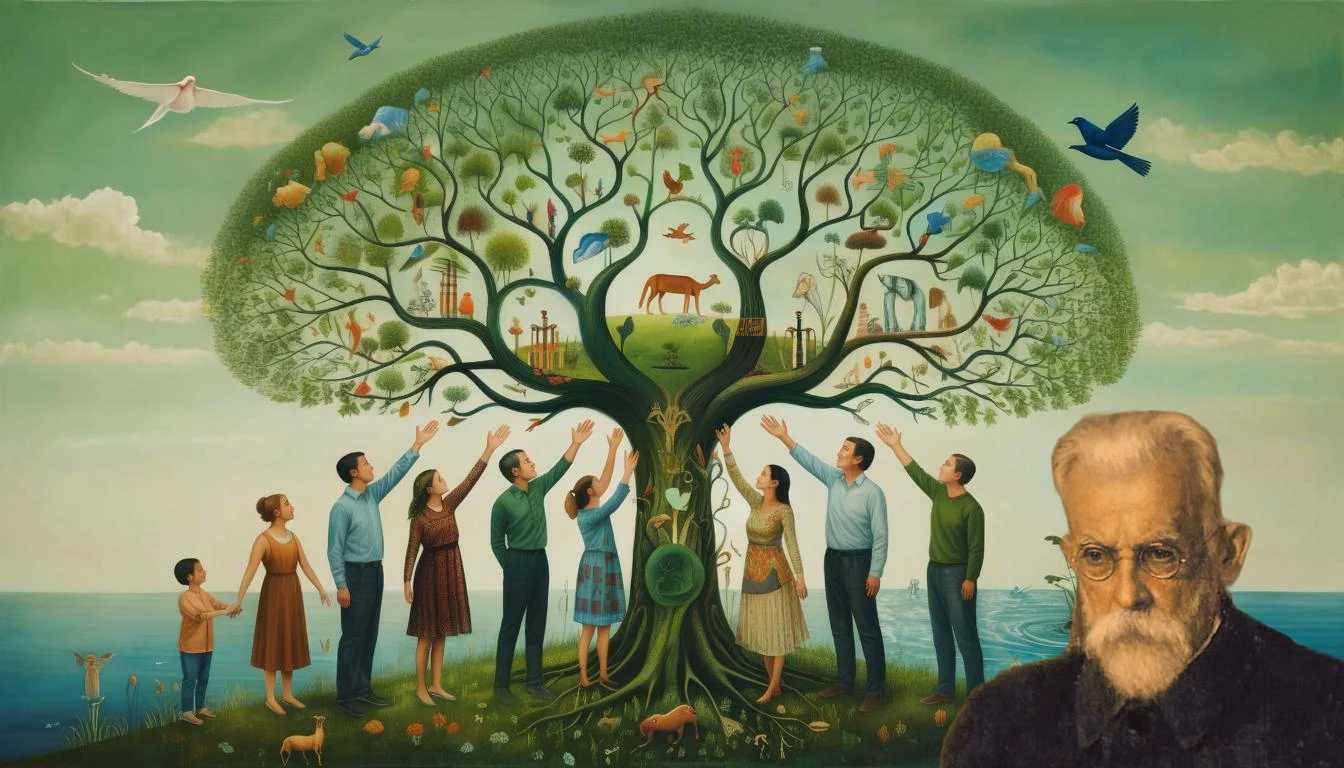
We continue to publish the legacy of the great thinkers of the past, in which they saw a bright prospect—but to achieve it, we must reconsider our attitude toward ourselves and the world around us. Vladimir Ivanovich Vernadsky, who possessed a tremendous gift of foresight, left us his teaching. Together with AI, the Futurating project reinterprets and expands his theses. For example, this one: “Humanity is inseparable from the biosphere; it is its natural part. The future is possible only through understanding this unity: human well-being directly depends on preserving the integrity of the biosphere.”
Vladimir Ivanovich Vernadsky understood the biosphere not simply as a “habitat” or the sum of living organisms, but as an integral, dynamic, and self-regulating geological shell of the Earth, where all components—rocks, water, air, living beings, and humans—are connected by a continuous cycle of matter and energy. In this system, humanity is not an outside observer or conqueror, but just as integral and naturally emerged a part as the forest, ocean plankton, or soil bacteria. We are shaped by the biosphere, our bodies consist of its elements, and all our life processes, from breathing to nutrition, are biogeochemical processes.
However, the uniqueness and at the same time the greatest danger of humanity lies in the fact that, while remaining part of the system, it has acquired, thanks to reason and science, power comparable to geological forces. And here the second proposition of the thesis becomes key: awareness of unity. The paradigm of “man against nature” or “man as the master of nature” turns out to be not only erroneous but also deadly dangerous. By disrupting the integrity of the biosphere—cutting down forests, polluting oceans, changing the climate, and destroying biodiversity—humanity is like an organism that, having imagined itself independent, began to destroy its own organs and life-support systems. The planet’s lungs, its water filters, climate stabilizers—all these are functions of the biosphere, and their degradation will inevitably strike at the well-being and very existence of human civilization.
Thus, this statement is a call for a deep ecological rethinking of our place in the world. The future is possible not through technocratic isolation from nature in artificial capsules, but only through co-evolution—the joint, harmonious development of humanity and the biosphere. Sustainable development, biodiversity conservation, closed production cycles—all these are practical consequences of understanding that we cannot be healthy on a sick planet. The integrity of the biosphere is not an abstract “love of nature,” but a fundamental condition for our survival and prosperity, the main imperative for all future generations.
Image generated by Shedevrum








Comments (1)
Если кто-то использует в речи слова «Окружающая среда», то это признак непонимания сути! Это ложное разделение на Я и не Я. Для тебя и меня нет никакой «окружающей среды», это всё ты и я. Когда кто-то говорит «окружающая среда», он слишком высокомерен, по сути говоря: «Я и планета». Нет, мой друг, ты и есть планета! Жизнь едина! Антропоцентризм в корне неправ! The End of Anthropocentrism: 3 Rules of Robotics Adapted for Humanity