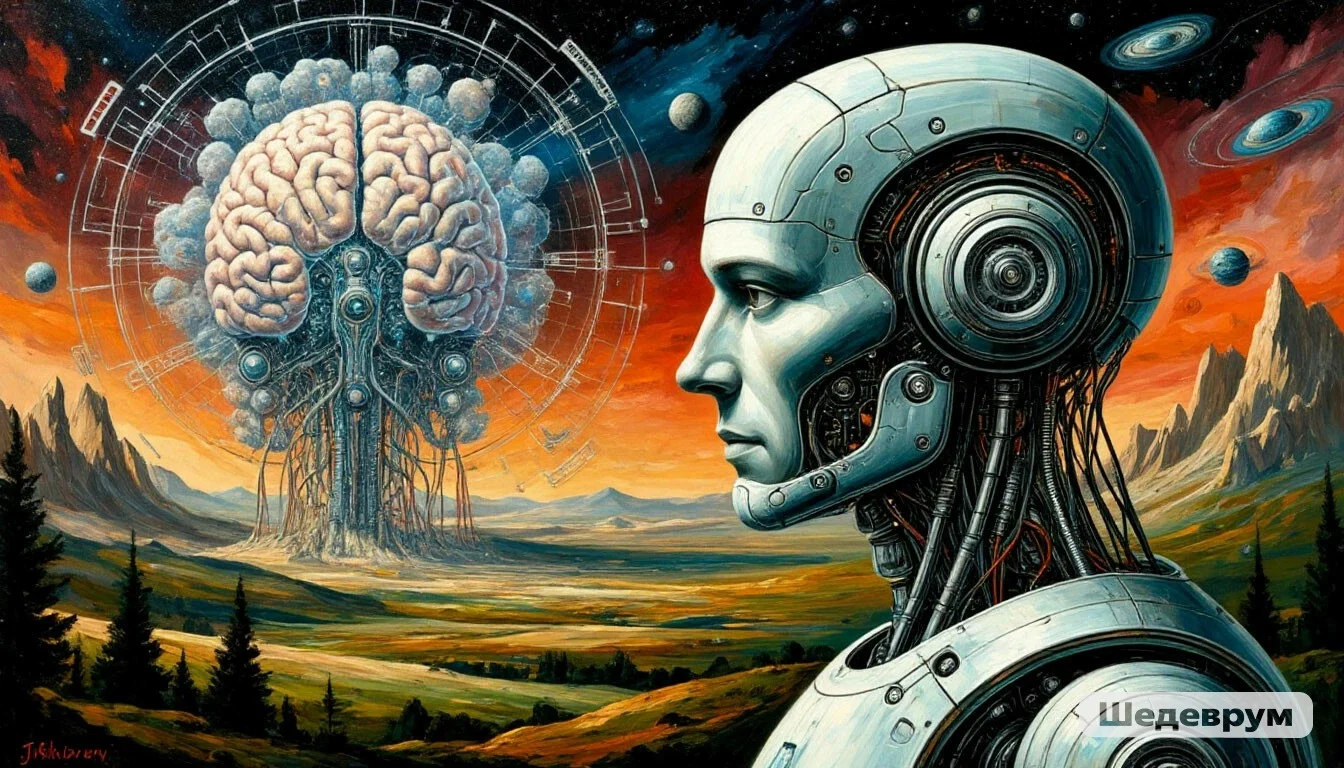
We continue to examine the legacy of great scientists: astrophysicist Iosif Shklovsky believed that human biological limitations can be overcome by replacing the carrier of the mind — and this will lead us to a cybernetic revolution. The third postulate in the series is devoted to this very question.
The hypothesis of the cybernetic evolution of the mind (or the replacement of biological carriers with artificial ones) is Shklovsky’s attempt to look beyond human biological limitations. He understood that organic life is only a brief, extremely fragile moment in the history of the Universe, and assumed that the future of any advanced mind is inevitably connected with the transition to an inorganic basis.
Shklovsky argued the physical limit of biology by the fact that the protein-nucleic form of life is too vulnerable for the conditions of deep space. Radiation, enormous distances requiring thousands of years of travel, and the brevity of human life make interstellar expansion of biological beings practically impossible. Consequently, a civilization striving for a truly cosmic scale will sooner or later come to the need to “shed” its biological shell. In his view, the “supercivilization” of the future is not a cluster of humanoids on planets, but giant computing systems operating in open space.
Iosif Samuilovich admitted that artificial intelligence is not just a tool, but a rightful heir of biological mind. He foresaw the possibility of “rewriting” consciousness onto more durable media or creating fully synthetic subjects. For Shklovsky, this was the logical completion of anthropocentric history: the mind separates from the body in order to become a universal factor in the physics of the Universe.
This hypothesis also provides an original explanation of the Fermi paradox. If most advanced civilizations in space are cybernetic, their logic, goals, and ways of communication may be absolutely incomprehensible to us. They may not use radio waves, may not need Earth-like planets, and may show no interest at all in “primitive” biological life forms, just as a human does not try to conduct philosophical conversations with ants. Philosophical significance — Shklovsky posed an uncomfortable question to us: will the mind remain “human” if it ceases to be biological? In his understanding, the value is represented not by the carbon basis, but by the very ability to cognize and create.
Illustration generated by Shedevrum






Comments (1)
Космос будем осваивать FPV-аватарами. Вот только нам с мгновенной сверхсветовой связью надо разобраться.