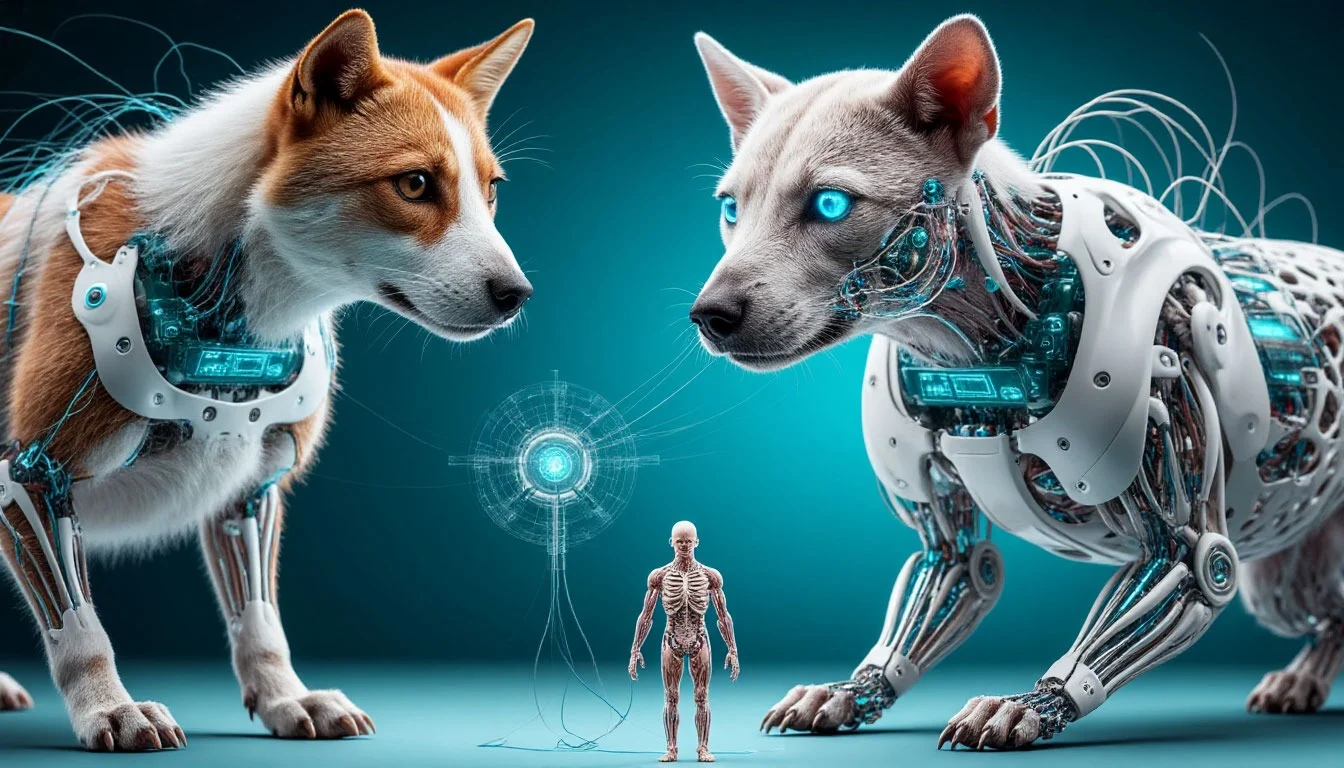
The veterinary medicine of the future has ceased to be exclusively a biological science. Today it is an advanced engineering discipline where doctors work hand in hand with roboticists and programmers. The boundary between a living organism and a high-tech device has blurred, giving animals with disabilities a chance for a fulfilling life indistinguishable from that of their healthy counterparts.
Neurointegration has become a key achievement. The passive and cumbersome prostheses of the past have given way to a new generation of bionic implants. These devices do not simply replace a lost limb — they become its natural extension.
— Tactile feedback. Thanks to miniature pressure and temperature sensors embedded in the bionic limb, the animal can once again feel the ground under its feet, sense warmth or cold. Signals from these sensors travel along neural pathways directly to the brain, creating the full illusion of a real limb.
— Intuitive control. Brain-computer interfaces (BCI) have become so miniature and energy-efficient that their implantation has become a routine procedure. The animal does not need to learn to consciously control the prosthesis. It is enough to simply think about a movement, and the nerve impulse is intercepted by the chip and instantly converted into a command for the servos of the bionic limb.
This technology has paved the way for restoring not only motor functions but also sensory functions.
— Restoration of vision. Neuro-optical implants have emerged for blind animals. A miniature camera mounted on the head converts the image into a digital signal, which the chip transmits directly to the brain’s visual cortex. The animal begins to “see” the world, albeit in a simplified form, allowing it to navigate and interact with its surroundings.
— The power of thought. Paralyzed pets have gained the opportunity to regain mobility with the help of exoskeletons. The BCI interface reads the animal’s intention to take a step, and the external exoskeleton frame performs the movement for it, setting the paralyzed limbs in motion.
Bionic fauna is not merely the replacement of lost body parts. It is a comprehensive restoration of quality of life, where technology serves not to demonstrate human superiority over nature, but to return to animals their natural right to movement, sensation, and active engagement with the world.







Comments (1)
Удивительно, как технологии позволяют животным вернуть утраченные способности — это действительно гуманное применение инноваций. Интересно, а как долго работают такие имплантаты и требуют ли они частой замены или перекалибровки?