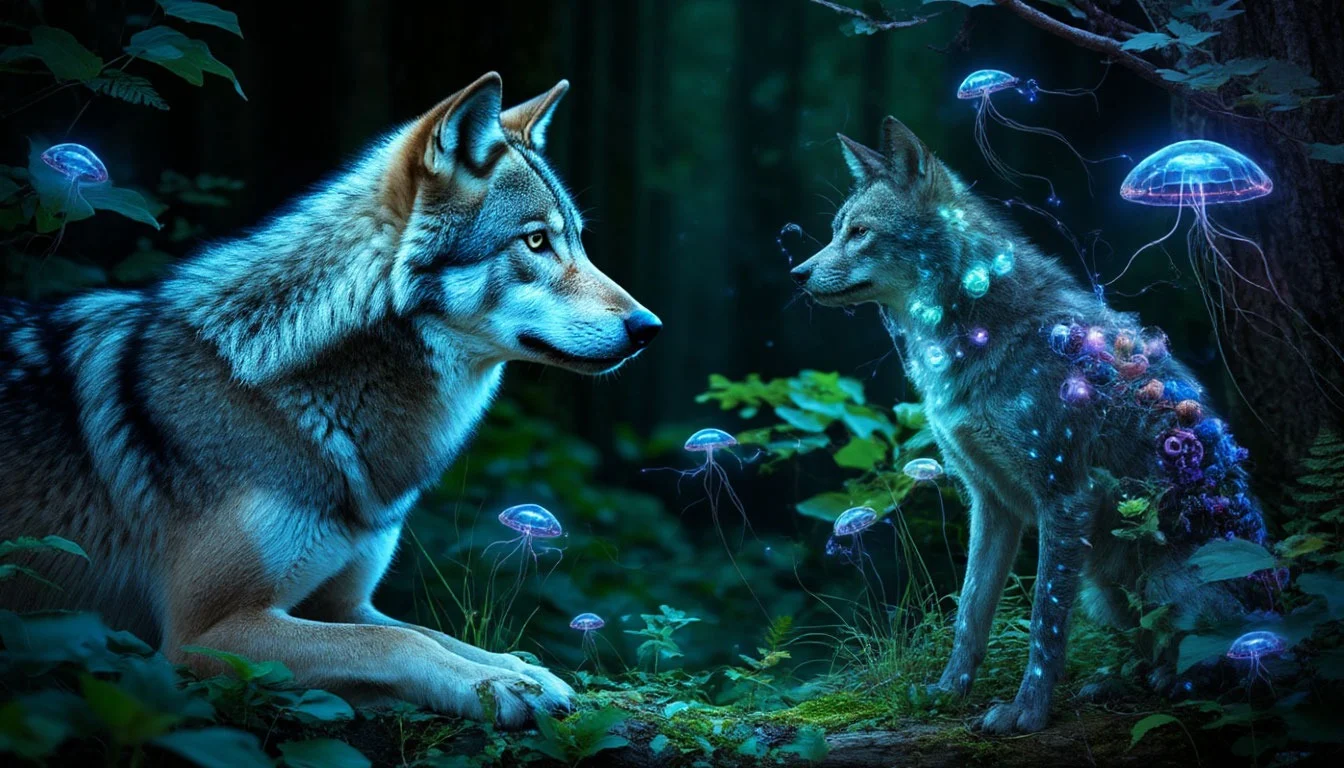

The veterinary profession has gone far beyond treating cats and dogs. New-generation specialists are entrusted with the care not only of evolved descendants of wolves and felines, but also of entirely new life forms—animals created by humans for symbiosis. Simple bioluminescent fish or air-purifying plants are a thing of the past, the first clumsy steps of bioengineering. The present and the future belong to an era of complex hybrid organisms that blur the line between the kingdoms of nature.
Synthetic biology became the scientific foundation of this world, making it possible to create not just organisms, but complex functional systems. The veterinarian has evolved from a doctor into an engineering consultant for the operation of living systems.
His patients now include:
— Animal-plant hybrids. These are creatures capable of photosynthesis. For example, a companion with skin containing chlorophyll that can draw energy from sunlight, reducing the need for food and generating extra oxygen for the owner. The veterinarian’s task is to monitor the balance between animal metabolism and plant processes, preventing «photochemical burns» or nutrient deficiencies.
— Animals with programmed functions. A dog is no longer just a friend. Its fur is genetically modified to release pheromones that automatically reduce the owner’s stress level. In case of injury, the same biosynthetic mechanism allows the fur to produce broad-spectrum antibiotics, disinfecting the wound. A cat may serve as a carrier of a symbiotic bacterial culture that cleans the air in the home of allergens.
Working with such creatures requires a multidisciplinary approach. The veterinarian must be at once a geneticist to understand the intricacies of the genome, a biochemist to control synthetic functions, and a systems engineer to diagnose interactions between biological modules. A breakdown in such a pet is not just an illness, but a malfunction in a complex program.
The veterinarian of the future is the keeper and tuner of man-made harmony. He ensures the vital functions of these amazing synthetic constructs, making sure that the symbiosis between humans and bioengineered creations remains safe and mutually beneficial.




Comments (3)
Мне понравилась идея хлорофильной кожи! Я бы себе такую поставил куда-нибудь в открытую часть кожи руки. Подпиточка энергетическая такая 👍
Честно говоря, это одновременно и пугает, и восхищает! Интересно, насколько сильно изменится сама концепция "животного", когда мы нач создавать таких гибридов? Будущее ветеринарии выглядит как фантастика.
Очень интересно, как автор показывает трансформацию ветеринара в инженера-консультанта по эксплуатации живых систем. Не думали ли создатели таких гибридов о возможных этических последствиях вмешательства в природные законы?