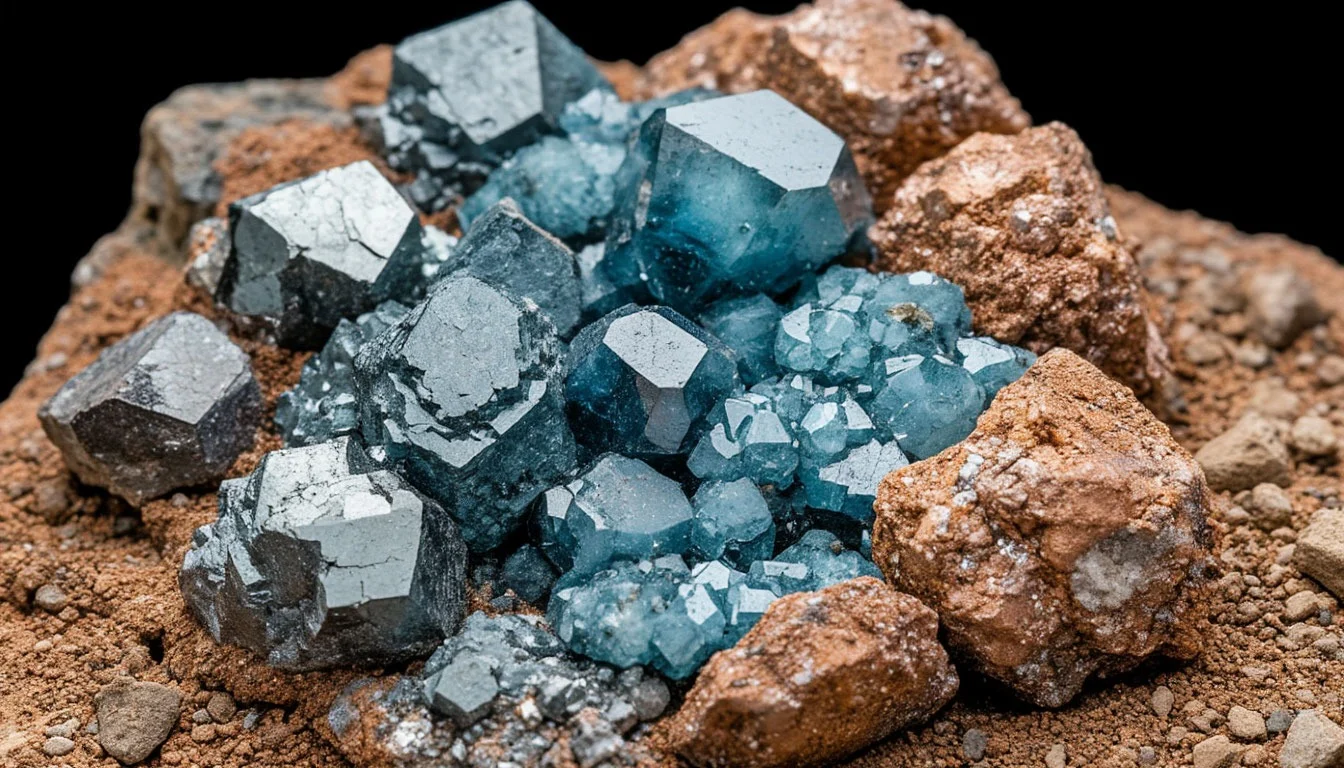
In the 2220s, geologists encountered a phenomenon that turned classical mineralogy upside down. At various points around the planet, from deep mines to hydrothermal vents, deposits began to be discovered whose geological age did not exceed a few years. Minerals that took nature millennia to form—from piezoquartz crystals to veins of rare-earth elements—were now “ripening” in just a few months. This phenomenon, called “geological acceleration”, became a true gift for industry but left scientists baffled.
Practical Benefits: The End of Resource Scarcity
The economic impact of this discovery is colossal. Humanity has learned to create “farms” for growing minerals.
- Rare-earth metals: instead of grueling and environmentally dirty mining, we can now grow neodymium or yttrium single crystals under controlled conditions, obtaining materials of ideal purity for electronics and the space industry.
- Piezo- and ferroelectrics: the crystals needed for microelectronics are no longer sought after, but manufactured, with the desired properties set at the growth stage.
- Construction materials: technologies make it possible to “age” concrete or grow ultra-strong composite minerals, which has revolutionized construction.
Industry has gained access to a virtually inexhaustible source of raw materials. Behind this success, however, lies a fundamental scientific problem: we know how to start the process, but we do not understand why it works.
The Scientific Enigma: The Search for the “Trigger”
Classical science is powerless. The rate of crystallization and mineralization contradicts all known laws of thermodynamics and chemical kinetics. Scientists have put forward several competing hypotheses about which environmental parameters are key:
- Quantum resonance theory. The most popular hypothesis holds that the acceleration is related to local fluctuations caused by the planet’s global energy grid (chrono-fuel reactors, deep dampers). These devices create a weak but constant “vibrational background” at the quantum level. This energy “rocks” the atoms in the lattice, helping them find their places more quickly and form a crystalline structure. We have learned to tune the instruments to the desired frequency, but the physical nature of this resonance remains a mystery.
- The nanocatalyst hypothesis. It is assumed that self-replicating nanostructures—possibly evolved remnants of old industrial nanobots—were accidentally introduced into the biosphere and lithosphere. They work like biological enzymes or templates, serving as an ideal “foundation” for crystal growth. Minerals literally “grow” on these invisible scaffolds at enormous speed.
- The influence of modified space-time. Radical physicists connect this process with a general “densification” or change in the topology of space-time in local areas. If the fabric of reality has become more “viscous” or, conversely, more “pliable,” this can directly affect the rate of any processes, including chemical reactions in the Earth’s interior.
The Price of Progress: Fragile Stability
The main fear of the scientific community is unpredictability. We have learned to create the conditions for mineral growth, but we cannot guarantee that this process will not begin spontaneously in an unsuitable place. What if tomorrow crystals start to “ripen” in the foundation of a megacity or in the hull of a spacecraft? We are using a technology that works like clockwork, but its internal mechanism remains a black box. We have become geological engineers, but we have still not stopped being students who are afraid to peek under the lid of their most successful creation.




Comments (1)
Фантастика, что теперь мы выращиваем редкоземельные металлы как цветы! Но как избежать спонтанного 'созревания' кристаллов в критически важных конструкциях?