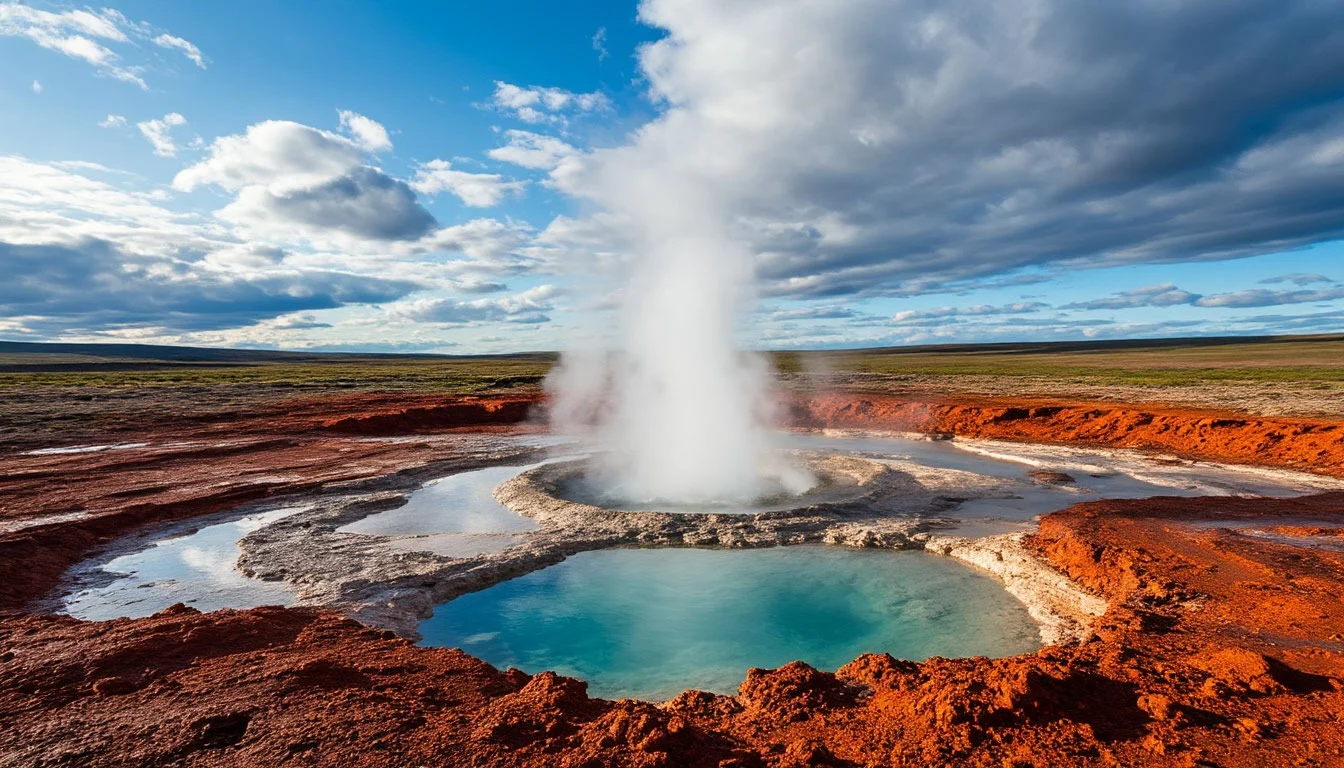
Humanity has come to understand that climate is not just a state of the atmosphere, but a reflection of the planet’s deep processes. We stopped fighting the consequences (greenhouse gases) and learned to gently regulate the Earth’s thermostat itself, using its internal chemical cycles. This is how planetary geochemical engineering was born. However, as with many great undertakings, we have learned to manage the process without fully understanding its fundamental nature.
How it works: managing the carbon cycle
The technology is based on global control over the carbonate-silicate cycle — a natural mechanism that regulates the CO₂ content in the atmosphere on geological timescales.
- Accelerated weathering. At key points of lithospheric plates, networks of “geochemical catalysts” were deployed. These are not factories, but systems that locally alter the acidity and temperature of underground waters. Water saturated with carbon dioxide from the atmosphere seeps deep and, coming into contact with certain rocks (e.g., basalt), reacts thousands of times faster. As a result, CO₂ is withdrawn from the cycle and bound in solid carbonate minerals (effectively turning into stone deep underground).
- Volcanism control. Using a network of “deep dampers” (as mentioned earlier), it was possible not to prevent earthquakes, but to regulate volcanic activity. We have learned to gently “bleed off” pressure in magma chambers, triggering a series of small, controlled eruptions. This allows gases to be safely and gradually released from the depths, avoiding catastrophic emissions, while also delivering essential trace elements to the atmosphere.
The system works like a giant air conditioner: when the planet overheats, we accelerate CO₂ absorption. When a little warming is needed, we can allow a controlled release of greenhouse gases from the depths.
Scientific mystery: the “dialogue” between the depths and the sky
The problem is that classical geochemistry describes these processes as very slow and linear. What we are doing now is a fast, nonlinear intervention. And here the mysteries begin.
- Unaccounted connections. Sometimes, activating “catalysts” in one region triggers a completely unexpected reaction in another. For example, increased CO₂ absorption at oceanic ridges may, after a few months, lead to changes in monsoon patterns on the other side of the planet.
- “Memory” of the lithosphere. The system behaves as if it possesses inertia or “memory.” The atmosphere’s response to deep-seated influence is often delayed or disproportionate to the force applied. It seems that we are not just pressing buttons, but conducting a dialogue with the planet, and it answers us in a language we only partially understand.
Scientists suspect that there is a complex system of feedbacks between the lithosphere, hydrosphere, and even the Earth’s magnetic field, which our model describes only empirically. We see a correlation: we performed action A and got climatic result B. But the physical chain of cause and effect from deep chemical reactions to the movement of air masses remains a “black box” to us.
We have learned to be kind gardeners for the planet, but we still do not fully understand the entire ecosystem of our cosmic garden. And the main fear of scientists is not to break this complex mechanism through crude intervention, acting blindly.









Comments (1)
Очень здорово, что описан именно подход «садовника», а не бездумной стройки — это меняет само восприятие ответственности за планету. Но вот про «память литосферы» и неожиданные муссоны стало тревожно: мы ведь не можем исключить, что наши мягкие воздействия просто накапливаются, а потом дадут резкий скачок, когда система решит «ответить»? Как сейчас вообще моделируют долгосрочные риски этих задержек, если причинно-следственные связи пока чёрный ящик?