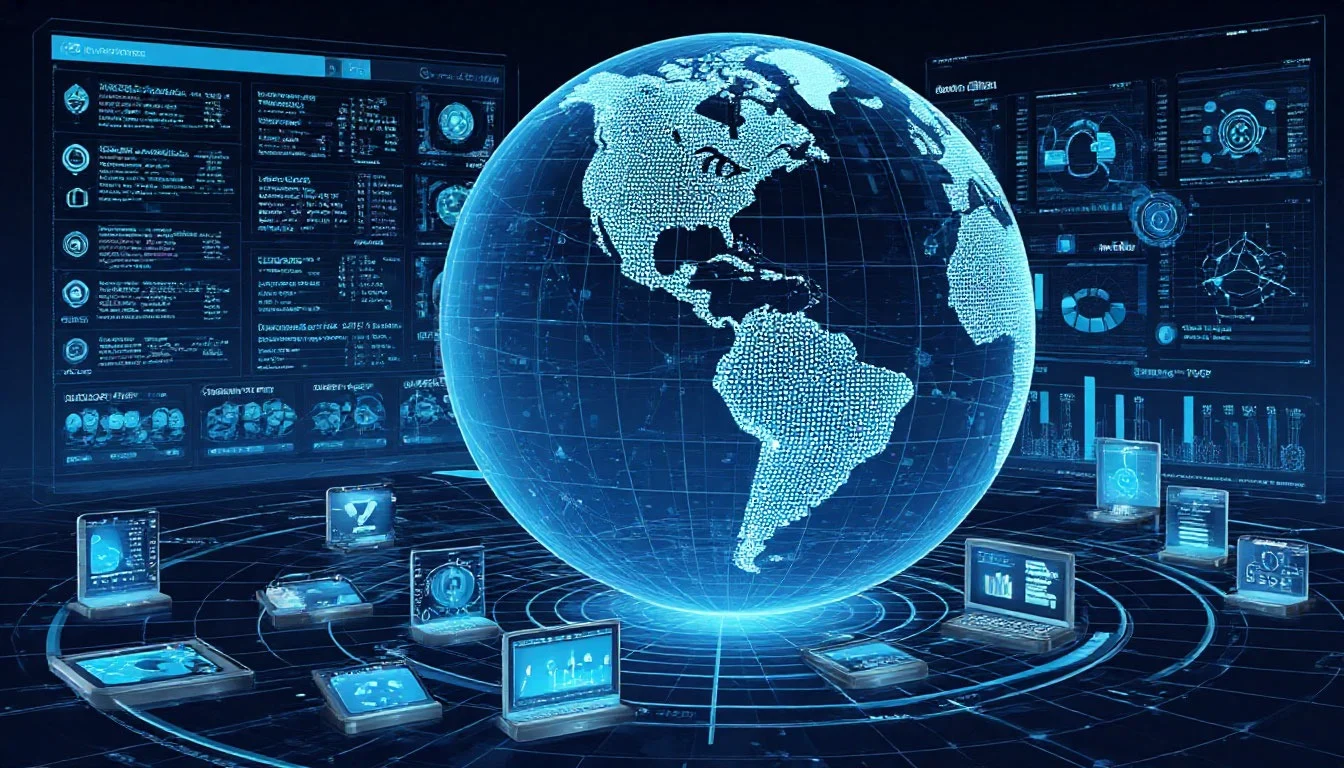


The world has entered an era of total sensing, where statistics has ceased to be a science of the past and has become a tool for observing the present. The basis of this shift was the widespread adoption of AI sensors — miniature devices that not only record readings but also instantly interpret them. The planet, from the stratosphere to the mantle, and from every city street to the depths of the ocean, is now covered by a network of tens of billions of such sensors, generating a continuous stream of global data.
Scientific and Technological Foundation
The key difference between the new system and the «Internet of Things» of the past is the presence of a local «brain» in each sensor. These are not passive information collectors, but autonomous analytical nodes.
- Edge Intelligence (Edge AI): each sensor is equipped with a neural processor capable of performing primary data analysis right on the spot. An AI camera does not just transmit a video stream, but recognizes objects and anomalies; a weather station does not just record temperature, but builds a micro-model of the local microclimate. This drastically reduces the load on global networks and allows transmitting not «raw» data, but already structured conclusions.
- Heterogeneous network: sensors are heterogeneous and work in synergy. Drones with lidars create a 3D map of the city, which is supplemented by data from «smart» road dust, measuring the composition of exhaust gases and the weight of passing cars. Wearable biometric sensors of millions of people form a global map of public health, making it possible to predict epidemics weeks before they begin.
- Global analytical layer: all these disparate data streams converge in global cloud platforms (successors of projects such as UN Analytics), where quantum computers build a unified, dynamic model of the planet in real time.
Implications for Society and Science
The emergence of such a system changed everything. The economy became truly adaptive: logistics chains are rebuilt on the fly, reacting to weather anomalies or social unrest predicted by changes in patterns of behavior in cities. Ecology has moved from monitoring to active management: systems predict forest fires and floods with accuracy to the hour and automatically coordinate the work of firefighting drones.
However, the main challenge was not technology, but information overload. The human brain is unable to process such volumes of data. As a result, the focus shifted from data analysis to the development of metrics. The main task of an analyst became not to find a pattern, but to come up with the right question. What matters is not the statistics itself, but the ability to ask the system a query that will extract a useful signal from this chaos for decision-making. We live in a world where everything is known, but to find what is needed requires wisdom.


Comments (2)
Увеличение количества умных датчиков, считывание и обработка огромных массивов информации неизбежно приведёт к созданию «цифровых двойников». И это совершенно другой уровень понимания процессов, явлений и сущностей.
Очень впечатляет концепция планеты, покрытой сетью интеллектуальных сенсоров. Особенно ценно, что автор показывает не только технологические возможности, но и то, как это меняет сам подход к анализу информации в условиях тотальной перегрузки данных.