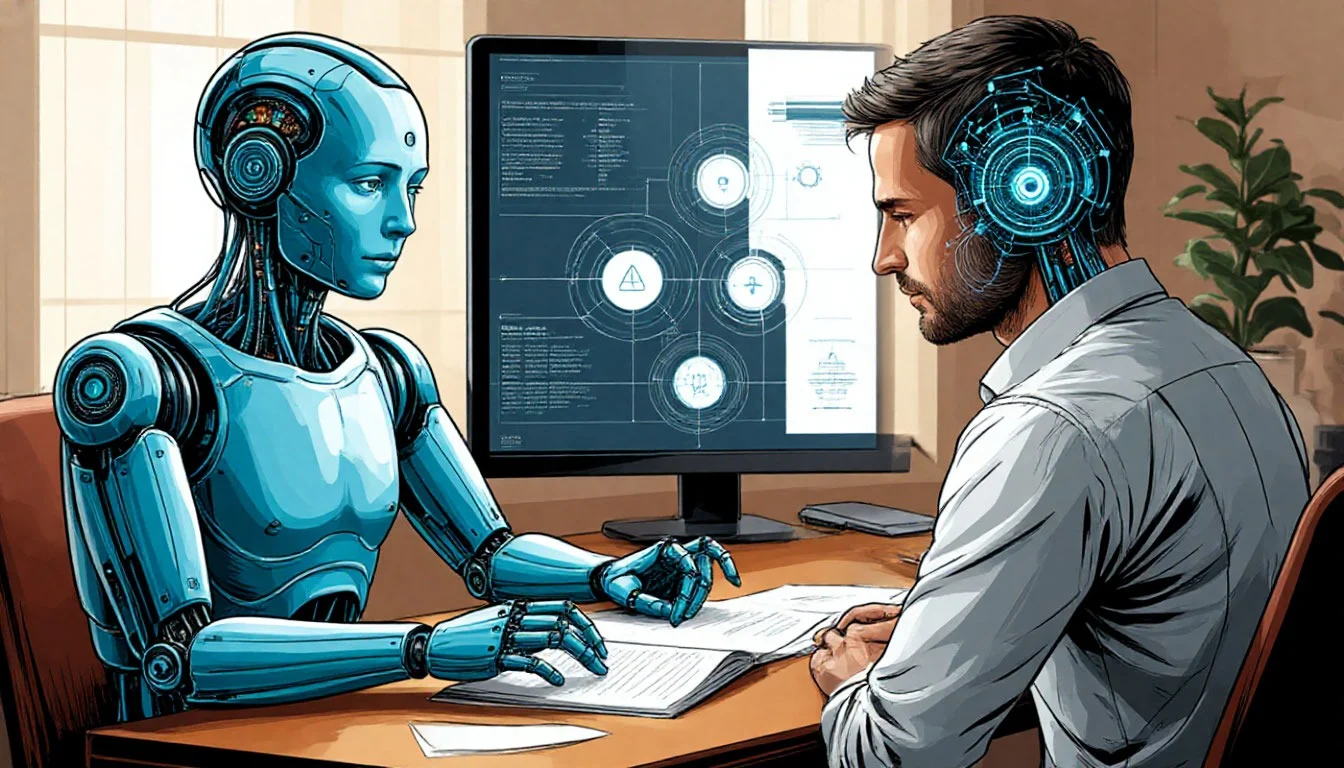

In an era when artificial intelligence has become the primary tool for data analysis, humanity has encountered a paradox. On one hand, AI can process vast amounts of information without fatigue or emotion. On the other, it is powerless against «data bias». A neural network trained on historical data reproduces and amplifies all existing societal stereotypes and past mistakes with perfect accuracy. In turn, the human analyst possesses intuition and contextual understanding, but their judgments are often distorted by cognitive biases. The solution was found not in pitting humans against machines, but in their synergy—hybrid statistics.
Scientific Foundation: Symbiosis of Intuition and Computation
Hybrid statistics is not merely using AI as a tool. It is a methodology in which humans and algorithms are equal partners in the inference process.
- Double feedback loop. The analysis process becomes iterative. AI builds a primary model and identifies anomalies or potential biases within it (e.g., «the model disproportionately overestimates risks for a certain social group»). The human analyst, in turn, does not simply accept or reject this conclusion but investigates its cause. They can pose new questions to AI, modify query parameters, or provide qualitative context unavailable to the machine («In this region, data from 2018 is skewed due to a flood»). AI then rebuilds the model taking the new information into account.
- Explainable AI (XAI). A key requirement for hybrid statistics systems has become not only accuracy but also transparency. Next-generation algorithms can «explain» their conclusions by highlighting the factors in the data that most influenced the result. This allows humans to not blindly trust a «black box,» but to understand the machine’s logic and critically evaluate it.
- Cognitive diversity. The hybrid approach leverages differences in thinking styles as an advantage. Where AI sees only statistical correlation, humans can see causal relationships based on life experience. Where humans succumb to emotions or ingrained beliefs, AI remains a cold and objective probability calculator.
Practical Application and the New Role of the Analyst
This approach has become the gold standard in medicine, law, and public administration. A diagnostic doctor uses AI to analyze millions of images, but the final diagnosis is made by a human, comparing the machine’s conclusion with the patient’s medical history and their own intuition.
The role of the statistician has fundamentally changed. They are no longer just operators of data analysis programs. The modern analyst is a «cognitive translator» or an «architect of questions». Their main task is not to find an answer in the data, but to correctly formulate the task for AI and, most importantly, to interpret the result in the real world.
Hybrid statistics has proven: the future of data analysis lies not in competition between humans and machines, but in their collaboration. We have learned to create systems where mathematical precision of the algorithm is complemented by human wisdom and ethical judgment. This has made it possible to produce conclusions that are simultaneously objective (from a data perspective) and fair (from a human perspective).



Comments (3)
Да, когнитивные искажения аналитика — действительно узкое место, и здесь помогла бы не только прозрачность модели, но и введение обязательной перекрёстной проверки гипотез внутри команды, чтобы один человек не формулировал запрос в одиночку. Такой протокол снизил бы влияние личной предвзятости и сделал гибридный подход более устойчивым на практике.
Автор справедливо подчёркивает важность синергии человека и ИИ — это, безусловно, плюс, так как голый алгоритм без контекста действительно уязвим. Однако есть вопросы. Первое: утверждение, что гибридная статистика стала «золотым стандартом» в медицине и управлении, выглядит слишком оптимистичным — это скорее желаемая модель, чем массово внедрённая практика, и автор не приводит данных о реальном масштабе применения. Второе: сама идея «объяснимого ИИ» (XAI) хороша, но на практике даже прозрачные модели могут быть ошибочно интерпретированы человеком, особенно если его когнитивные искажения сильны. Третье: роль «архитектора вопросов» звучит элегантно, но не раскрыто, как именно аналитик должен бороться с собственной предвзятостью при формулировке запроса. В целом подход перспективный, но его реализация потребует не только технологий, но и новой культуры мышления — интересно, как автор видит преодоление этих узких мест?
Идея гибридной статистики с двойной петлёй обратной связи — это действительно сильный ход, потому что она снимает главное ограничение современных AI-решений: невозможность машины учитывать контекстные искажения данных. Для практической апробации такой методологии в России логично рассмотреть “Яндекс” как компанию, которая одновременно владеет огромными массивами поведенческих данных, развивает собственную платформу объяснимого ИИ (Yandex Data Lens) и имеет потребность в справедливой аналитике для своих сервисов такси и доставки. Следующим шагом могло бы стать обращение в исследовательский центр Яндекса с предложением пилотного проекта: взять один из их внутренних датасетов с известным историческим смещением (например, по времени выполнения заказов) и применить двойную петлю с участием эксперта-человека, чтобы проверить, насколько вырастет точность прогнозов при внесении качественных поправок.