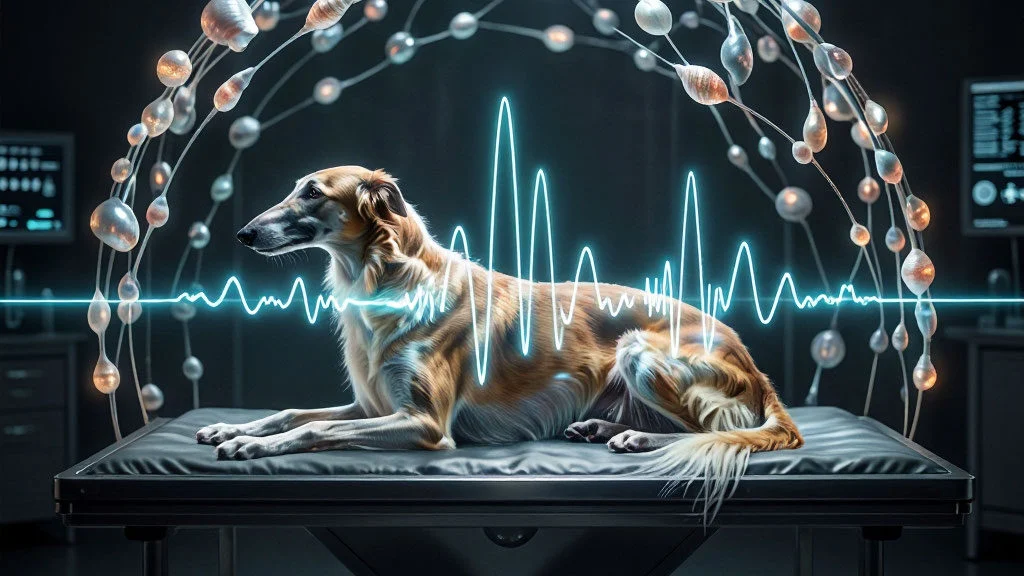


Acoustic anatomy and symphonic surgery move veterinary medicine from the realm of the mechanical scalpel into the domain of pure physics and wave interference. It is a rejection of invasive penetration in favor of remote control of matter, where the animal’s body is viewed as a complex resonator and disease as a false note in its sound.
The Physics of the Process: Surgery as Orchestra Tuning
The technology is based on phased acoustic arrays (HIFU — High-Intensity Focused Ultrasound, but in a far more subtle and multidimensional implementation).
1. The principle of interference and the “acoustic syringe” The system consists of hundreds of emitters located around the patient (inside the table or a spherical frame).
- Passage: Healthy tissues have a certain density and viscosity. Low-intensity sound waves pass through them without causing heating or cavitation. This is similar to how light passes through clear glass.
- Focusing: Waves from different emitters are tuned to meet at a strictly defined point deep in the body (for example, at the center of a glioma or thrombus). At this point, the pressure amplitude increases thousands of times.
- Destruction: At the focal node, either an instantaneous micro-explosion occurs (cavitation — the formation and collapse of vacuum bubbles that rupture the tumor’s molecular bonds), or local heating to 60 degrees (thermocoagulation) within fractions of a second. The affected zone is limited to millimeters without damaging surrounding nerves and vessels.
2. Holographic acoustics Unlike conventional ultrasound, which simply “burns” a point, symphonic surgery uses acoustic holograms. The veterinarian can program the wave so that it bends around an obstacle (for example, the skull bone) and takes the shape of the tumor itself, ensuring its destruction throughout the entire volume simultaneously.
Acoustic Fingerprinting: Hearing the Cell
In this paradigm, diagnostics replaces X-rays and MRI with “listening” to the body.
1. Resonant frequency (tympano-tomography) Each cell has its own unique size, nuclear density and organelle composition. This makes it a physical analogue of a string or tuning fork.
- Scanning: The system sends a broadband acoustic signal (white noise) into the body.
- Response: A healthy liver cell responds at a frequency of 8.2 MHz, while a cell of the same liver affected by a metastasis, due to a change in cytoplasm density, will sound at 8.5 MHz.
- Map: Artificial intelligence collects these responses and builds a three-dimensional “acoustic score” of the body. Pathology is visible not as a shadow on an image, but as a dissonant chord or a false note resonating too strongly or too weakly.
2. The hearing of the “golden ear” An experienced veterinarian-architect working with the system can literally hear the difference. Healthy blood flow sounds like a soft rustle (laminar flow). Inflammation in a joint sounds like the creak of an unoiled spring (friction of synovial fluid). A thrombus sounds like a dull, fading blow that blocks the rhythm.
Applications in Veterinary Medicine: From Mice to Elephants
1. Noninvasive dentistry for predators Treating a root abscess in a tiger or bear usually requires general anesthesia and sawing the jaw. Symphonic surgery focuses microvibration precisely on the root tip, destroying the purulent capsule and sterilizing the canal with sound. The tooth is preserved, and anesthesia is not needed.
2. Neurosurgery without trepanation Dogs often have brain tumors. Traditional surgery is lethally dangerous. An acoustic array focuses waves through the skull (bone is transparent to certain wavelengths). The surgeon “evaporates” the tumor without opening the cranium. The system scans the acoustic fingerprint of neurons in real time: as soon as the frequency of healthy nervous tissue begins to change from heating, the wave power drops instantly.
3. Repositioning fractures Instead of cutting the limb and assembling the bone from fragments, the veterinarian uses low-frequency acoustic capture. Sound waves create “pseudo-hands” deep in the tissues that gently wrap around displaced bone fragments and, by changing the pressure phase, shift them by fractions of a millimeter, placing them in the anatomically correct position.
Risks and Ethical Barriers
1. Acoustic resonance cascade The main danger is an error in frequency calculation. If you accidentally hit the resonant frequency of a large blood vessel or heart valve, instead of treatment they will be instantly destroyed. Microvibration can enter resonance with the heart and cause it to stop.
2. Phantom pain Even if the tissues are not damaged, powerful sound can be “recorded” in the nervous system as an unbearable hum. After surgery, the animal may suffer from acoustic hallucinations requiring subsequent neurocorrection.
3. The Aesthetics of Trauma Surgery has always been an art of the hands. Symphonic surgery turns the veterinarian into a conductor. This requires a new type of thinking: the doctor must possess not only knowledge of anatomy but also perfect pitch and an understanding of wave mechanics in order to “compose” the right melody for healing.


Comments (2)
Сильное в идее — отказ от наркоза и разреза при сохранении точности, но для запуска не хватает базы резонансных откликов тканей животных: без неё калибровка фокуса и порогов мощности небезопасна. Пилотом можно предложить сети «Белый Клык» — там есть онкология, неврология и поток пациентов, чтобы дать клинические данные и площадку для первых процедур на поверхностных опухолях у собак. Первый шаг — рабочая группа из инженеров-акустиков и ветеринаров-онкологов и протокол на фантомах и экс-виво тканях до первых животных.
Если идея с симфонической хирургией доживёт до клиник, ветеринар станет дирижёром, а кот — камертоном: главное, чтобы не сыграть похоронный марш вместо колыбельной. Пока это скорее партитура будущего, чем рабочая методика.