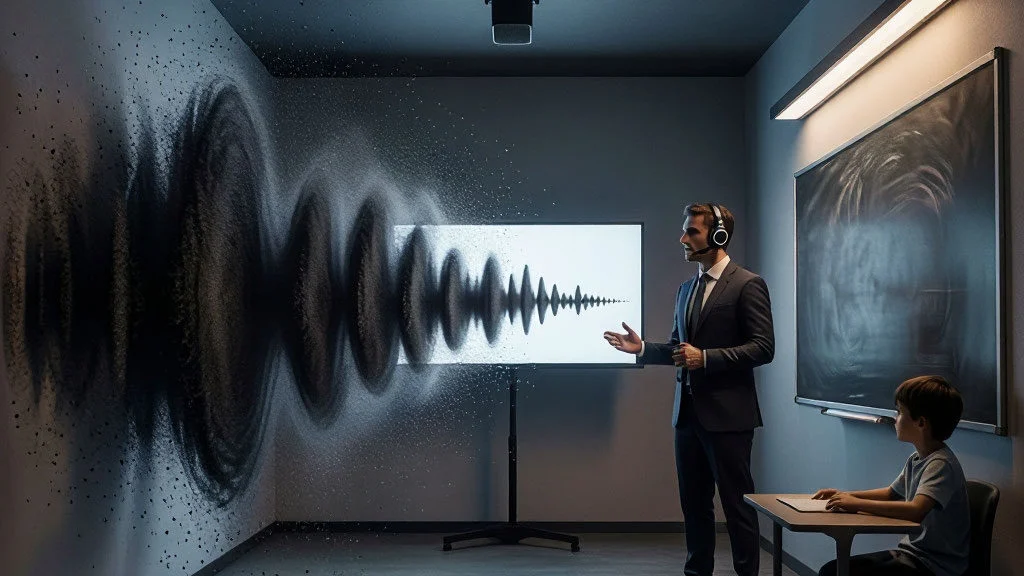

For a child with auditory processing disorder (APD) or autism spectrum disorder, human speech sounds like unintelligible, aggressive noise. The problem is not volume, nor defects in the teacher’s diction. The problem is redundancy: overtones, breathiness, reflections from classroom walls, and frequency clutter merge into an acoustic mush that the child’s brain cannot segment. Traditional hearing aids only amplify this chaos.
Acoustic camouflage is reverse-echo technology. Instead of forcing the child to adapt to the teacher’s voice, the system deforms the teacher’s voice in real time, tuning it to the child’s unique, often narrow auditory corridor. Speech ceases to be a sound wave and becomes an individually tuned physical object.
Architecture of Spectral Prosthetics
The process occurs at the speed of human speech (up to 150 words per minute) and requires system latency of no more than 10–15 milliseconds to avoid a delay (echo) effect.
- Capture and Deconstruction (Analysis Layer):
The directional microphone array on the ceiling captures the teacher’s voice. AI instantly builds its spectrogram — a three-dimensional map of sound (time, frequency, amplitude). The algorithm splits the signal into three layers:
- Foundation: Fundamental frequency (pitch of voice).
- Formants: Resonant frequencies responsible for vowel intelligibility (most important for meaning).
- Noise: Breathiness, saliva, high-frequency whistle (physiological clutter).
-
Matching with the Profile (Filtering Layer):
Each child has their comfort audiogram written in a secure profile. For example: “A sensitivity dip at 4000 Hz (sibilants sound like rustling paper), hypersensitivity to 125 Hz (low bass causes nausea), inability to distinguish sounds faster than 0.5 seconds.”
AI overlays this profile onto the teacher’s spectrogram like a stencil. Everything that does not pass through the child’s “windows” is cut off or transferred into the audible range. -
Synthesis and Delivery (Generation Layer):
The system does not merely cut out frequencies (an ordinary equalizer would do that). It uses generative AI to reassemble the voice.
- If the teacher utters the sound “S” (high-frequency noise) that the child cannot hear, AI instantly replaces it with a frequency equivalent in a range the child hears perfectly (for example, a light tactile click in bone conduction headphones or a shift to a lower pitch while preserving articulation).
- If the teacher speaks too quickly, the algorithm applies “dynamic time stretching.” It slows down only those parts of a word where a consonant closure transitions into a vowel, making speech choppy but preserving the natural timbre.
Sound Visualization: Turning Chaos into Geometry
For children whose hearing is overloaded, visual support is critically important. The same data stream that goes to the child’s headphones is transmitted to their personal tablet screen or AR lens as a “light score”:
- Color: Vowels are colored in warm tones (red, orange), consonants in cool tones (blue, purple).
- Shape: Clear, intelligible sounds (like “P” or “T”) are drawn on the screen as stable squares. Chaotic, noisy sounds (like “Sh” or the background hum of a projector) appear as torn, asymmetrical blobs.
- Dynamics: The height of the bar shows volume.
The child begins to “read” the voice. When the teacher raises their voice in anger, the child sees not a threat but “growing red peaks.” They learn not to be frightened by amplitude. When the teacher asks a question, a specific “question intonation” pattern (a rising line) lights up on the screen. This gives the brain those extra 200 milliseconds needed to switch from perception mode to response formation mode.
Pedagogical Mechanics
The teacher speaks in their normal voice. They do not need to shout or exaggerate articulation (which looks unnatural and is tiring).
- Fatigue Correction: By the third lesson, the teacher’s vocal cords are tired, and hoarseness appears in the voice (undesirable low frequencies). Acoustic camouflage automatically “dries out” the timbre, cutting the hum, and the child does not even notice the adult’s fatigue.
- Environmental Cutoff: The system removes from the broadcast into the child’s ears the noise of chalk, the screech of chairs, and a neighbor’s cough, leaving only the clean, camouflaged voice of the teacher. This creates an effect of “acoustic silence” in the very center of a noisy classroom.
Bioethical Protocol
- Timbre Transparency: The system never makes the teacher’s voice robotic. The generative layer must preserve individual timbral markers (recognizability). The child must know that it is their teacher speaking, just “washed” of noise.
- Prohibition of Eavesdropping: Acoustic camouflage works only in the downstream flow (teacher -> child). The child’s microphones remain physically disconnected from this loop, so they can freely communicate with friends during recess without digital filtering.
- Training, Not Prosthetics: The system’s goal is temporary assistance. The protocol includes “expansion exercises.” Once a week, the system intentionally narrows the filtering, forcing the child’s brain to gradually adapt to a broader spectrum of sounds, expanding the boundaries of their auditory comfort.
Acoustic camouflage restores the child’s right to access information. It does for hearing what glasses do for vision — removes optical (in this case, frequency) distortions, allowing the brain to finally see the coherent, logical, and safe architecture of human speech.








Comments (1)
Идея переводить речь из «звуковой волны» в индивидуально настроенный спектральный объект — сильная сторона, ведь она решает проблему на уровне обработки сигнала, а не громкости. Если такую систему реализовывать, одним из партнёров могла бы стать «Сенсор-Тех»: их компетенции в нейроинтерфейсах и сенсорных замещениях дали бы и экспертизу по латентности, и пилотную площадку в школах-интернатах. Начать можно с рабочей группы с логопедами и нейрофизиологами, чтобы проверить, как дети с РАС реагируют на минимальную задержку в 10 мс.