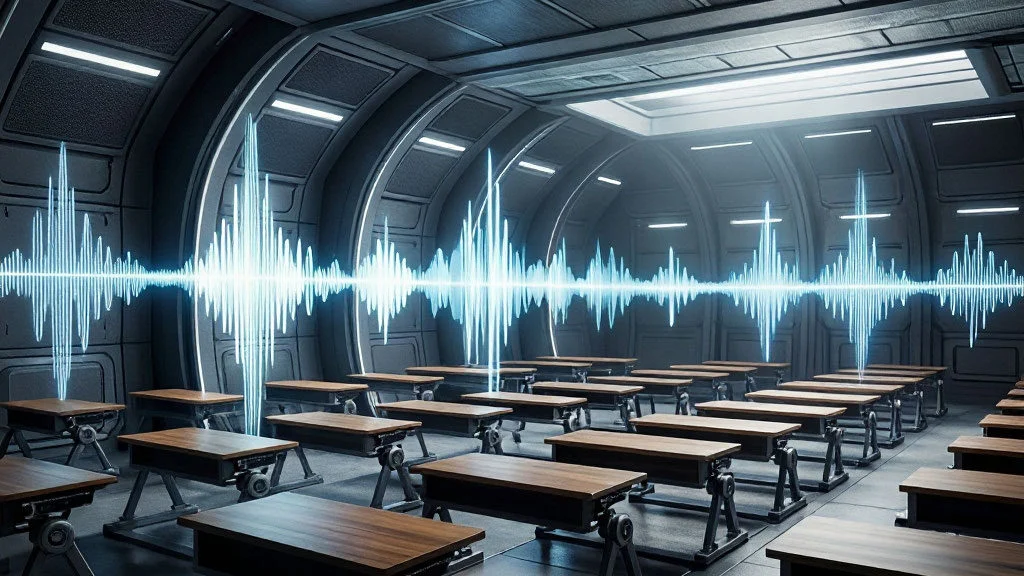

In traditional architecture, a classroom is a box in which sound obeys the laws of random reflection. For a child with auditory processing disorder (APD), ADHD, or heightened anxiety, a school classroom sounds like an aggressive, unintelligible mush. The rustle of a pen, the creak of a chair, and a neighbor’s cough reach the eardrums with the same force as the teacher’s voice, causing instant sensory overload.
Architecture of acoustic shadows rejects the fight against noise through absorption (felt, panels). Instead, it uses AI to actively manage sound through destructive interference. The classroom becomes a highly complex wave machine, where the geometry of the space and the arrangement of furniture are calculated to create zones of “sound vacuum”—areas where unwanted frequencies are physically absent.
Mathematical model of wave cutoff
The design process begins not with drawings of walls but with the digitization of acoustic profiles.
-
Sonar scanning and profiling:
The AI system scans the room, creating a digital twin accurate to the millimeter. The database records the acoustic profiles of all potential noise sources: the spectrogram of polypropylene rustling (pencil cases), the vibration frequency of plastic chair legs, the aerodynamic noise of breathing.
The teacher’s voice is also digitized, but not as a single stream—rather as a set of critically important formants (frequencies responsible for the intelligibility of the consonants “s,” “t,” and “p”), which must be delivered to the child’s ear without distortion. -
Calculation of the interference lattice (the “Shadows” algorithm):
The AI calculates the trajectories of sound waves from each source. The main task is to create conditions for destructive interference in the desk zones.
- Principle: If two waves of the same frequency meet in antiphase (the crest of one overlaps the trough of the other), they annihilate.
- Implementation: The AI calculates the ideal curvature of the ceiling and the tilt angle of mobile acoustic screens that will stand between rows. These surfaces do not absorb the neighbor’s sound; they reflect it in such a way that, above the ear of a specific student rustling a pencil case, a “zero-pressure” zone is created for the rustling frequency. Sound physically cannot enter that point—it bends around it, heading into “traps” designed by the AI at the joints of the walls.
- Dynamic seating score:
The desks in the classroom are not bolted to the floor. They stand on robotic platforms. Every morning the AI generates a seating plan.
- If a child is diagnosed with hypersensitivity to low frequencies (the bass from a computer tower or the low register of the teacher’s voice), their desk is physically moved to a nodal point where these frequencies have minimal amplitude.
- The desks are arranged not in even rows but along a complex fractal grid that works like a phased antenna array. It concentrates the energy of the teacher’s voice into narrow, laser-like “beams of attention” aimed precisely at the students’ ears, creating the effect of a personal headphone without a physical device.
Pedagogy of transparent sound
In such a classroom, the teacher can speak in an ordinary, calm voice. There is no need to strain the vocal cords.
- Personal volume: Thanks to acoustic focusing, a child at the back desk hears the teacher as clearly as at the front, yet does not feel pressure on the eardrums.
- Cutting off the periphery: A child prone to distraction physically cannot hear a pencil being dropped three rows away. The sound of the fall lands in the zone of their “acoustic shadow.” For their brain, that event simply does not exist at the sensory level.
- Sound cocoon: If a child needs to take a test under high stress, they can move to a “deep vacuum zone”—a special corner where the AI has reduced almost the entire reverberation tail of the room to zero. It is a space of absolute, dead silence, unattainable even in anechoic chambers, created solely by the geometry of the walls.
Bioethics and the benchmark of silence
- Ban on complete isolation: The system never creates “silence bubbles” forever. Once a day, the AI deliberately “blurs” the acoustic shadows, letting natural noise into the classroom for 5–10 minutes. This is necessary to train the adaptability of the auditory cortex so that it does not lose the ability to filter sounds on its own.
- Safety: Acoustic architecture always leaves “safety windows” for emergency frequencies—the sound of a fire alarm or a shout. Destructive interference is never applied to these ranges.
- Light synchronization: The architecture of acoustic shadows works in tandem with a lighting score. In zones of ideal sound, the light is always warm and diffused. If a child moves out of the teacher’s “beam of attention” (for example, to get distracted), the light above their desk instantly becomes cold and directional, physically returning their attention through the visual channel.
Architecture of acoustic shadows makes silence visible and tangible. The child learns to understand: silence is not the absence of sound; it is a highly complex engineering achievement. Desks arranged by a robot become their bodyguards, absorbing the impact of the sound wave and allowing the brain to finally hear a clear, crystalline thought at the center of a noisy world.





Comments (1)
Автор предлагает сильный инженерный разворот: не глушить шум, а гасить его противофазой, и это опирается на физику, а не на веру в войлок. Для пилота я бы шёл к Сберу: GigaChat и вычислительные мощности для расчёта интерференционных решёток, кампусы и школы-партнёры как площадка, ресурс на НИОКР. Первый шаг — рабочая группа с акустиком и дефектологом: снять STI и реверберацию в одном кабинете до и после мобильных щитов и предложить Сберу измеримое ТЗ на пилот.