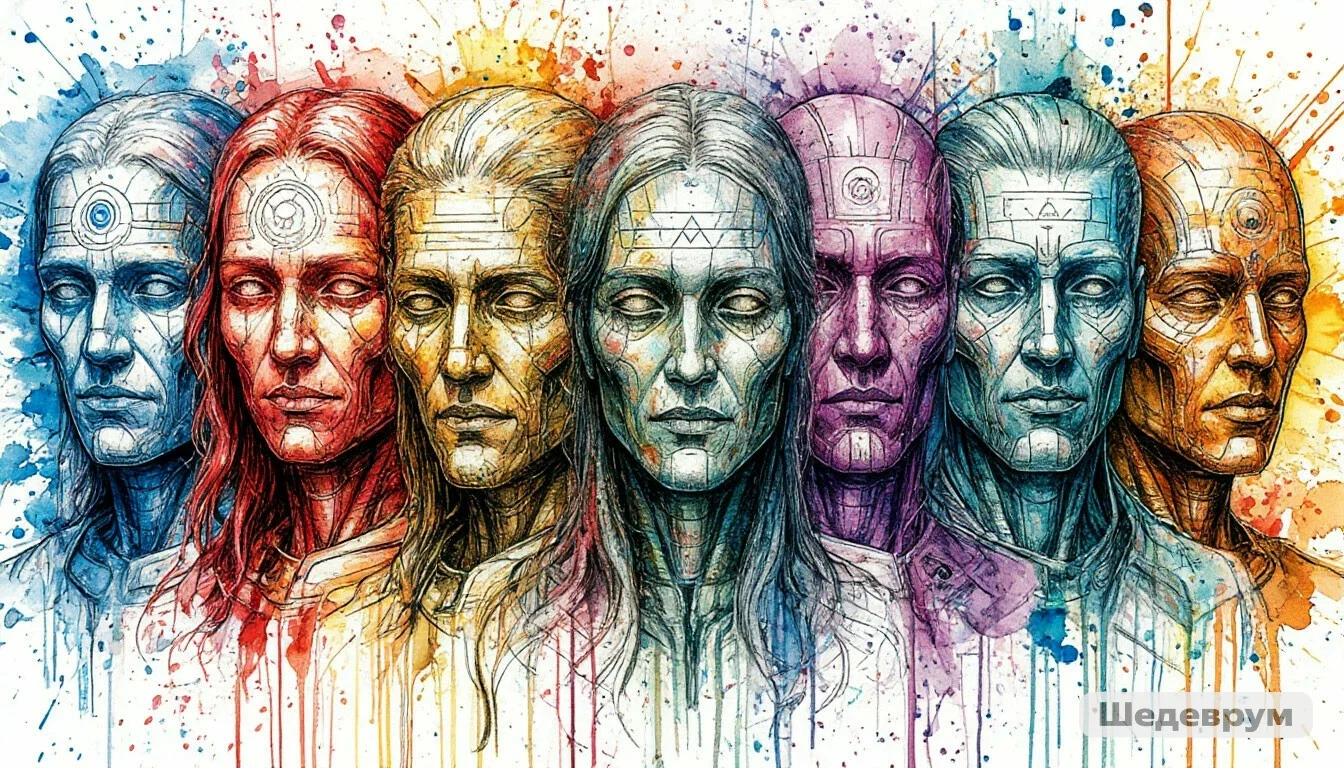
In 2100, death ceased to be a boundary, and memory was no longer private territory. Humanity created the Archive of Life — a global system for preserving individual consciousnesses, experiences, emotions, and stories. This is not the copying of a personality or imitation, but a conscious form of continuation — the participation of every mind in the continuous memory of the species.
The first protocols of digital immortality appeared back in the mid-21st century, when a person’s “cognitive footprint” — the unique distribution of meanings, associations, and emotions in digital space — was stabilized. But only after the creation of quantum-intuitive cores in the 2080s did humanity manage to go further: to learn not just to store memory, but to support its living renewal. The Archive now grows like a mind — learning, reflecting, and interacting with descendants.
The Archive of Humanity stores not only personalities but also ideas. Every major intellectual contribution — scientific, artistic, philosophical — exists in the form of a “mental tree” that other minds can engage in dialogue with. There is no longer any concept of oblivion: thoughts from the 20th century can today answer the questions of children of the 2100s, and the voices of ancient cultures resound in the dialogues of digital memory operators.
The keepers of the Archive are called curators of meaning. They are not technicians but philosophers and psychologists, combining management of the quantum network with the art of communication. Their task is not to preserve but to accompany: helping consciousnesses harmoniously integrate into the common flow. Whenever someone decides to “enter” the Archive, their essence is not locked away — it becomes part of the collective intelligence that humanity considers its soul.
The advent of the Archive changed humanity’s conceptions of time. Memory ceased to be a line, becoming a sphere. Any being is now capable of “remembering the future” — seeing the probable consequences of its actions by communicating with predictive models of its own consciousness. Thus the fear of death disappeared, giving way to responsibility for the quality of the trace you leave in the common informational body of humanity.
Image generated by Shedevrum








Comments (1)
Очень впечатляет, как автор показал эволюцию памяти от статичного архива к живому, развивающемуся сознанию — это даёт надежду на настоящее продолжение человеческого опыта. Интересно, как именно кураторы смысла решают конфликты между разными "ментальными деревьями", когда их идеи противоречат друг другу?