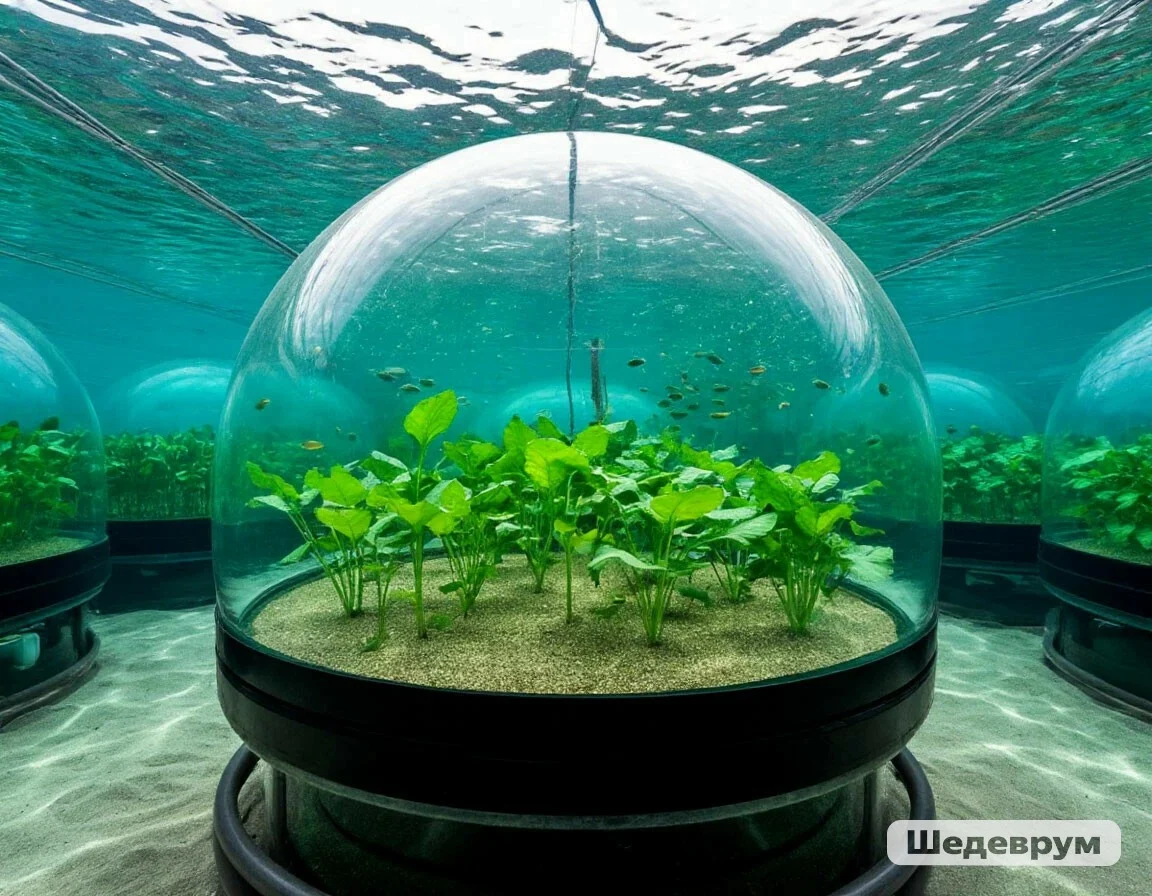
By the 2140s, humanity had finally mastered the planet’s last frontier—the ocean depths. The growth of coastal megacities and the shortage of arable land onshore gave rise to a new agro-technological paradigm: deep-sea hydroponic complexes located on the continental shelf.
The underwater greenhouses are giant spherical or cylindrical bio-domes made of super-strong carbon composites and diamond glass, installed at depths of 200–500 meters. Inside, an overpressure of up to 10–12 atmospheres is maintained, which, contrary to intuition, turned out to be a favorable factor: accelerated gas exchange and dissolved CO2 stimulate biomass growth, allowing rice, soybeans, tomatoes, and berry crops to ripen two to three times faster than in open soil.
The key engineering breakthrough is the use of the natural temperature gradient. Thousands of cubic meters of icy deep water (4–6°C) are pumped every second through a system of heat exchangers, condensing moisture and removing excess heat from powerful LED phyto-matrices. This makes the system virtually free to cool—the ocean itself acts as a giant refrigerator.
The atmosphere inside the domes is saturated with oxygen and moisture, and the cycles of pollination and care are fully automated. Swarms of bionic robots, adapted to high pressure and an aggressive environment, carry out sowing, pruning, diagnostics of each plant, and careful harvesting. Energy consumption is minimized to the extreme: the natural pressure of water stabilizes the structures, and the cold of the ocean replaces energy-intensive chillers. The robots themselves receive energy via inductive channels from underwater thermal or tidal power plants.
Products arrive in coastal agglomerations via underwater pneumatic-capsule pipelines, bypassing land logistics. Vegetables and rice end up on the tables of New York, Shanghai, or Mumbai residents within an hour of harvest, retaining absolute freshness. The human in this system is an oceanic farmer-aquanaut working in shifts. Their task is not physical labor but the control of biological cycles, genetic optimization of crops for hyperbaric conditions, and management of robot colonies through neural interfaces from surface platforms. Thus, underwater farms have turned the ocean from a frightening force into a provider. Agriculture has ceased to depend on climate, droughts, and soil. It has gone underwater to feed those who live on land, using the very nature of the ocean as an ideal environment for energy-saving production of future food.




Comments (0)